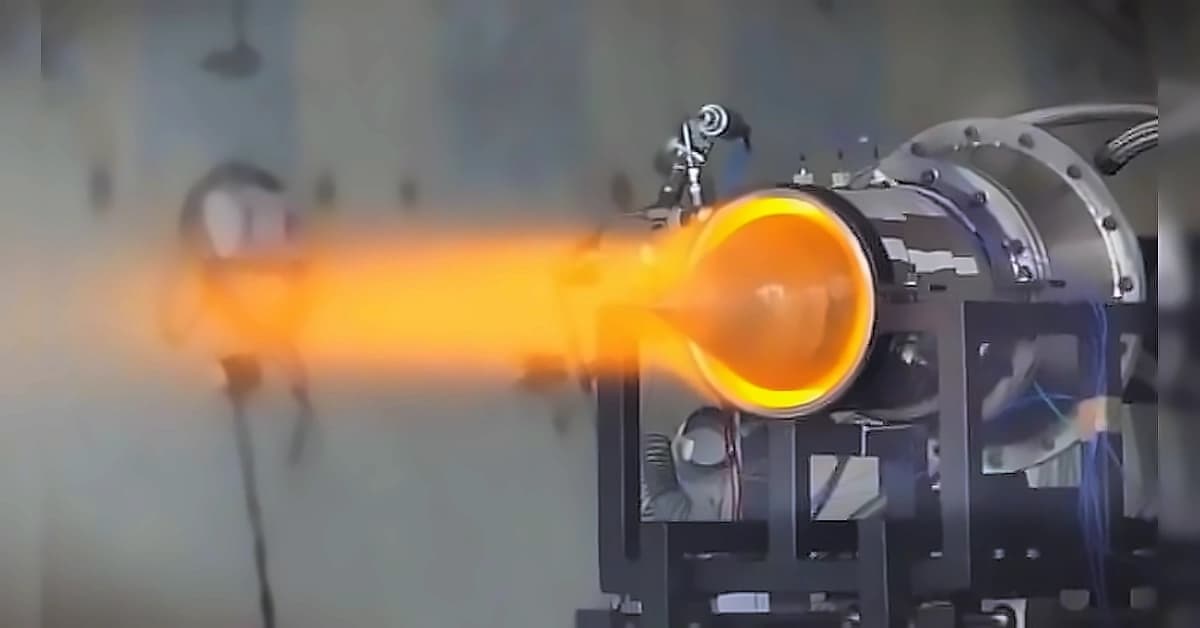
IIT Madras-incubated startup D-Propulse has achieved a significant milestone in indigenous propulsion technology by testing a rotating detonation engine (RDE) capable of powering smaller, faster missiles and drones. According to reports from Business Standard, the startup tested a five kilonewton air-breathing RDE at a Defence Research and Development Organisation facility in Hyderabad in July 2026, achieving a technology readiness level (TRL) 5. This achievement places the program among only a few propulsion programmes globally to reach this milestone.
The RDE operates by using a supersonic detonation wave to compress and burn a fuel-air mixture inside a ring-shaped chamber, generating thrust without conventional compressors. As reported by Business Standard, the engine achieved five tests in 24 hours with each burn lasting 5 to 10 seconds, demonstrating the repeatability of the combustion process. The technology offers 15-25% higher thermal efficiency through pressure-gain combustion and produces more thrust from a smaller engine with fewer moving parts. According to D-Propulse founder Saurav Jha, the superior thrust-to-weight ratio enables building smaller missiles that can reach the same distance with the same payload.
The RDE technology has potential applications beyond missiles, extending to high-speed unmanned systems where it could serve as the main propulsion system after initial boost. As reported by Business Standard, D-Propulse is initially focusing on surface-to-surface and air-to-ground missiles, with Jha highlighting that the RDE's ability to operate across different angles of attack could allow adaptation to different missile classes. The startup plans to gradually extend the engine's operating time from the current 30, 60 and 120 seconds with better heat management and cooling systems.
India faces competition in this technology race from several US-based companies including RTX, GE Aerospace and Lockheed Martin, as well as Chinese military research institutes developing RDE-powered munitions. According to Group Captain Rajiv Kumar Narang (retired), senior fellow at Manohar Parrikar Institute for Defence Studies and Analyses, the technology still requires development to align with operational military requirements. As reported by Business Standard, gaps exist in the testing and certification framework for emerging propulsion technologies, with no mechanism for independent certification of small propulsion systems without platform integration.