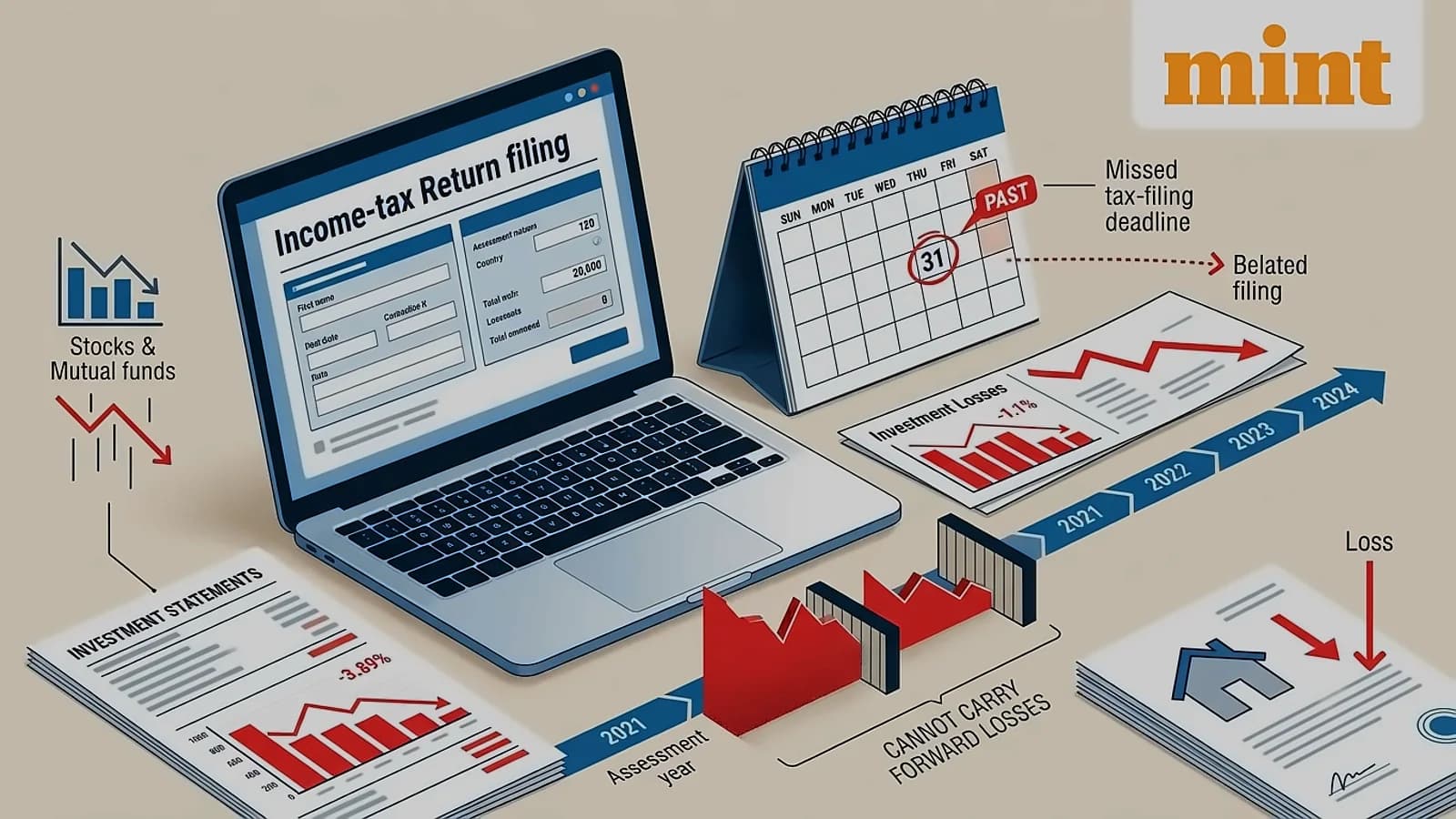
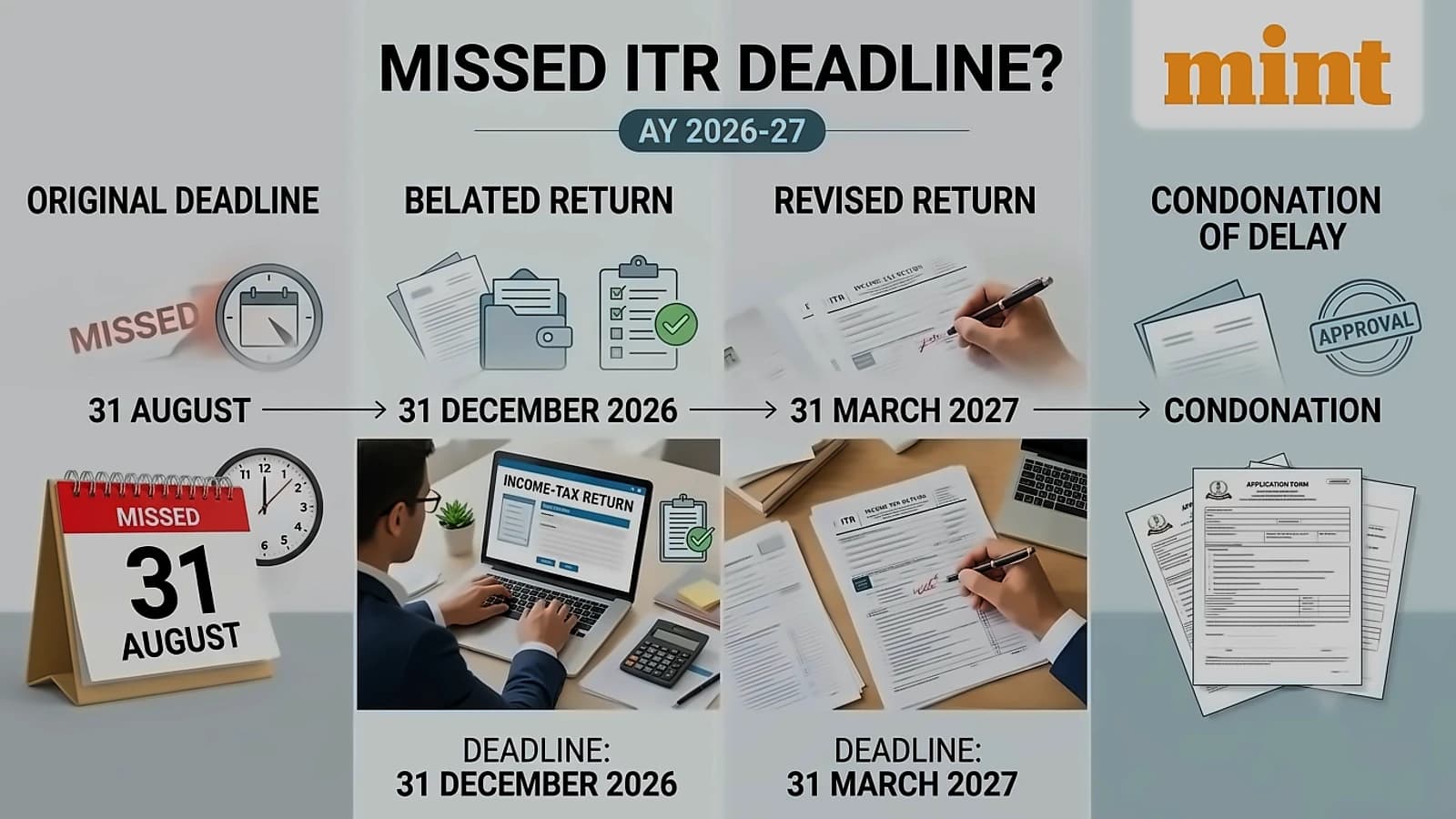
If you missed the July 31, 2025 deadline for filing Income Tax Returns for FY 2025-26, you can still file a belated return under Section 139(4) until December 31, 2026. According to tax experts, a belated return works exactly like a regular return in most respects - you use the same ITR form (ITR-1, ITR-2, ITR-3, or ITR-4) depending on your income profile. The belated return covers all income from FY 2025-26 and can be used to claim refunds, report income, and comply with filing obligations. However, it cannot carry forward most losses, including capital gains losses, business losses, or speculation losses to future years. For house property losses, you can still carry forward up to ₹2 lakh per year subject to usual conditions. For Tax Year 2026-27, which runs from April 1, 2026 to March 31, 2027, the belated-return deadline is December 31, 2027. After this window closes, only an updated return under Section 263(6) remains available, carrying steeper conditions and a rising additional tax the longer it's delayed.

The late filing fee under Section 234F is ₹5,000 for taxpayers with total income above ₹5 lakh, and ₹1,000 for those with income below ₹5 lakh. This is a flat fee payable at the time of filing, regardless of whether you owe additional tax or are due a refund. Additionally, Section 423 interest at 1% per month applies on any outstanding tax liability from August 1. For example, if ₹40,000 remains payable after adjusting TDS and other tax credits and you file three months late, the interest would be ₹1,200: ₹40,000 × 1% × 3 months. These charges work independently - if your TDS and other tax credits have already covered your entire tax liability, you may still have to pay the late filing fee, but there would be no Section 423 interest because there isn't outstanding tax. Section 234F deals with the late-filing fee, not your eligibility to file a belated return, so if you weren't required to file under Section 139(1), the fee doesn't apply.
According to The Times of India, a refund arises when the income tax paid exceeds the final tax liability. This can occur due to excess TDS, TCS, advance tax, self-assessment tax, deductions, exemptions, or treaty-based relief claimed in the return. The refund process involves checking whether the ITR is verified, PAN is linked with Aadhaar, the bank account is pre-validated on the portal, and there are no mismatches in Form 26AS, AIS or TIS. For refund claims involving treaty relief or foreign tax credit, taxpayers should verify whether Form 10F or Form 67 has been filed. Importantly, you need to file to get the refund - the department does not process refunds on returns that have not been filed. If your total income is below the basic exemption limits (₹4 lakh under the new tax regime; ₹2.5 lakh under the old tax regime) and none of the conditions that make filing mandatory apply, you generally don't need to file a return. However, you may still file a belated return to claim a TDS refund or report losses that you want to carry forward.
To track ITR refund status, taxpayers must log into the Income Tax Department's e-Filing portal at incometax.gov.in/iec/foportal/. The process involves going to e-File - Income Tax Returns - View Filed Returns, selecting the relevant Assessment Year, and clicking 'View Details' to check the return and refund status. For refund claims involving treaty relief or foreign tax credit, taxpayers should verify whether Form 10F or Form 67 has been filed. The latest guidance emphasizes navigating directly to the official Income Tax Department website at eportal.incometax.gov.in and avoiding third-party links following filing deadlines. According to tax experts, refund processing has significantly improved in FY 2025-26, with many taxpayers receiving refunds within 24 hours of filing and completing e-verification, a dramatic improvement from the 30-40 days it previously took. The Income Tax Department states that refunds are usually credited within 4-5 weeks after the return is e-verified, subject to successful processing.
Beyond belated returns, taxpayers have the option of filing an Updated Return under Section 263(6) within 48 months from the end of the financial year following the relevant tax year. For FY 2025-26 (AY 2026-27), this window extends until March 31, 2029. However, this option is designed for taxpayers who need to include income they missed or under-reported, not for claiming additional refunds. An Updated Return filed in the first twelve months typically costs a smaller surcharge on the extra tax due, while waiting into the third or fourth year pushes that surcharge considerably higher, on top of interest that has continued accruing the entire time. This route comes at a real cost, with additional tax applying on top of the outstanding liability, and the exact amount rises the longer a taxpayer waits before filing it. The additional tax scales in bands tied to how much time has passed since the original due date, making it a last resort for correcting an unfiled or incomplete return.