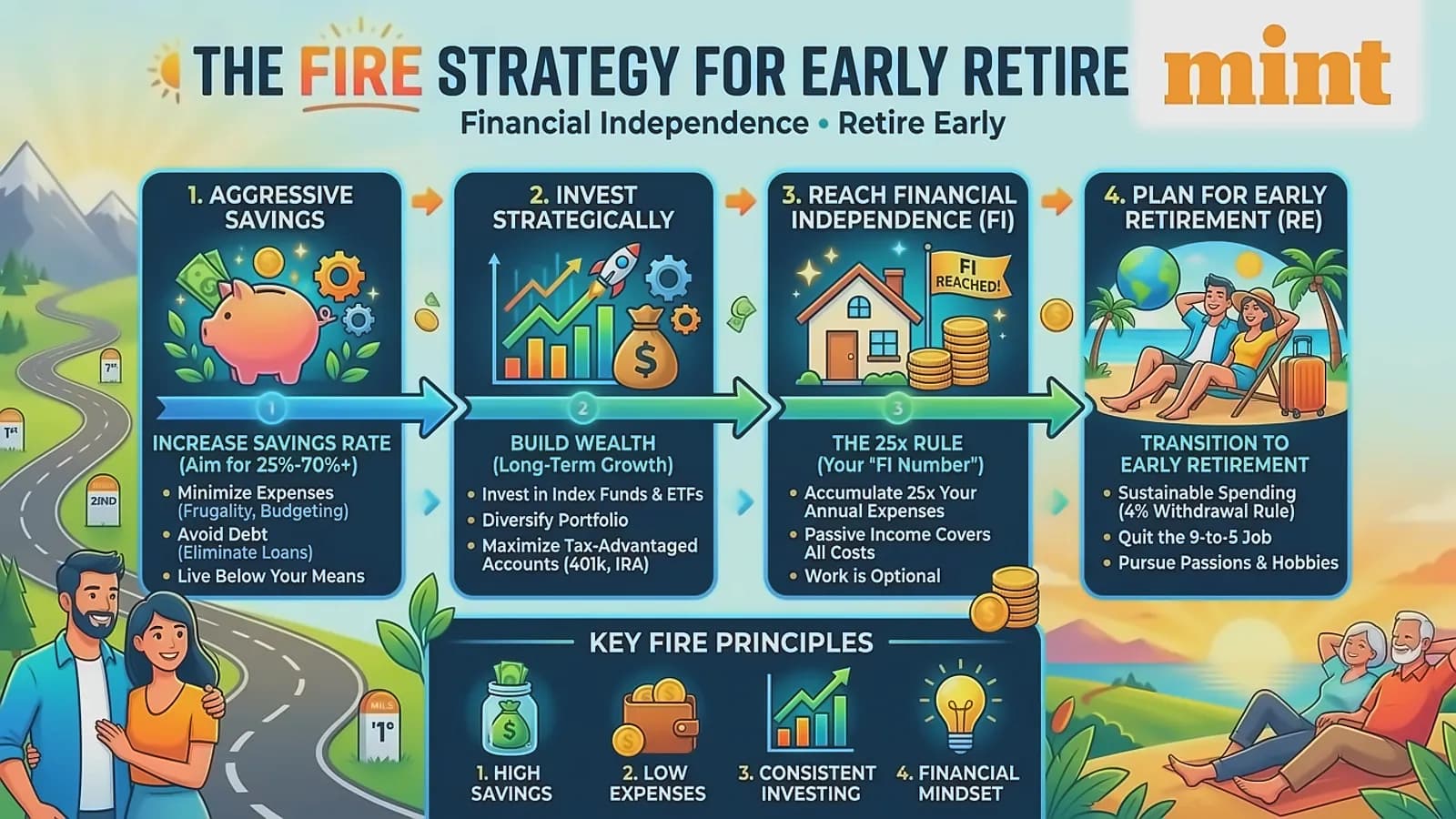
The Financial Independence, Retire Early (FIRE) concept has evolved from a niche philosophy to an increasingly mainstream approach to work, money, and overall quality of life. Over the past decade, outlets like podcasts and online communities have successfully introduced millions to the idea that retirement isn't necessarily an experience reserved for mid-60s. FIRE represents a fundamental shift from traditional retirement planning, focusing on gaining the freedom to focus on work you actually want to do, instead of just the work you have to do to survive. The movement traces its roots to Your Money or Your Life, a highly influential 1992 book by Vicki Robin and Joe Dominguez, with popular finance blogs like Mr. Money Mustache helping spread the concept to a wider audience. Today, overall awareness continues to grow, fueling regular discussions among retirement experts and financial institutions.
The core of FIRE strategy relies on two simple concepts: maintaining a high savings rate and building a target investment portfolio. The FIRE number represents the total amount of investments needed to support annual spending without depending on a paycheck. Using the 4 percent rule inspired by the Trinity Study, the equation is annual expenses multiplied by 25. For a more conservative estimate, some experts suggest multiplying by 30-33 instead. This approach assumes a diversified investment portfolio withdrawing around 4 percent per year has a very high probability of lasting through a standard 30-year retirement period. However, for retirement in one's 30s or 40s, which could last 40-50 years or more, many financial experts recommend adopting a more conservative withdrawal rate of 3-3.5 percent, requiring a larger portfolio.
FIRE has evolved into multiple approaches reflecting different lifestyle preferences and financial goals. Lean FIRE focuses on modest living expenses with annual spending often under $40,000-50,000, depending on location and household size. Since expenses stay fairly low, the investment portfolio required can also be smaller, though it calls for meticulous budgeting and fewer discretionary expenses. Fat FIRE occupies the opposite end of the spectrum, aiming for financial independence while maintaining a comfortable or luxurious lifestyle with planned annual retirement spending typically exceeding $100,000. To support these higher expenses, you need a much bigger investment portfolio and likely significantly higher household income pre-retirement. Barista FIRE blends partial financial independence with part-time employment, focusing on building a portfolio big enough to cover part of lifestyle while planning supplemental income via flexible work. For example, someone expecting to spend $60,000 annually while earning $20,000 via part-time employment would need investments to cover the remaining $40,000.

The savings rate emerges as the single biggest factor determining how quickly a person reaches financial independence. FIRE enthusiasts recommend saving 50-70 percent of income instead of the traditional 10-15 percent, with every dollar saving both increasing investments and reducing future spending needs. The recommended approach involves strategically combining equity and debt mutual funds to pursue long-term growth. This disciplined investment approach is particularly relevant in an emerging market context, where investors must maintain close attention to asset allocation, long-term planning, and the impact of rising prices on their savings. The extended planning horizon of 40-50 years necessitates careful consideration of inflation's cumulative effect on expenses over several decades, making it crucial to factor in realistic inflation projections when determining retirement targets.
While FIRE offers significant benefits, it presents practical hurdles that require careful consideration. Healthcare costs before 65, when Medicare becomes available, and accessing retirement accounts before 59 ½ are key considerations. Traditional approaches to FIRE call for very high income, very low living expenses, or both, making it difficult for the average household to reach full financial independence decades before standard retirement. According to Charles Schwab's 2025 retirement survey, most American workers expect to retire around age 66. However, FIRE doesn't have to be an all-or-nothing proposition - priorities like building passive income, minimizing unnecessary spending, and increasing savings rate are helpful regardless of retirement timeline. Even partial adoption of FIRE principles can strengthen financial foundation as you progress toward eventual retirement, with professional financial software providing personalized projections and Certified Financial Planners offering personalized guidance based on individual goals and tax situations.