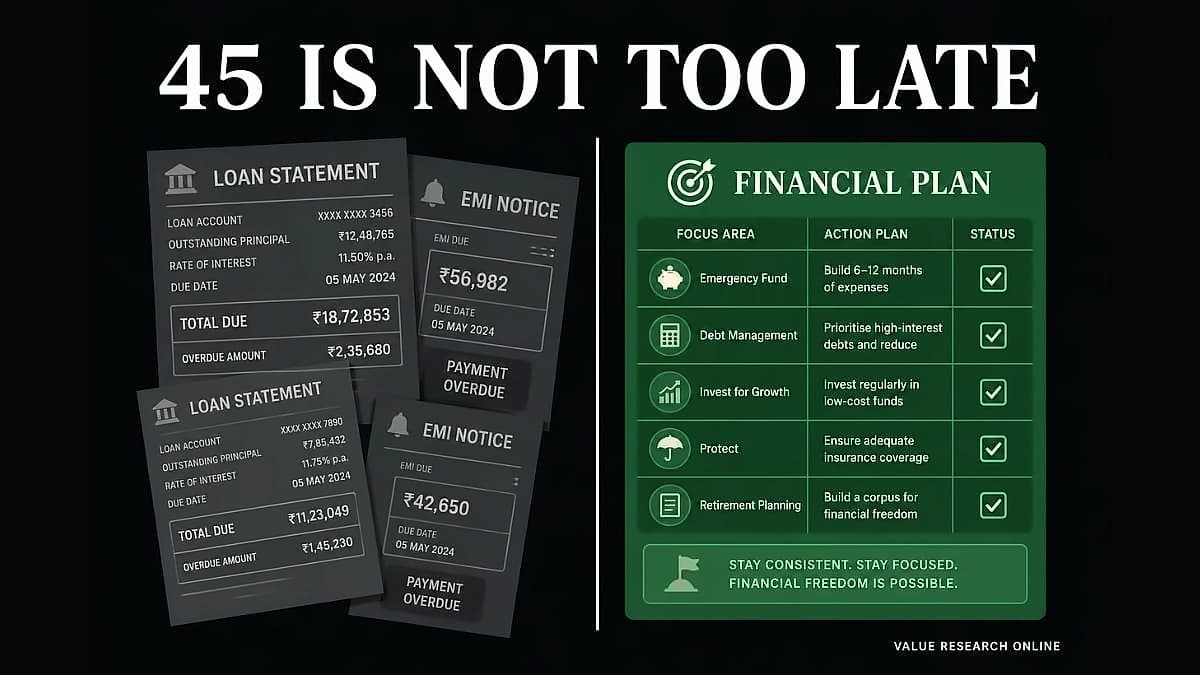
Late retirement planning requires saving a higher portion of income to build a retirement portfolio, as time becomes less of an advantage and discipline becomes the primary focus. According to recent guidance, in your 40s and 50s, focus more on discipline, allocation, and avoiding mistakes rather than relying solely on time. Start with around 10-15% of your income if possible, then increase contributions to 30-40% when your income rises. Avoid becoming too conservative too early, as keeping everything in safe options limits growth and may not beat inflation. The key is to begin with small, consistent investments in your 40s and 50s to reduce the pressure you would otherwise feel later, even if it's not large amounts right away. You don't need a perfect plan on day one - you just need to begin.
Building the right mix across growth, debt, income buckets, and healthcare buffers is essential for successful retirement planning, with late starters requiring more aggressive approaches. Growth bucket should focus on equity mutual funds and market-linked investments as the main driver to catch up, while debt bucket includes debt funds, provident fund-type options, and fixed deposits for balance and stability. Income bucket should include annuities and other income-focused options for later stages, and healthcare buffer starts with strong personal health insurance and separate buffers for expenses not covered by insurance. Expenses can double every 10-12 years, making it important to convert current monthly expenses into annual amounts and multiply by around 25-30 times to estimate corpus needs. The goal is to replace around 70-80% of current income after retirement, requiring careful planning and regular portfolio adjustments.
Retirement planning has become significantly more complex due to extended lifespans, with many people now living well past 80 years and sometimes into their 90s. According to the Centers for Disease Control and Prevention (CDC), the average life expectancy at birth in 2024 was 76.5 years for males, 81.4 years for females, and 79 years for both sexes. However, these averages don't tell the whole story, as medical advances mean more people are living into their late 80s and 90s than ever before. The challenge lies in savings having to stretch across a far longer period than previous generations ever had to consider, making traditional retirement strategies insufficient for modern circumstances. Some people face shorter retirements due to health issues, while others may need their money to last far longer, making planning for 25, 30, or even 35 years of retirement essential rather than optional. Longevity risk presents a particularly thorny problem for retirees, as one's exact lifespan is inherently unknowable, making it difficult to precisely estimate how long assets will need to support lifestyle spending needs. However, life expectancy can be better estimated using actuarial projections that are then refined for an individual's particular health circumstances, and longevity risk can be mitigated through the use of lifetime income sources, such as Social Security benefits and annuities.

Rising costs across multiple categories present another significant challenge for retirement planning. As reported, while inflation may appear mild, it silently takes away the value of money over time. Key expense categories include groceries, rent, electricity bills and medical expenses that tend to increase annually. The financial impact is compounded by the need for savings to grow fast enough to stay ahead of those rising costs, requiring more sophisticated investment strategies than simple savings accumulation. Inflation has become a major factor lately, as the US experienced the highest year-over-year inflation rates in 2022 and 2023 in about 40 years. When living on a fixed income during retirement years, all these factors can make a huge difference in buying power and quality of life. Inflation can be particularly worrisome for retirees, as they no longer bring in earned income to mitigate its effects and can see its impact compound over what could be a multi-decade retirement. To manage inflation risk, retirees might consider how much of their income is inflation-adjusted, such as Social Security benefits and Treasury Inflation-Protected Securities (TIPS) yields that are designed to increase alongside inflation. Certain components of an individual's portfolio might perform well during inflationary periods, such as commodities as an asset class that have tended to perform well amidst inflation.
Medical expenses represent a critical consideration in modern retirement planning, with health costs increasing as individuals age. According to experts, a single serious illness can drain years of savings in a short time, making healthcare planning essential rather than optional. The recommended approach includes keeping aside a dedicated healthcare fund and securing proper health insurance well before retirement, rather than waiting until medical needs arise to address coverage gaps. Health care costs tend to rise with age, as does the need for more doctor visits and medication. Based on National Center for Health Statistics data, the number of nursing home residents could increase by as much as 75% over the next decade. Medicare doesn't cover all the costs, adding another layer of stress to healthcare planning. According to Fidelity's 2025 Retiree Healthcare Cost Estimate, a 65-year old who retired in 2025 can expect to pay an average of $172,500 for healthcare expenses in retirement. Health risk includes the emergence of chronic medical conditions that can create the need to pay for long-term treatment, as well as long-term care needs that can add up to the tens or hundreds of thousands of dollars when an individual's health deteriorates significantly. Retirees face decision risk, or the risk that they will make financial decisions that are deleterious to their financial health, with aging potentially coming with diminished mental capacity that can magnify this category of risk.
The five- to 10-year period leading up to retirement is often called the gray zone, presenting a unique opportunity to strengthen retirement planning through focused strategies. During these years, retirees can estimate healthcare expenses before and after Medicare eligibility, understand Medicare, Medigap and Medicare Advantage options, evaluate long-term care insurance, and contribute as much as possible to health savings accounts (HSAs). The gray zone is an ideal time to reduce tax exposure and improve tax diversification, with strategies including converting traditional IRA or 401(k) balances to Roth accounts and building a mix of tax-deferred, tax-free and taxable accounts. Working with a financial advisor during these years can help clarify retirement goals, model different scenarios, and design an investment strategy appropriate for your stage of life. Catch-up contributions to workplace retirement plans and IRAs can be particularly beneficial for those in their 50s or early 60s, allowing contributions beyond standard limits to meaningfully boost retirement assets during final working years. The key point is that while inflation represents a key retirement risk, it has a varying impact depending on a particular individual's circumstances, presenting opportunities for advisors to support clients during inflationary periods by assessing their specific exposures and considering potential ways to dampen this risk.