An investment banker named Deepak, who planned to retire at 40, discovered a critical gap in his financial strategy when comparing his parents' retirement expenses over time. According to reports from Mint, healthcare, medicines and caregiving costs had climbed far faster than he had anticipated, making him question whether reaching his FIRE (Financial Independence Retire Early) number was only half the battle. Abhishek Kumar, SEBI-registered Investment Adviser and Founder of SahajMoney, emphasizes that someone planning to retire at 40 should be cognizant that they need to plan for the next 50 years, as life expectancy is increasing. This extended timeline requires consideration of the compounding effect of inflation over five decades, higher healthcare-related spending in later life, and the risk of sequence of returns in initial retirement years.

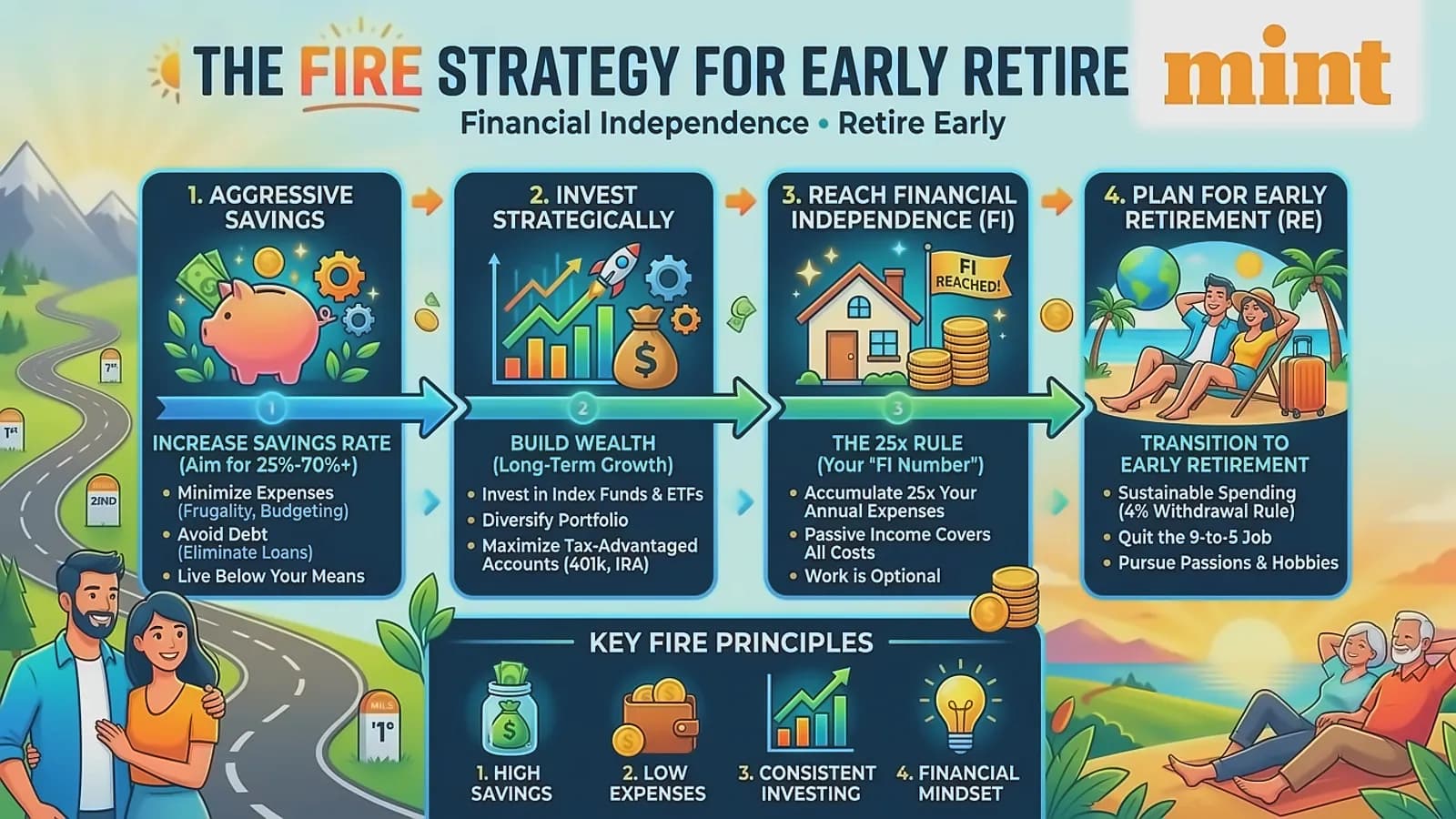
The traditional 4% withdrawal rule, designed for a 30-year retirement window, carries significantly higher risk for a 50-year retirement horizon. As reported by Mint, the standard 25x expenses guideline and 4% withdrawal rule are not applicable for a 50-year retirement horizon. Kumar suggests that someone planning to retire at 40 should keep a more conservative target of 30x to 35x annual expenses, which would help maintain a safer initial withdrawal rate of roughly 3% to 3.5%. This conservative approach accounts for the longer period of exposure to inflation and market downturns over five decades. However, Mint now recommends an even more conservative 2-3% withdrawal rate given India's higher inflation environment.
The fundamental difference between US and Indian FIRE models lies in inflation rates. Over the long term, the annual inflation rate in the US has averaged between 2% and 3%, while in India, it has averaged between 5% and 7%. According to Mint, if an Indian investor makes annual withdrawals from their FIRE corpus at a 5% to 7% inflation-adjusted rate, the corpus will be exhausted sooner than a US investor who makes withdrawals at 2% to 3% inflation-adjusted rates. Additionally, Indian stock markets have historically been more volatile than US markets, with significant drawdowns during the subprime crisis (60% fall) and COVID pandemic (40% fall). This volatility requires different withdrawal strategies and portfolio management approaches.
A critical difference between US and Indian retirement planning is the availability of social security and healthcare programs. In the US, individuals have access to Social Security programmes and public healthcare programmes like Medicare and Medicaid. In India, individuals must build their retirement funds through voluntary programs like Public Provident Fund (PPF), National Pension Scheme (NPS), and mutual funds, with low participation rates. Healthcare costs in India are rising at double-digit rates, faster than core inflation, making medical inflation a primary concern for retirement planning. Mint recommends maintaining a separate healthcare fund for regular doctor consultations, diagnostic tests, and medicines, as healthcare expenses can exhaust the corpus earlier than expected.
For Indian market conditions, Mint advocates a three-bucket strategy to manage stock market volatility. The first bucket should maintain 12 to 24 months of regular monthly expenses in a savings bank account or liquid mutual fund, insulated from stock market volatility. The second bucket should hold 3 to 7 years of regular monthly expenses in a hybrid mutual fund, with debt portion acting as a shock absorber against volatile equity. The third bucket can contain the remaining corpus in equity mutual funds, subject to volatility but not dependent on immediate expenses. This strategy ensures that annual withdrawals can be funded from the second bucket during market downturns, while the third bucket can feed the second bucket during market rallies.