Taxpayers who missed the June 15, 2026 advance tax deadline can still pay their owed amounts with interest. According to reports from Mint and Zee News, missing the first instalment deadline does not close the payment window entirely, though it may incur additional interest charges under Sections 234B and 234C of the Income-tax Act. For example, if a taxpayer's estimated advance tax liability for FY 2026-27 is ₹1 lakh, the first instalment of ₹15,000 can still be paid later, along with applicable interest. The upcoming instalment due on September 15 would then be ₹45,000, bringing the cumulative advance tax payment to 60% of the estimated liability. As per Zee News, those who missed the payment earlier now have to pay the total liability till September 15, including any taxes applicable on the first instalment. The Income Tax Department has actively reminded taxpayers through social media posts, urging eligible taxpayers to make the payment on time to avoid interest on late payments.
Interest charges apply when advance tax payments are delayed beyond prescribed deadlines. As reported by Mint and Zee News, Section 234C levies 1% per month interest on the shortfall amount if advance tax is not paid according to quarterly deadlines. According to Niresh Maheshwari, Director of Wealth Wisdom India pvt ltd, "Even a delay of a few days attracts 1% interest for one month on the unpaid amount, because any fraction of a month is treated as a full month for tax computation." Additionally, if taxpayers fail to pay at least 90% of their total tax liability by March 2027, Section 234B interest comes into effect at 1% per month starting from April 1, 2027, continuing until payment is made. However, taxpayers should note that Section 234C interest is charged only for three months on the shortfall amount, calculated against the 45% target for the instalment. As per Zee News, paying 12% of the tax liability would remove the interest of 1% that applies to the shortfall amount otherwise.
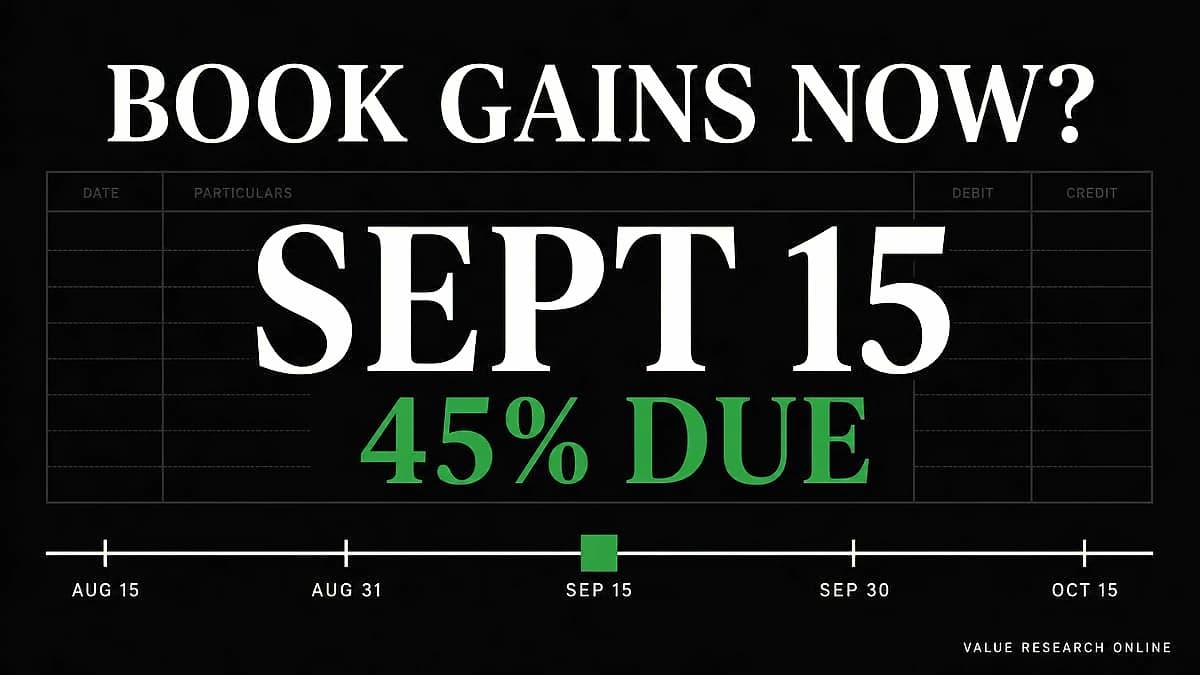
The September 15, 2026 deadline represents the second regular instalment for FY 2026-27, with a crucial 45% cumulative target requirement. Under the Income Tax Act, 2025, taxpayers must ensure their cumulative advance tax payment reaches 45% of their estimated liability by this date, after accounting for any earlier instalments paid. For example, if a taxpayer's estimated advance tax liability is ₹1 lakh and ₹15,000 was already paid in June, the September payment would be ₹30,000 to reach the 45% cumulative target. Industry experts recommend a step-by-step approach: estimate total income across all sources for the full financial year, compute tax payable on that income, subtract any TDS or TCS expected during the year, and then calculate 45% of the net figure as the cumulative amount required by September 15. The Income Tax Department confirms that advance tax is based on expected tax liability for the year, making it essential for taxpayers to review their accounts before making the September payment rather than blindly following previous instalments. As per Zee News, it's important to assess total income carefully to correctly calculate the total tax liability, as income may change annually and previous years' liability may not continue in the present year.
Advance tax payments are mandatory for specific categories of taxpayers who earn income beyond the basic tax thresholds. As reported by Mint and Zee News, the requirement applies to freelancers and consultants, individuals receiving rental income from property, and salaried individuals with additional income not fully covered by TDS. This includes profits from stock sales, cryptocurrency gains, and rental income. Under the Income Tax Act, 2025, advance tax generally applies when the estimated tax payable is ₹10,000 or more, subject to applicable exceptions, with taxpayers using applicable presumptive taxation provisions generally paying the entire advance tax by March 15 instead of using four regular instalments. The advance tax system operates on a "pay-as-you-earn" basis, with taxpayers paying estimated amounts in instalments during the year rather than waiting until filing returns. For most taxpayers, advance tax is divided into four instalments: June 15 (15%), September 15 (45%), December 15 (75%), and March 15 (100%), with any tax paid on or before March 31 also treated as advance tax for that financial year. Notably, there is a built-in cushion for taxpayers: if cumulative payments fall below 36% of total estimated tax by September 15, no interest is charged for that particular instalment, even though the actual target is 45%. By the deadline of March, if the person has paid even 90% of the total tax liability, no interest would be charged.