The July 31, 2026 deadline for eligible taxpayers to file their income tax returns for Assessment Year 2026-27 has now passed, with the government not announcing any further extension as expected by most tax experts. According to Zee News, over 5.9 crore ITRs were filed by July 31, 2026, but some may have missed the deadline due to various reasons. The Income Tax Department continues to remind eligible taxpayers to file their returns by this date, with no official extension announced as of July 29, 2026. Taxpayers should follow only official government updates and avoid relying on rumours about a possible extension.
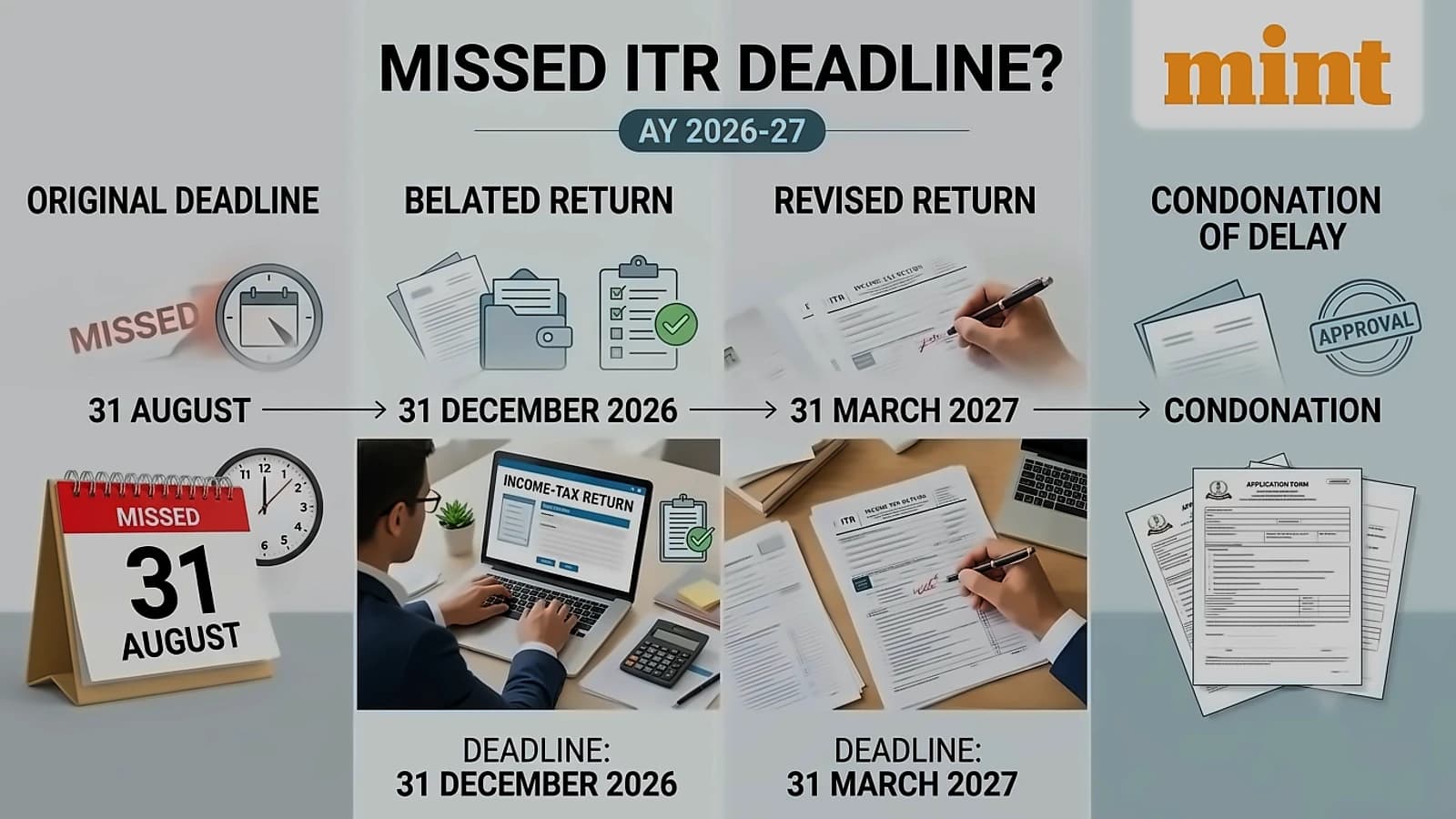
While the July 31 deadline has passed, taxpayers can still file a belated return by December 31, 2026 under Section 139(4) of the Income Tax Act. According to Mint, the filing process remains largely the same as a regular return, with taxpayers needing to log in to the income tax e-filing portal, select the appropriate ITR form, choose Section 139(4) while filing, report their income, pay any outstanding tax along with applicable interest and late fees, and complete e-verification within 30 days. Taxpayers with total income below ₹5 lakh face a late filing fee of ₹1,000 under Section 234F, while those with income above ₹5 lakh pay ₹5,000. For taxpayers who owe tax, the late filing fee applies in addition to interest charged on outstanding tax dues at 1% per month under Section 234A, calculated from the applicable ITR due date until the return is filed. As per ClearTax tax expert CA Chandni Anandan, any taxpayer who missed the original due date can file a belated return under Section 139(4), including salaried individuals, freelancers, business owners, and those expecting refunds.

For FY 2025-26 (AY 2026-27), there are three distinct deadlines based on income type: Salaried individuals and pensioners (ITR-1 or ITR-2) have until July 31, 2026 - the same as previous years. Freelancers, professionals, and small businesses (ITR-3 or ITR-4) now have an extended deadline of August 31, 2026 - a new change introduced in Budget 2026. Businesses requiring tax audit must file by October 31, 2026 with audit reports due by September 30, 2026. Transfer pricing cases have a November 30, 2026 deadline. Belated returns and revised returns can be filed until March 31, 2027 with additional late fees and interest charges. This extra month for non-audit business filers was specifically introduced to give them more time to close their books.
Missing the original ITR filing deadline has significant implications for loss carry-forward benefits. According to the provisions of the Income-tax Act, taxpayers can carry forward losses from the current year to future periods to offset against future profits, thereby reducing total tax liability. However, taxpayers who file a belated return are not allowed to carry forward their losses to future years, meaning they lose the opportunity to set them off against future gains. These losses include loss on sale of capital assets like properties, stocks, mutual funds, and business losses. As per Mint, taxpayers can carry forward certain losses such as unabsorbed depreciation even if the return is filed after the due date, but most business and capital losses cannot be carried forward. Taxpayers expecting a tax refund should also file their returns on time, as while a belated return may still be eligible for a refund, filing before the due date helps ensure the refund is processed sooner. However, house property losses remain an exception and can still be carried forward subject to applicable provisions.
Beyond the immediate penalties, late filing creates several long-term financial implications. According to Mint, taxpayers may lose the benefit of carrying forward business and capital losses, which can significantly impact future tax planning. Tax refunds may be delayed as the Income Tax Department processes belated returns more slowly, and taxpayers may receive lower interest on delayed refunds compared to those filed on time. Loan and visa applications may face additional scrutiny, as banks and embassies typically seek recent ITRs as proof of financial stability and tax compliance. Interest under Sections 234B and 234C may also apply depending on the taxpayer's circumstances, with taxpayers able to use the interest calculator available on the Income Tax Department's e-filing portal to calculate applicable interest amounts. Taxpayers who fail to file within the original due date lose the option to opt for the old tax regime for that assessment year, and cannot carry forward capital losses, business losses and futures and options (F&O) trading losses. ITR-U filings under Section 139(8A) have steeper penalties, with additional taxes charged at 25% within 12 months, 50% within 24 months, 60% within 36 months, and 70% within 48 months of the assessment year's end.