The Securities and Exchange Board of India (SEBI) has extended the implementation deadline for its Exchange Traded Fund (ETF) trading norms circular from September 1, 2026 to September 7, 2026. The extension was notified through Circular No. HO/47/11/11(1)2026-MRD-POD3/I/19839/2026 dated August 28, 2026, following feedback received from stock exchanges regarding operational readiness. SEBI stated that the extension follows requests from stock exchanges seeking additional time to implement the changes, with the circular addressing all recognized clearing corporations, asset management companies (AMCs) of mutual funds, and Association of Mutual Funds in India (AMFI) to be operationally ready by the new deadline. The revised timeline provides stock exchanges and market participants with an additional week to complete required system modifications and operational preparations before the revised framework takes effect.
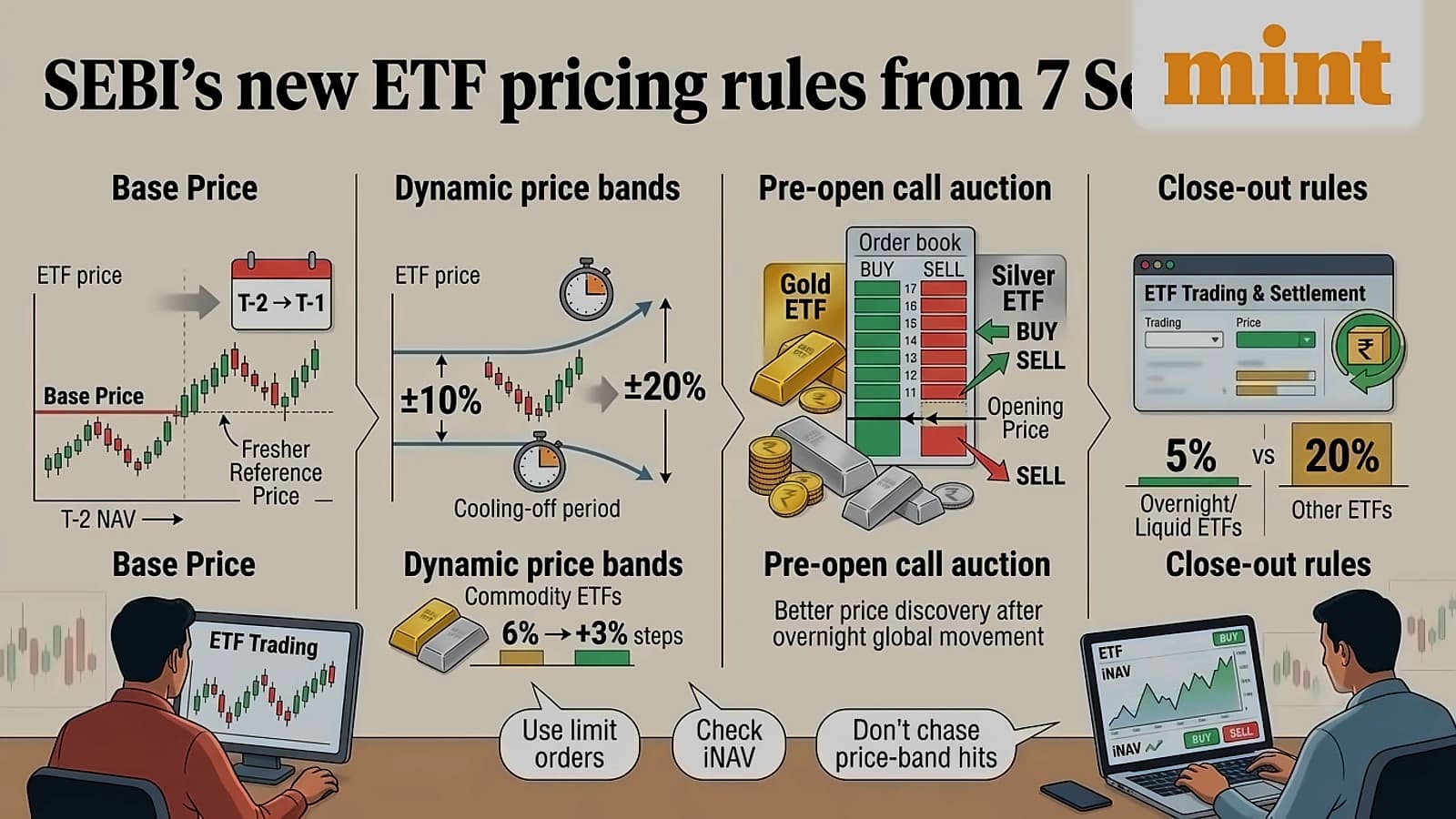
Under the revised rules, an ETF's base price will be linked to its previous trading day's closing price, calculated using the 30-minute volume-weighted average price (VWAP) at the end of the session. According to ET Now, if an ETF does not trade during the final 30 minutes, its last traded price will be used. If there was no trade on the previous day, the latest available closing NAV will become the base price. SEBI and asset management companies will work towards using the T-1 closing NAV as the base price from April 1, 2027, after resolving operational issues. This change removes the one-day lag that can cause ETF prices and the value of their underlying assets to move out of sync, replacing the earlier system that used the ETF's Net Asset Value (NAV) from two trading days earlier (T-2). As reported by The Economic Times, this change ensures base prices are more responsive to actual market movements and reduces the time lag between ETF pricing and underlying asset value.
The new framework introduces dynamic price bands for equity and debt ETFs, starting with a ±10% initial band that can expand to ±20% after a cooling-off period. As reported by ET Now, for equity ETFs and debt ETFs, excluding overnight and liquid ETFs, the band can be expanded up to ±20% with a 15-minute cooling-off period when prices move to or beyond 9.90% of the base price. If this happens during the last 30 minutes of trading, the cooling-off period will be five minutes. The band can be widened by 5% at a time, up to two times in the same direction. For equity and debt ETFs, the 10% price band will begin the day, which can widen in steps up to 20% depending on market volatility. Market participants dealing in ETFs should be aware that trading from September 7, 2026 onward will be governed by these new base price and price band norms, which may affect order placement strategies, particularly for less liquid ETFs.
Commodity ETFs tracking gold and silver will benefit from dynamic price bands with an initial ±6% band, which can expand in stages of 3% after a cooling-off period, depending on market movements. According to ET Now, unlike equity and debt ETFs, there will be no upper limit on the price band for commodity ETFs and no cap on how many times it can be expanded during a trading session. SEBI has introduced a pre-open call auction for gold and silver ETFs, where buy and sell orders will be collected before market opening to establish a fair opening price. As reported by The Economic Times, this mechanism allows the opening price to be determined by the balance of demand and supply rather than by the first stray order of the day. The pre-open auction ensures better inclusion of overnight changes in international bullion markets in the ETF's opening price, with the move intended to improve price discovery because gold and silver markets trade internationally and can remain active outside Indian market hours. The tighter 6% band for gold and silver ETFs allows prices to adjust towards fair value even after large overnight moves in global markets.
SEBI has updated close-out procedures for Overnight and Liquid ETFs, setting the close-out price as the higher of two calculations: the highest price recorded during the relevant settlement cycle up to the auction/close-out date, or 5% above the latest available closing price on the day auction offers are called. As reported by ET Now, for all other ETFs, the existing close-out rule continues, with the close-out amount being the higher of 20% above the closing price or the highest price during the settlement period. This change ensures better settlement mechanisms when sellers fail to deliver ETF units. The circular has been issued under Section 11(1) of the SEBI Act, 1992, read with Regulation 51 of the Securities Contracts (Regulation) (Stock Exchanges and Clearing Corporations) Regulations, 2018, empowering SEBI to take measures to protect investor interests and regulate the securities market.
SEBI has mandated cross-exchange synchronization for ETF price bands, ensuring the same band applies across all exchanges where an ETF trades. According to ET Now, this prevents price discrepancies and arbitrage trades, ensuring the same ETF doesn't have different trading limits on NSE and BSE. The rules, originally scheduled for September 1, have been revised to take effect on September 7, 2026, giving exchanges, clearing corporations, mutual fund houses and AMFI six additional days to complete system changes and operational preparations. Additionally, exchanges will extend the reference-price and price-band framework currently applicable to stock futures to index futures from September 7, aligning derivatives contracts with the price-band framework used during the Closing Auction Session (CAS) period. Under the revised framework, index futures will have a 3% price band from 3:15 pm to 3:40 pm, with the reference price based on VWAP of trades executed between 3 pm and 3:15 pm, ensuring closer alignment between index futures and cash-market closing processes. The revised framework is aimed at making ETF price discovery more responsive to underlying assets, particularly when there are significant overnight moves in global markets, and improving liquidity and price discovery, especially during volatile market conditions.