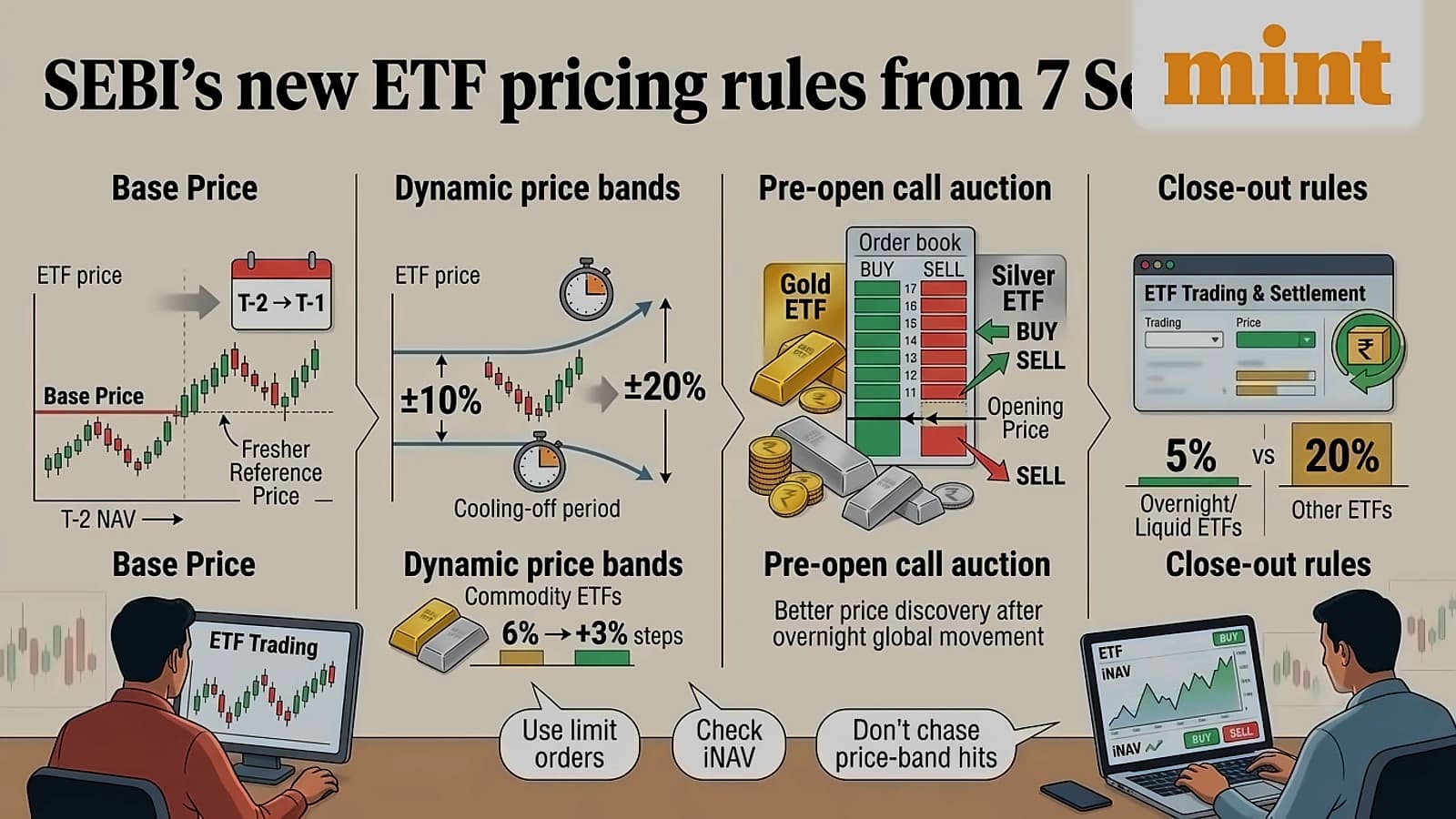
The Securities and Exchange Board of India (SEBI) has extended the implementation deadline for new ETF trading norms by one week, according to the latest circular issued on August 28, 2026. The new base-price and price-band rules are now effective from September 7, 2026, providing additional time for market participants to prepare for the regulatory changes. The extension was announced on Friday and comes after feedback received from stock exchanges to ensure smooth implementation of the new framework. As per SEBI's latest circular, the decision was taken to defer the implementation after receiving feedback from stock exchanges and to ensure smooth implementation of the provisions. The regulator has clarified that the move was intended to ensure smooth implementation of the new provisions, with the substantive provisions of the June circular remaining unchanged through the August 28 update.
The extended deadline applies to new base-price and price-band rules that were originally scheduled to take effect on September 1, 2026, as detailed in SEBI's latest circular. These regulatory changes represent a significant overhaul of ETF trading mechanisms in the Indian market, affecting how exchange-traded funds are priced and traded on stock exchanges. The framework includes changes to the methodology for determining the base price of ETFs as well as the applicable price bands, with the objective of improving price discovery and trading efficiency. The June 15 circular had specified that the provisions would come into effect from September 1, but with the latest decision, market participants and exchanges have been given an additional week to make the necessary operational and system-level changes. The framework lays down specific norms for how ETFs will be handled during the trading process, including how their base price and price bands are determined.
Under the revised timeline, market infrastructure institutions (MIIs), including stock exchanges and clearing corporations, will have additional time to put the required systems and processes in place. SEBI has directed stock exchanges, clearing corporations and other market infrastructure institutions to put the necessary systems in place and make any required changes to their rules and regulations. The MIIs have been directed to take necessary steps and put in place the required systems for implementing the provisions, while also making necessary amendments to their relevant bye-laws, rules and regulations wherever required. SEBI has advised market infrastructure institutions to take necessary steps and put in place systems for implementation of the norms, while also informing market participants, including investors, about the provisions. The extension provides operational breathing room as exchanges and clearing corporations work towards operationalising the new requirements.

The new framework introduces several significant changes to ETF trading mechanisms. One of the key changes is the introduction of a pre-open call auction mechanism for commodity ETFs, which is expected to help improve price discovery when trading begins and potentially reduce the impact of sharp price movements at the start of the trading session. A call auction is a mechanism in which orders are collected during a specified period and then matched at a price that facilitates the maximum possible trading. SEBI has also prescribed changes relating to close-out mechanisms for ETFs, adding another layer to the revised trading framework. This provides a framework for dealing with situations where obligations arising from trades cannot be completed through the normal settlement process. The regulator has clarified that the extension is limited to the implementation timeline and does not alter the provisions contained in its earlier circular, with the June circular seeking to bring greater clarity and standardisation to certain aspects of ETF trading, including the pre-open session, price bands and close-out mechanism.