International exchange-traded funds in India are experiencing unprecedented premium trading, with Motilal Oswal Nasdaq Q50 ETF trading at approximately 81% premium to its indicative net asset value (iNAV) on September 9, according to latest market data. The Nasdaq Q-50 index, made up of 50 companies next in line to enter the Nasdaq-100, did little from September 4-9, yet the Indian ETF saw its market price shoot up by 50% during this period. On September 9, each unit was bought and sold for ₹213, while the NAV was just ₹117, representing a dramatic escalation from earlier data showing the Nasdaq 100 Top 50 ETF at 65% premium and the S&P 500 Top 50 ETF at 46% premium. This represents a significant escalation from earlier data showing the Nasdaq 100 Top 50 ETF at 65% premium and the S&P 500 Top 50 ETF at 46% premium. The first major divergence was seen on September 8, after US markets were closed on September 7 for the Labour Day holiday, with the trend appearing to have continued.
The premium surge stems from strict regulatory constraints that have exhausted available overseas investment capacity. The Securities and Exchange Board of India (SEBI) and Reserve Bank of India (RBI) cap overseas investment at $7 billion for the industry and $1 billion per fund house, with the ceiling now reached. As reported by The Economic Times, with these limits exhausted, fund houses cannot create new ETF units, leaving a supply-and-demand mismatch that pushes existing units above fair value. Harshal Dassani, business head at INVasset PMS, described the recent surge as "less a global-equity story and more a scarcity premium created by market structure." The rising domestic demand for international exposure, coupled with restrictions on creating fresh units, has weakened the normal arbitrage mechanism that typically keeps an ETF's market price close to its underlying value. Investor appetite for US funds has remained strong, with these funds having performed better than Indian equities, further intensifying demand for overseas exposure.
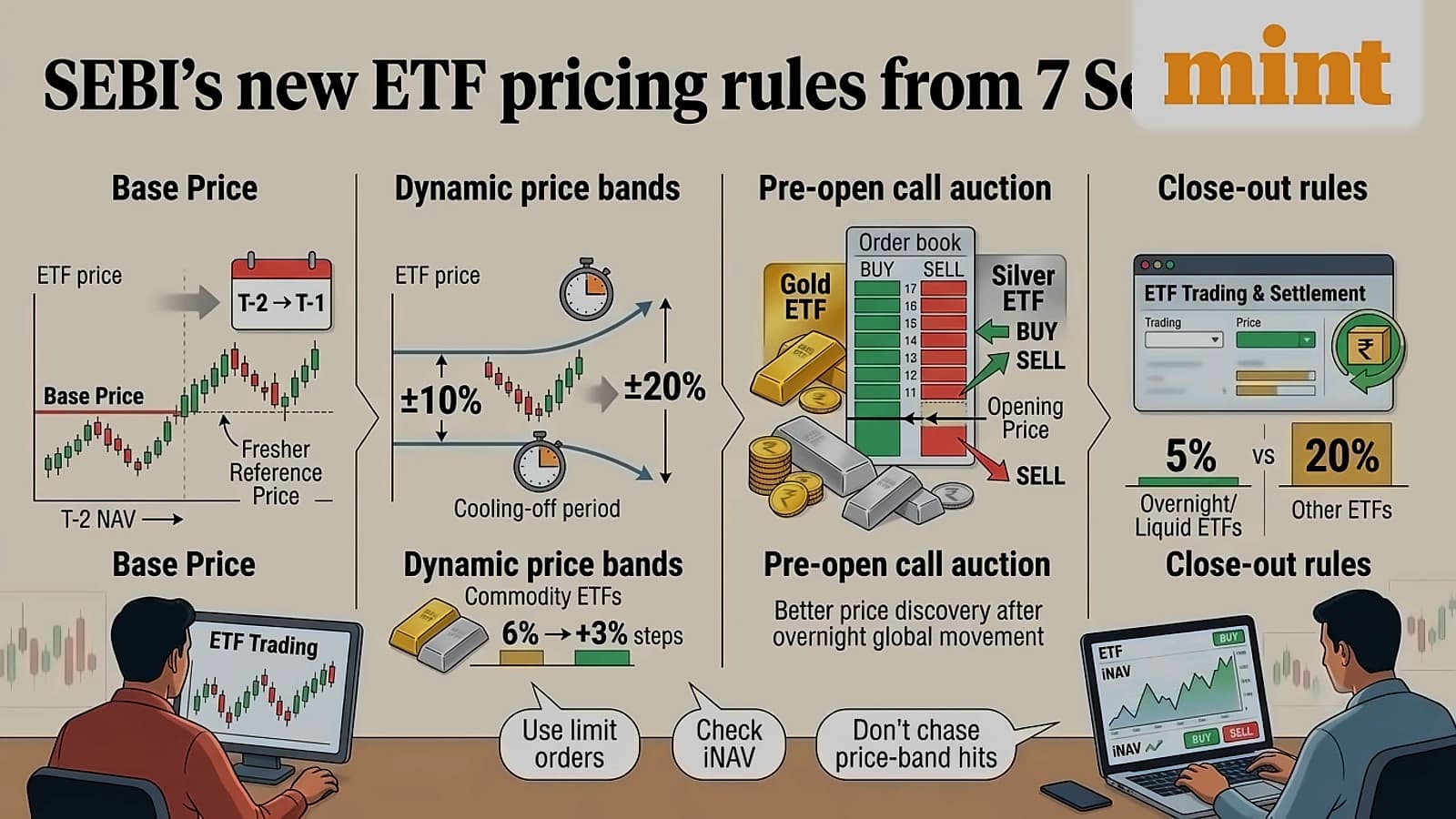
Recent regulatory changes have significantly intensified the premium trading environment. SEBI's new ETF price-band rules took effect on September 7, with the band now anchored to the previous day's closing price rather than the iNAV. As noted by an industry expert to Mint, "Under the new rules, the price band for ETFs is anchored to the previous day's closing price instead of the NAV. For international ETFs that already trade at a premium, the reference point itself is inflated. As the circuit limits are dynamically adjusted off that price each day, the premiums keep building." Under the framework, equity ETFs get a dynamic price band starting at ±10%, which can widen to ±20% after a cooling-off period. However, The Economic Times reports that circuit limits are now calculated based on the T-1 closing price, bringing them in line with domestic ETFs, which has pushed the price caps further away and could lead to sharper divergence between iNAV and market prices. The Q50 ETF rose 15.6% on September 7 when US markets were shut for Labour Day, with the NAV remaining flat, demonstrating how the new rules allow premiums to compound. Some mutual fund industry officials have also attributed part of the recent rally to a change in the methodology used to calculate circuit limits, with an industry executive noting that "the reason we have seen a jump in global ETF prices over the last two days is a change in the methodology used to calculate their upper and lower circuit limits."
For investors seeking global diversification, alternative routes have become more practical than buying ETFs at premiums. Under the RBI's Liberalised Remittance Scheme (LRS), individuals can remit up to $250,000 a financial year and invest directly in ETFs listed on US exchanges, though this involves currency conversion and brokerage costs. Outbound fund-of-funds (FoFs) based in Gift City's International Financial Services Centre represent another option that stays outside overseas limits. Advisers recommend building international exposure gradually with a typical allocation of 10-30% of the portfolio, given how sharply US markets have already run up. However, The Economic Times warns that investors buying at elevated premiums risk losses if the gap narrows, with Kirttan Shah, founder of Truvanta Wealth, cautioning that "you may end up losing up to 50% on day 1." For example, if an ETF's underlying assets are worth ₹100 per unit but its market price is ₹165, an investor buying at ₹165 is paying a ₹65 premium. Investors should always check the iNAV before buying an ETF from the exchange, assess trading liquidity and bid-ask spreads, and avoid placing market orders in thinly traded ETFs. As noted by The Economic Times, "when the gap reaches 65%, it is no longer just a valuation curiosity. It raises a much bigger question for investors... Global diversification makes sense. Paying a 65% premium for it doesn't."