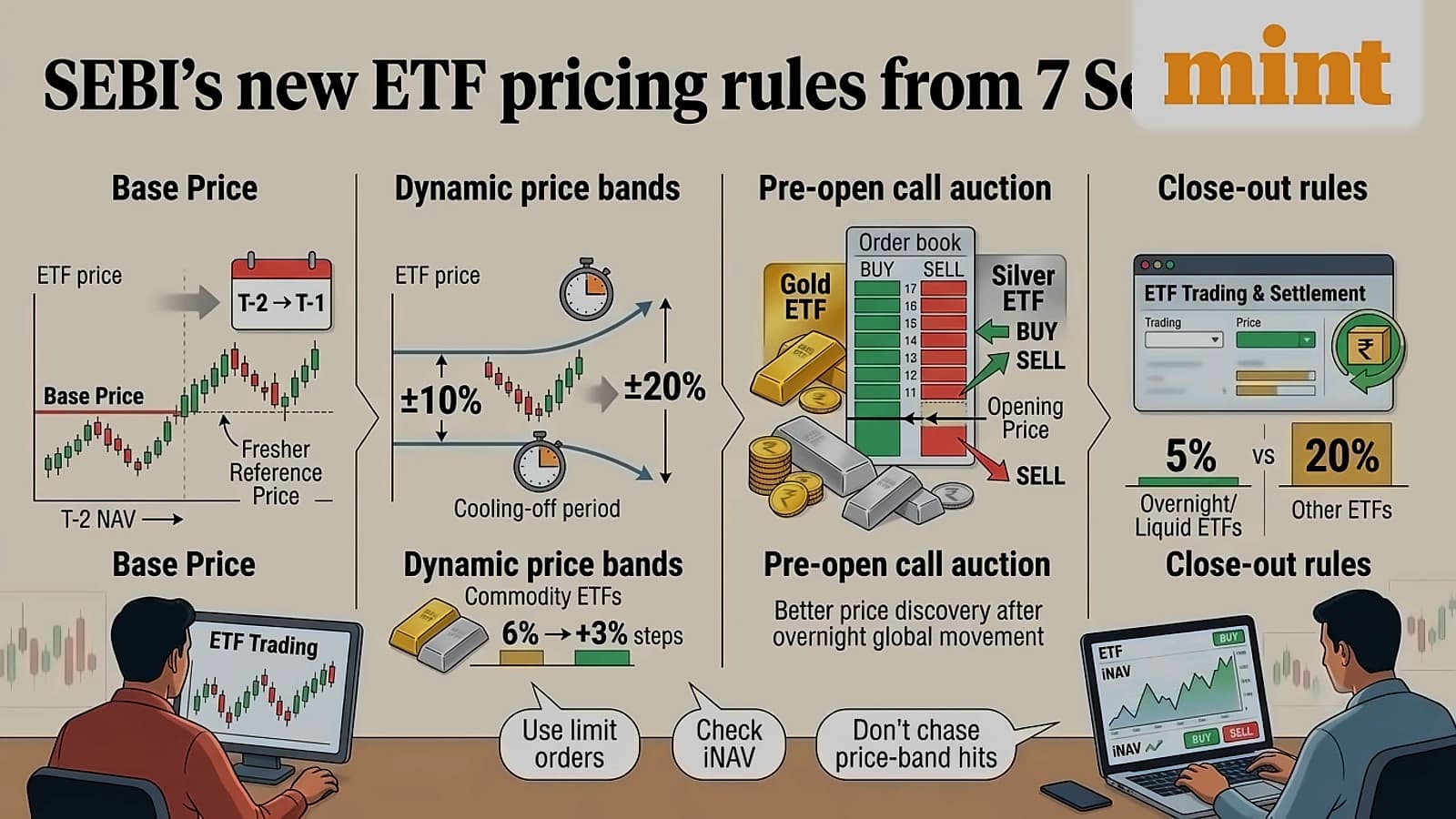
The Securities and Exchange Board of India (SEBI) has introduced a new base price calculation method for ETFs, effective from September 1, 2026. According to reports from Business Standard, the base price will be calculated as the previous day's closing price, determined as the last 30-minute volume weighted average price (VWAP). If no trades occur during the last 30 minutes, the last traded price will be used. If there are no trades on the previous day, the latest available net asset value (NAV) will serve as the base price. The regulator stated that stock exchanges and mutual fund houses should work towards using the previous day's closing NAV as the base price from September 1, 2026. However, SEBI has announced that stock exchanges and asset management companies would work towards implementing T-1 day closing NAV as the base price from April 1, 2027, after addressing operational challenges. The new framework aims to ensure that ETF prices stay closer to the value of the assets they track and better align domestic commodity ETF pricing with global markets, as reported by Zee News.
For equity ETFs and debt ETFs, excluding overnight and liquid ETFs, SEBI has introduced dynamic price bands with an initial setting of 10%. As reported by Business Standard, these price bands can be expanded up to 20% after a 15-minute cooling-off period if prices hit the upper or lower thresholds. The cooling-off mechanism will be triggered when prices move to or beyond 9.90% from the base price. The pause will last 15 minutes during normal trading hours and five minutes if triggered near market close. The changes represent a significant shift from the previous flat price band system, moving towards a more asset-linked pricing mechanism. Currently, stock exchanges use the ETF's Net Asset Value (NAV) from two trading days earlier (T-2) to determine the base price for applying price bands, but the new system will use the previous day's closing price instead.
For commodity ETFs including gold and silver, SEBI has introduced a pre-open call auction mechanism along with dynamic price bands to improve alignment with underlying asset prices. Under the revised system, commodity ETFs will have an initial price band of plus or minus 6%, which can be expanded in stages of 3% after a cooling-off period depending on market conditions. Unlike the current system, there will be no upper limit on how many times the band can be widened during a session. SEBI stated that the move is necessary given that "the underlying commodities trade across international markets beyond domestic trading hours". The changes aim to ensure that Gold and Silver ETF prices better reflect overnight movements in global commodity markets, reducing the chances of large premiums or discounts during volatile sessions. The new framework will help reduce sharp premiums and discounts during volatile markets and changing market dynamics, as reported by Zee News.
Foreign institutional investors (FIIs) turned net buyers after 11 trading sessions as easing geopolitical tensions and lower crude oil prices supported Indian equities. According to exchange data, FIIs purchased equities worth ₹15,650.20 crore and sold shares worth ₹15,450.15 crore, resulting in net inflows of ₹200.05 crore. Domestic institutional investors (DIIs) also remained net buyers, purchasing equities worth ₹3,189.26 crore. The positive momentum continued on Tuesday, with the benchmark index trading 344.78 points higher at 76,609.11 as of 11:14 AM, supported by the US-Iran deal confirmation and crude oil price corrections.
According to Business Standard, SEBI stated that the changes are aimed at addressing issues arising from the one-day lag in ETF base prices and the mismatch between existing price bands and movements in underlying assets. The regulator emphasized that the revised norms were finalised after recommendations from stock exchanges, discussions in SEBI's Secondary Market Advisory Committee and feedback received through public consultation. CFP Shweta Shastri noted that "SEBI's revised ETF framework is a timely and investor-friendly reform, especially for those investing in Gold and Silver ETFs." She highlighted that earlier, a key challenge was the disconnect between ETF prices and the actual value of underlying assets, largely because global commodity prices move overnight while Indian markets remain closed. The new framework is intended to improve price discovery, align ETF trading mechanisms more closely with underlying asset movements and enhance market efficiency.