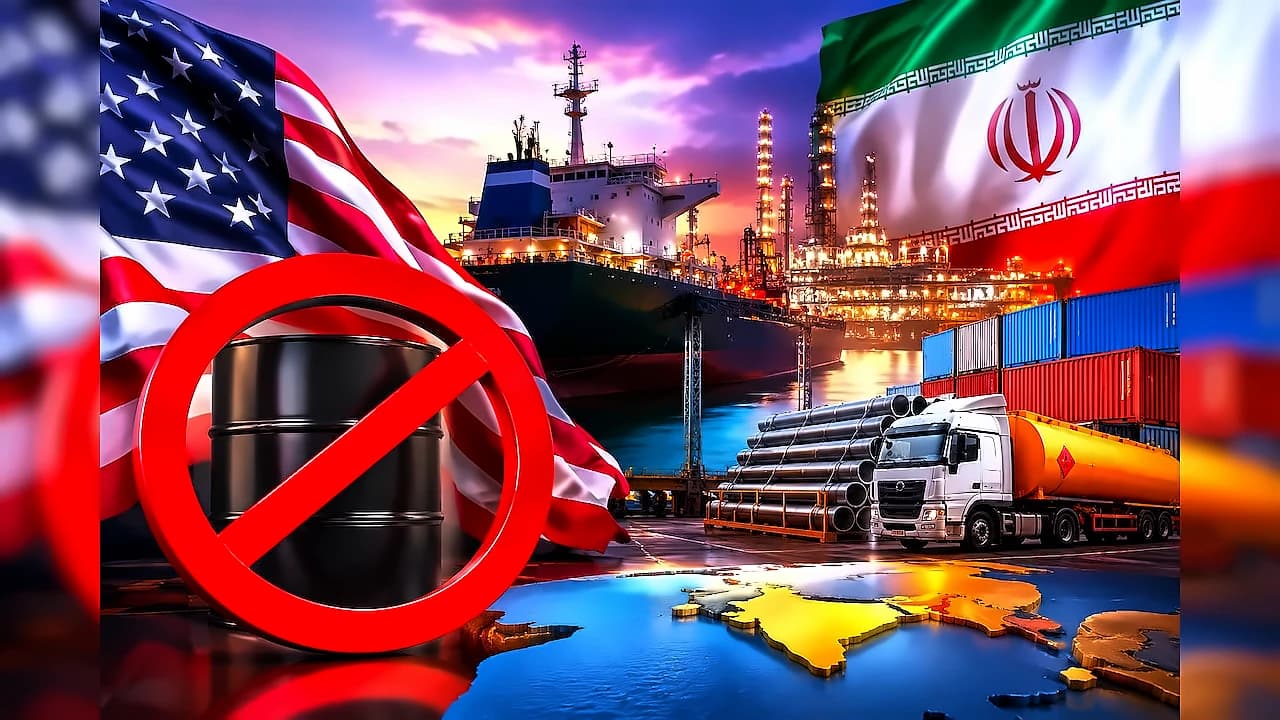
U.S. Treasury Secretary Scott Bessent announced 'Operation Economic Outcast' on Monday, launching what he called 'the greatest financial offensive ever marshalled' against Iran. According to The Times of India, Bessent said President Trump is making phone calls to world leaders with specific requests to stop all interactions with Iran, warning that continuing economic ties could expose countries to retaliation. Bessent emphasized that 'it was no longer acceptable to operate in the gray spaces' of the conflict, with the Treasury Department sanctioning nearly 60 entities, individuals and vessels as part of the new measures. The campaign names five sectors: digital assets, technology, gold, aviation and shipping, with OFAC Director Bradley T. Smith signing the determination at 9:25 a.m. Eastern, effective the same day. This marks the first time any country's crypto sector has been designated under Executive Order 13902, which had been used only twice before for financial services in 2020 and petroleum in 2024. As per Treasury, the department presented Iran with two possible outcomes: continued isolation or a route back into the international economy, with reintegration requiring the Iranian government to change conduct that Washington regards as a threat.
The Trump administration has significantly expanded its crypto sanctions against Iran, with OFAC adding Iran's digital asset sector to Executive Order 13902 on August 24. According to Treasury, the department alleged that UAE-based broker Ivan Obukhov processed more than $100 million in cryptocurrency for oil sales linked to Iran's Islamic Revolutionary Guard Corps-Quds Force since 2023. OFAC can now sanction any person determined to operate in Iran's digital asset sector or provide services supporting it, regardless of where that person is located. The determination does not automatically sanction every crypto company serving Iranian users, but participation in the sector can now serve as a basis for future designations. OFAC also sanctioned Foscom FZE, the UAE-based company Obukhov owns and manages, which Treasury said Obukhov purchased in 2022 and used in his brokerage activities. The action follows earlier measures that targeted Iranian exchanges including Nobitex, Wallex, Bitpin, Ramzinex, Shelbit and Aban Tether in June and August, with OFAC alleging these exchanges processed approximately $5 million involving sanctioned Iranian platforms.
The Trump administration's latest sanctions have swept up businesses in China and Hong Kong as part of Operation Economic Outcast, though avoided targeting major Chinese financial institutions. According to Business Standard, the inclusion of Hong Kong-based entities follows a pattern seen in US enforcement of sanctions imposed over Russia's war in Ukraine, with Washington targeting trading intermediaries and shipping companies accused of helping move goods, including sensitive technology. A key focus of the measures was a tech-procurement network centered on Hong Kong-based Sweet Ocean Industrial Ltd., where Treasury alleged the company acted as an intermediary in acquiring laser-optics equipment destined for Iran's Malek Ashtar University of Technology, a defense-linked research institution. The individuals Li Na, Tian Jianbai and Zhang Limei — all based in China — were also designated for allegedly helping coordinate procurement activities through the network. The sanctions also reached several firms linked to the same supply chain, including Shenzhen Sweet Ocean Technology Ltd., RPT Technology Ltd., Tiany Technology Ltd. and MT Trading and Logistics HK Ltd.
Iran has escalated its response to U.S. sanctions threats by vowing to shut down all oil exports from the Gulf if economic war continues. According to Reuters, Mohsen Rezaei, secretary of Iran's Supreme National Security Council, wrote on social media: "If the economic war continues, not a single drop of oil will be exported, neither through the Strait of Hormuz nor from anywhere in the Persian Gulf. Iran will regard any country's participation in or support for America's economic war against the Iranian people as an act of war." After the Treasury announcement, Iranian Economy Minister Ali Madanizadeh said 'We are fully prepared for the US sanctions' and warned that Iran has its own defensive tools. Brigadier General Hossein Mohebbi, spokesperson for Iran's Islamic Revolutionary Guard Corps, vowed heavy blows to US vital interests and energy chokepoints if Iran's infrastructure is threatened, as reported by Press TV. Madanizadeh told state television that 'Naturally, the enemies intend to launch an economic terrorist attack on us, but we also have our own tools and know how to play the game. Our defense is no longer so defensive; the enemies should wait for an attack.' He also claimed that neither China nor Russia had 'accepted' the US measures, predicting other countries would resist them. The escalation comes nearly six months after the United States and Israel launched strikes on Iran, a conflict that has degraded much of Tehran's conventional military capacity and killed the country's then-Supreme Leader.
The Trump administration is implementing a 'zero-leakage approach' designed to prevent Tehran from rebuilding its economic capacity, as reported by The Times of India. Bessent warned that countries allowing financial institutions, businesses, airports or government entities to provide Iran with 'any type of lifeline' would face 'TREMENDOUS Economic Consequences'. The administration said it would pursue a 'zero-leakage approach' and could cut entities involved in money laundering for Iran off from the US dollar financial system. President Trump had issued a similar warning last week, calling for what he described as the 'MOST CRUSHING ECONOMIC OPERATION EVER TAKEN AGAINST ANY COUNTRY'. Trump specifically cited Iranian oil smuggling, financial swap arrangements, cash transfers, exchange houses, ship registries and front companies as targets. The campaign marks an escalation in Washington's economic pressure on Tehran, which has been subject to extensive US sanctions for decades, dating back to the aftermath of Iran's 1979 Islamic Revolution. Bessent said countries continuing to trade with Tehran risked being forced out of the dollar-based financial system, though he declined to name targets, saying Washington would give them time to comply. Trump warned on August 19 that countries and entities helping Iran could face severe economic retaliation, stating on Truth Social: "ANY country that allows its financial institutions, businesses, airports, or government entities to provide any type of lifeline to Iran will itself face TREMENDOUS Economic Consequences."
Oil markets are responding to the escalating tensions with Brent crude sliding to $90.44 while West Texas Intermediate lost roughly 2% to $85.76, as traders sold into the news after a two-week rally. According to CNBC, Bessent threatened to cut anyone who launders money for Iran out of the U.S. dollar system, stating "Any entity that facilitates money laundering on behalf of Iran will be removed from the U.S. dollar system. The clock is ticking." Oil prices fell Monday across the energy complex as markets priced a warning rather than a direct hit. Thousands of people have died, most of them in Iran and Lebanon, despite Monday's announcement. The war has degraded much of Iran's conventional military capacity, inflicted economic pain and killed then-Supreme Leader Ayatollah Ali Khamenei, but Iran has preserved enough missile and drone capability to attack its Gulf neighbors and threaten oil tankers in the Strait of Hormuz. While the war has shown little sign of reaching a diplomatic solution, the US is seeking new ways to end Iranian attacks on ships in the Gulf and, more recently via its allies, in the Red Sea. The White House has presented the operation as the economic phase of its campaign against Iran, stating that military action has weakened Iran's military and nuclear capabilities and that economic pressure is now needed to cut off the regime's remaining sources of revenue.
Iran's currency has reached a record low of 2.02 million rials per U.S. dollar as Washington prepares to announce new sanctions, according to Associated Press reports. The official Central Bank rate stands at around 1.5 million rials to the dollar, but the market rate represents what most Iranians actually pay. The currency has been under pressure since nearly six months of war began, with Iranians finding daily staples increasingly unaffordable. Rice prices have increased 60% and beef prices are more than 150% higher since the conflict began. The International Monetary Fund forecasts that GDP will contract more than 5%, adding to the economic pressure. Amid the saber-rattling, Pakistani army chief Asim Munir visited Iranian President Masoud Pezeshkian in Tehran on Monday in a peace mission that came after Munir spoke with Trump last week. 'The United States must correct its tone and approach in interacting with Iran, because relying on coercion and bullying will only complicate the processes,' Iranian state media quoted Pezshkian as telling Munir. Pakistan's earlier mediation efforts between the US and Iran resulted in an interim peace agreement signed in June, but the Islamabad Memorandum quickly faltered.
Indian exporters are bracing for significant disruption to their Iran trade following the UAE's suspension of all trade activities, exchanges and financial transactions with Iran until further notice. According to reports from Business Standard, this development comes alongside planned new U.S. sanctions on Iran, creating a dual pressure on trade routes that have traditionally relied on Dubai's port infrastructure. India has been among Iran's five largest trading partners, though bilateral trade has fallen by more than 90% from its 2018/19 highs of $17 billion, with exports now limited mostly to goods exempted on humanitarian grounds. Indian exporters fear U.S. President Donald Trump's proposed 'economic D-Day' plan, likely to be unveiled later on Monday, could further squeeze trade weakened by sanctions, banking caution and shipping constraints. India exported $383.11 million of rice to Iran in the first half of 2026, making it the second-largest overseas market for premium rice including long-grained basmati, while Indian tea exports to Iran totalled $14.34 million in the same period.