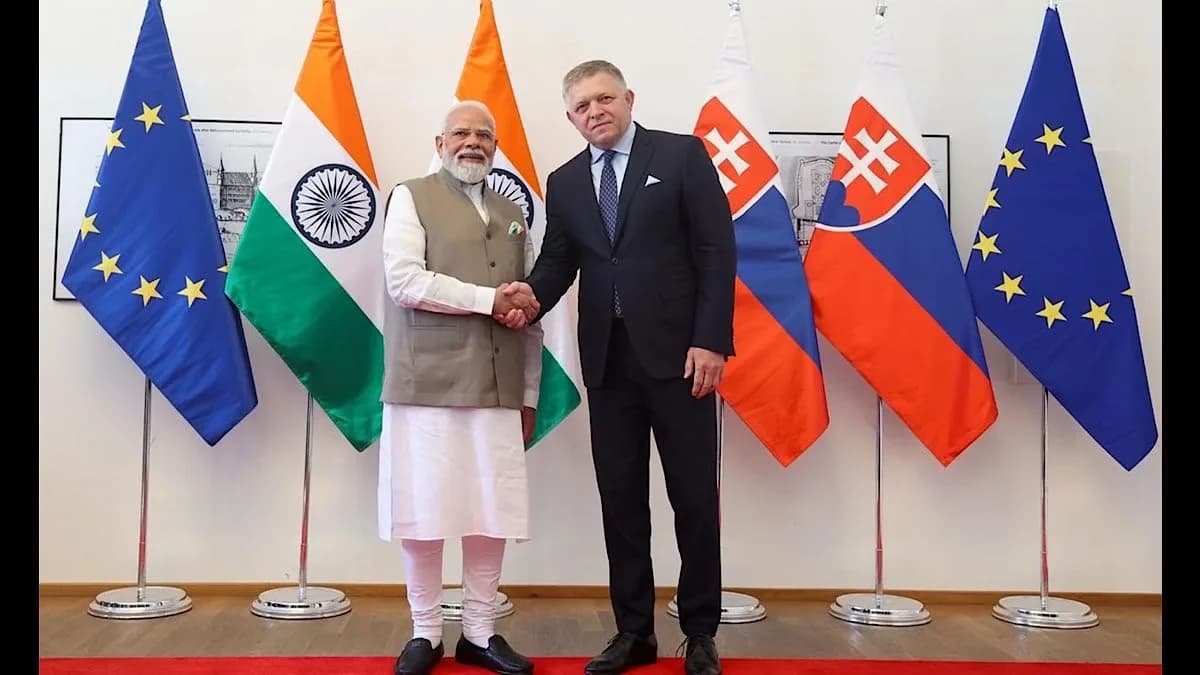
India and Slovakia have elevated their bilateral relations to the level of comprehensive partnership following high-level talks between Prime Minister Narendra Modi and Slovak counterpart Robert Fico. According to reports from PTI, Modi stated that this upgrade symbolizes shared beliefs, shared priorities, and shared future between the two nations. The partnership was formalized during Modi's visit to Bratislava as part of his week-long European tour, marking the first visit by an Indian prime minister to Slovakia since Czechoslovakia split into the Czech Republic and the Slovak Republic in 1993. Slovak Prime Minister Robert Fico described the elevation as a political miracle, congratulating Modi on becoming India's longest-serving elected Prime Minister. As per PTI, Fico praised Modi's enduring popularity and leadership, highlighting the significance of his continued tenure in office, with Modi calling Fico an experienced leader and a true friend of India.
In a significant development, Slovakia backed India's bid for permanent membership in a 'reformed' UN Security Council as the two countries elevated their ties to a Comprehensive Partnership. According to the joint statement issued after talks between PM Modi and his Slovak counterpart, the two sides underlined the need for comprehensive reforms of multilateral institutions, including the UN and UNSC to make them more representative, inclusive and reflective of contemporary geopolitical realities. The leaders stressed the urgent need to expand the Security Council in both permanent and non-permanent categories. As stated in the joint statement, India appreciated Slovakia's continued support for India's permanent membership in a reformed and expanded United Nations Security Council. Modi and Fico reaffirmed their commitment to multilateralism with the United Nations at its core and agreed to coordinate closely in global forums, including the UN. India has long been pressing for permanent membership in a reformed and expanded Security Council, contending that the current structure of the 15-member body is outdated and does not adequately reflect contemporary global realities.
The two countries announced 14 outcomes spanning defence, labour mobility, digital technologies and advanced manufacturing following their comprehensive partnership upgrade. According to Business Standard, Modi and Fico agreed to enhance bilateral trade and two-way investments across sectors such as automobiles, electronics and other advanced manufacturing industries. Modi emphasized that automobiles, railways, advanced manufacturing and green technologies are areas of particular interest to both countries, with the leaders resolving to strengthen cooperation in defence manufacturing, labour mobility and digital technologies. On defence cooperation, the two leaders agreed to strengthen collaboration in defence technologies, research and development, capacity building and defence industrial cooperation. They welcomed the signing of a Letter of Intent on Defence Cooperation and agreed to strengthen cooperation in the protection of critical information infrastructure and in preventing and countering cybercrime. The leaders also expressed their commitment to supporting each other in safeguarding information technology systems against emerging quantum threats to cryptography.
The leaders welcomed the conclusion of negotiations on the India-European Union Free Trade Agreement in January this year and called for its early signing and implementation to unlock new opportunities in trade and investment. According to Business Standard, they agreed to further strengthen the role of the India-Slovakia Joint Economic Committee in identifying and promoting high-potential areas of economic cooperation between the two countries. India and Slovakia agreed to boost cooperation in sectors such as meteorology, hydrology, automotive manufacturing, electronics, railways, clean energy, healthcare, education, space technology and labour mobility. The countries also agreed to further strengthen collaboration in artificial intelligence, semiconductors, start-ups, innovation ecosystems, research institutions and technology companies, Internet of Things (IoT) and machine-to-machine (M2M) applications. They also encouraged exploring direct air connectivity between India and Slovakia to facilitate growing economic, business and people-to-people exchanges.
India and Slovakia agreed to establish a Joint Working Group on Counter-Terrorism and called for strong action against terrorists and entities designated by the UNSC's 1267 Sanctions Committee, as well as their proxies, sponsors, financiers and supporters. According to Business Standard, the leaders strongly condemned the terror attack in Jammu and Kashmir's Pahalgam on April 22 last year, in which 26 people were shot dead by Lashkar-e-Taiba (LeT) terrorists. They also agreed to work closely towards the early finalisation and adoption of the Comprehensive Convention on International Terrorism (CCIT) at the United Nations. The two countries also reaffirmed their commitment to a free, open and rules-based Indo-Pacific, respect for international law and freedom of navigation. Modi and Fico also unequivocally condemned terrorism in all its forms and manifestations, including cross-border terrorism.