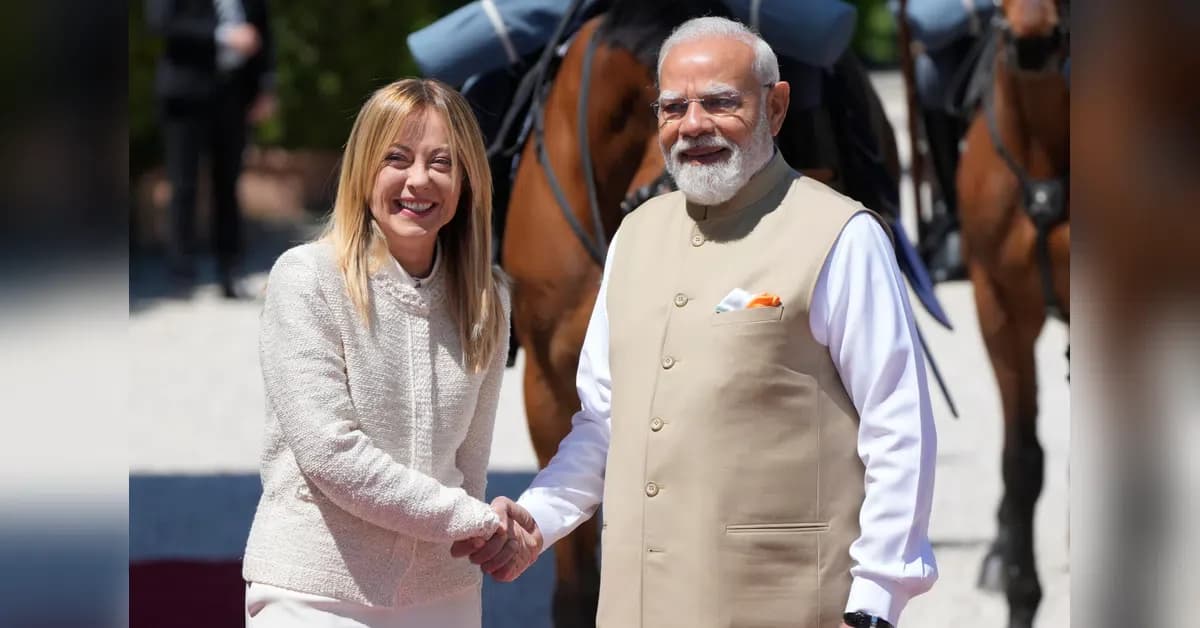
Prime Minister Narendra Modi concluded his visit to Italy, the final leg of his five-nation foreign tour, with India and Italy committing to increase their annual bilateral trade to €20 billion by 2029. According to reports from Business Standard and ETEnergyworld, after talks between Prime Minister Modi and Italian counterpart Giorgia Meloni in Rome, the two countries announced 15 outcomes including an India-Italy defence industrial roadmap for cooperation in defence manufacturing, cooperation in critical minerals, and a pact to facilitate the mobility of Indian nurses from India to Italy. "We deliberated extensively on enhancing India-Italy ties," PM Modi said after the talks, adding that the relationship was now "capable of realising its fullest potential". The announcement came during PM Modi's official visit to Italy at the invitation of Italian Prime Minister Giorgia Meloni, with both sides elevating their bilateral relationship to the level of a "Special Strategic Partnership" signalling a significant expansion of cooperation across trade, defence, technology, connectivity and global governance.
India-Italy bilateral trade stood at €14.25 billion in 2025, with India's exports at €8.55 billion and Italian exports to India recorded at €5.70 billion. As reported by Business Standard, bilateral trade has grown by over 9% from the previous year, with Italy being India's fourth-largest trading partner in the European Union. The latest agreements signed between the two countries include cooperation in critical minerals, agriculture, maritime transport and ports, while committing to strengthen supply chain resilience and cooperation in mineral recovery and recycling. The two leaders also reviewed the Joint Strategic Action Plan 2025-2029, a comprehensive roadmap for cooperation across various sectors including manufacturing, energy transition, mobility and innovation. The two sides decided to establish a Foreign Ministers-led mechanism to review implementation of the India-Italy Joint Strategic Action Plan 2025–2029, adopted during the G20 Summit in Rio de Janeiro in November 2024, and agreed to institutionalise annual meetings between the Prime Ministers, including on the sidelines of multilateral summits, along with regular ministerial and institutional dialogues.
Technology collaboration emerged as a key pillar of the upgraded partnership, with both countries identifying artificial intelligence, quantum technologies, space and civil nuclear energy as strategic areas of cooperation. PM Modi announced the setting up of an India-Italy Innovation Centre aimed at linking startups, research institutions and industries from both countries. The leaders announced the launch of INNOVIT India, an innovation hub aimed at supporting startup collaboration, research partnerships and university cooperation in areas such as artificial intelligence, semiconductors, quantum computing, healthcare, logistics and fintech. The hub is expected to support joint research, university collaboration, talent mobility and start-up acceleration programmes in sectors including fintech, healthcare, logistics, agritech, energy and AI. Both countries also agreed to deepen collaboration in supercomputing, scientific research and emerging technologies, while reaffirming support for a human-centric, secure and trustworthy approach to AI development. India welcomed Italy's participation in the AI Impact Summit held in New Delhi earlier this year.
India and Italy adopted a Defence Industrial Roadmap and a joint declaration of intent to strengthen cooperation in co-development, co-production and defence technology partnerships covering helicopters, naval systems and electronic warfare. The two countries also agreed to launch a maritime security dialogue and examine the feasibility of an annual high-level military dialogue. In the space sector, the leaders committed to expanding cooperation between ISRO and the Italian Space Agency in areas including Earth observation, heliophysics and space exploration. The joint declaration included a strong condemnation of terrorism and violent extremism, with both leaders specifically condemning the April 2025 Pahalgam terror attack and pledging closer cooperation against terror financing and extremist networks. The two sides reiterated commitment to cooperation under multilateral mechanisms including the United Nations and the Financial Action Task Force (FATF) to counter terror financing and dismantle terror infrastructure.
PM Modi thanked Italy for supporting the India-European Union Free Trade Agreement (FTA) and said both sides would work towards its early implementation so that the business community can fully benefit from it. The two leaders welcomed the conclusion of India–EU Free Trade Agreement negotiations and backed stronger India–EU cooperation in trade, technology and economic security. On international issues, India and Italy expressed concern over the conflicts in West Asia and Ukraine, supporting diplomacy and dialogue for lasting peace. Regarding West Asia, the leaders welcomed the ceasefire announced on April 8, 2026, and stressed the need for dialogue, diplomacy and freedom of navigation through the Strait of Hormuz. Regarding Ukraine, India and Italy supported efforts towards a "comprehensive, just and lasting peace" through dialogue and diplomacy in accordance with international law and the UN Charter. The two countries also agreed to expand mobility pathways for students, researchers and skilled workers, particularly in STEM sectors, and discussed mechanisms to facilitate the movement of Indian nurses to Italy. 2027 would be celebrated as the "Year of Culture and Tourism between Italy and India", with plans for cultural forums, exhibitions and cooperation in heritage conservation. Italy also signed an MoU related to participation in the development of the National Maritime Heritage Complex at Lothal in Gujarat, while PM Modi invited Italian universities and institutions to establish campuses in India under the National Education Policy framework.