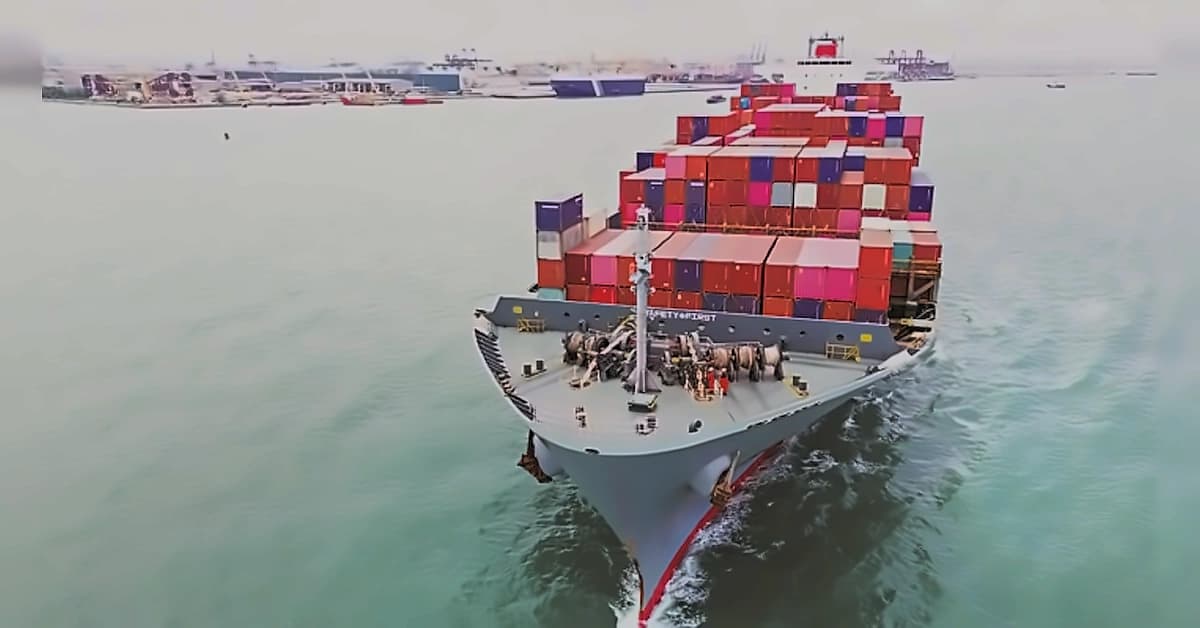
China has achieved a significant milestone in Arctic shipping with Sea Legend shipping company announcing the launch of a regular container service through the Northern Sea Route (NSR) in mid-August 2026. According to The Intel Drop, this marks the first regularly scheduled commercial transit of the Arctic Ocean, with ships sailing from China to Rotterdam in approximately 20 days - roughly half the time of the route through the Suez Canal. The service operates with seven modestly-sized container ships that will operate the route for four months annually, representing a major shift from China's previous exploratory voyages through the NSR. The route's appeal is expected to grow as traditional routes such as the Red Sea and Strait of Hormuz become riskier, making the NSR increasingly viable for commercial shipping.
Major economies including China, India, and Japan are reassessing their trade route dependencies following disruptions to traditional maritime corridors. According to The Times of India, Donald Trump's trade policies, sanctions risks, and ongoing Middle East conflicts have exposed critical vulnerabilities in existing trade routes. The US-Iran war and Houthi attacks in the Red Sea have highlighted the need for alternative maritime connections, with the Northern Sea Route (NSR) emerging as a viable option for Asia-Europe trade. This development comes as the United States struggles to realise its own Arctic shipping options, highlighting the competitive advantage China has gained through its partnership with Russia.

While India, Japan, and South Korea have expressed interest in the Northern Sea Route, China has moved fastest and is already receiving shipments through the route. As reported by The Times of India, traders are anticipating that China will step up shipments if Iranian oil supplies remain disrupted due to Middle East conflict. The NSR reduces travel time to China by approximately two weeks compared to traditional routes, with China's ports being closer to Russia's Far Eastern export terminals. For China, the route is reduced from 40 days via Suez Canal to just 18 days to the United Kingdom. China's new Arctic service builds on this foundation, offering approximately 40% reduction in travel time to Europe compared to traditional routes.
The NSR operates under Russia's de facto control, with Moscow not considering it an open international waterway and controlling the bulk of the route through permits and fees collected by state nuclear company Rosatom. According to The Intel Drop, China now implicitly acknowledges and legitimises the Russian position by complying with Russia's required fees and permits through its new commercial service. This represents a significant shift from previous exploratory voyages, where China's access depended heavily on Russia's goodwill. The route's appeal lies in its ability to be scheduled, priced and repeated, making it integrable into supply chains and reducing the operational risks that previously limited commercial viability.
The development underscores a significant disparity in Arctic shipping capabilities, with Russia operating the world's largest icebreaker fleet of more than 40 polar vessels while the United States has just one functioning heavy icebreaker and one medium icebreaker. As reported by The Intel Drop, the US is attempting to address this gap through a $6.1 billion contract with Finland for 11 medium icebreakers, with seven to be built in the US and four in Finnish shipyards. This infrastructure gap illustrates how China's lead is derived from its industrial capacity in shipbuilding and drones, while the US lacks the industrial base required for strategic Arctic operations. The disparity in icebreaker capabilities demonstrates how China's new Arctic shipping route is not only a result of its geography, but a consequence of Russia's dependence on China and of Chinese economic and industrial muscle.