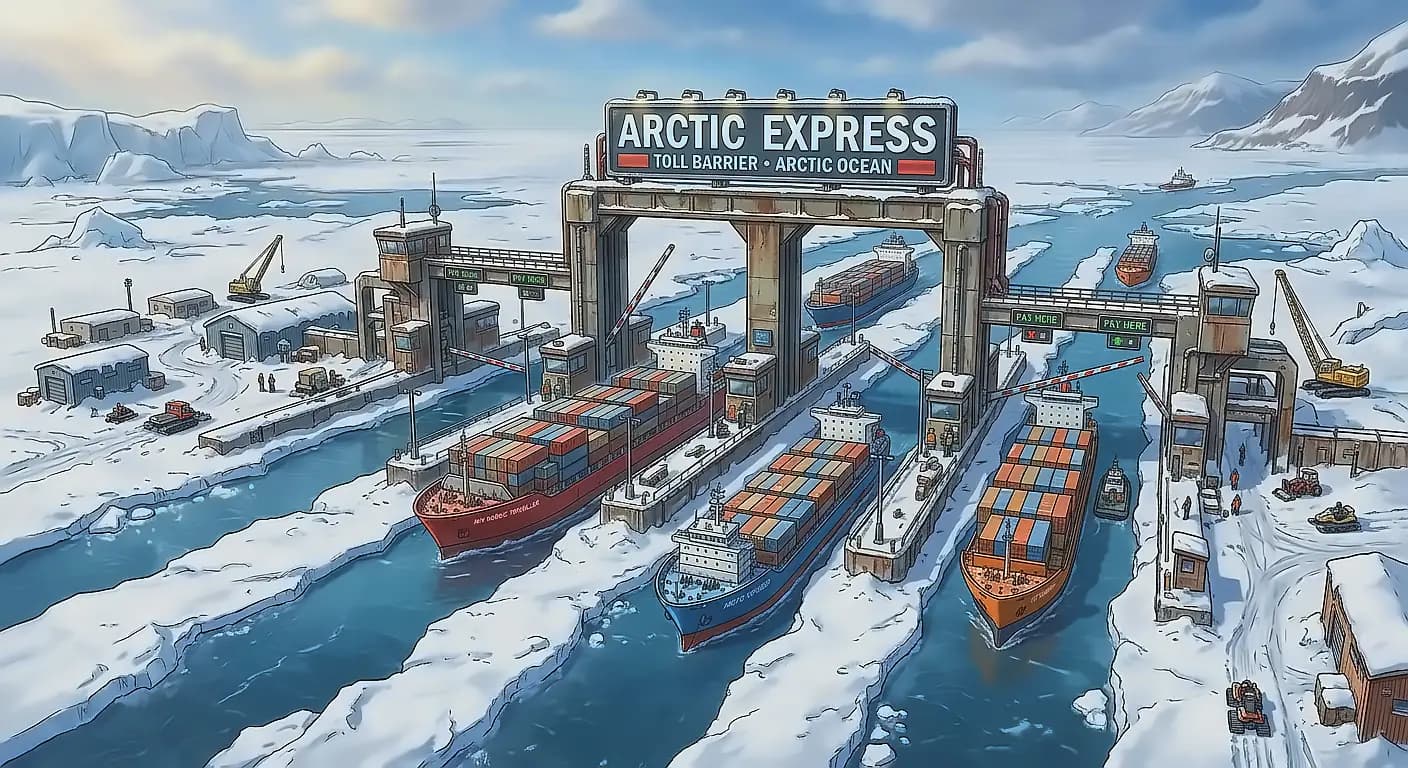
China has advanced from trial voyages to regular weekly operations on the China-Europe Arctic Express, demonstrating the route's commercial maturity. The service now includes eight fixed weekly sailings through October 3, with target transit times of about 20 to 22 days - a significant improvement from the initial 20-day journey that cut Asia-Europe shipping from approximately 40 days to 20 days. According to Global Times, this represents a major milestone as the route enters regular weekly operations during the summer season in 2026. The company's vessel Dubai Tower continues sailing from Ningbo-Zhoushan Port to Felixstowe covering roughly 5,600 kilometres through Arctic waters, with the route particularly suitable for temperature-sensitive cargo including electric vehicles, lithium batteries and solar products.
South Korea has launched its first commercial trial of Arctic shipping with the PanStar Acro, carrying 837 TEU of cargo including auto parts, chemical products and approximately 100 empty containers on a government-backed voyage. According to Reuters, the ship has total capacity of 2,758 TEU and is scheduled to stop in Felixstowe in the United Kingdom, Rotterdam in the Netherlands and Gdańsk in Poland before returning to South Korea. The full voyage is expected to take approximately 40 to 45 days, representing a 35% reduction in travel time compared with the traditional Suez route. This initiative is part of a broader strategy under President Lee Jae Myung to strengthen Busan's position as a global logistics hub, with officials looking toward 2030 as a potential horizon for routine use.
Despite recent Western media reports suggesting 'competition' between China and South Korea in Arctic shipping, industry experts emphasize that the route's demanding operating conditions make cooperation more beneficial than competition. The Arctic route features volatile sea ice, a seasonal navigation window and scarce supporting maritime resources, making its development far more challenging than traditional sea routes. As reported by Global Times, every country's technological investment, trial navigation practice and operational experience contribute to the global accumulation of Arctic maritime knowledge, continuously improving the overall safety and commercial maturity of the Arctic route. While China and South Korea are advancing at different paces - with South Korea just launching its first commercial container ship trial and China progressing to regular weekly service - the high technical and operational thresholds ensure that every country's contribution benefits the entire Arctic maritime community.
Two converging forces have made the Arctic route commercially viable for the first time. Retreating Arctic ice is extending the summer navigation season and reducing the need for specialised ships designed to clear sea ice paths. Additionally, Houthi attacks in the Red Sea since 2023 have forced many ships to avoid Suez and sail around the Cape of Good Hope instead, adding considerable distance and fuel consumption. The US-Iran conflict has disrupted traffic through the Strait of Hormuz, with Brent crude remaining elevated roughly 25% above pre-war levels by mid-August. The International Energy Agency expects global oil supply to remain below near-normal levels until early 2027, directly impacting bunker fuel costs for commercial ships. Russia's state nuclear corporation Rosatom, which oversees the NSR, has issued permits for seven Chinese vessels to use the route to Europe, as reported by ChinaScope. The PanStar Acro voyage is ultimately not about one shipment but about testing whether businesses can eventually rely on the route, with South Korea effectively saying that China should not be the only major East Asian trading power building experience in the Arctic.
The Arctic shipping development creates complex geopolitical dynamics as Russia, China, and South Korea compete for control of the most commercially viable Arctic corridor. For Russia, success does not necessarily require filling the Northern Sea Route exclusively with Russian cargo, as foreign companies treating the route as legitimate commercial infrastructure makes it more difficult to isolate Russia from Arctic economic development. China has incorporated Arctic connectivity into what it calls the Polar Silk Road, essentially a northern extension of the broader network of infrastructure and trade routes Beijing has spent years building across Eurasia. The China-South Korea cooperation narrative demonstrates how climate change is creating extraordinary paradoxes: global warming is opening a trade route that, if heavily used, could contribute to still more warming, as ships emit greenhouse gases and black carbon that reduce ice's ability to reflect sunlight. The commercial proposition is built around this paradox, with the route becoming increasingly navigable because Arctic sea ice is declining, but more traffic also means greater risk of spills and accidents in one of the most environmentally difficult places on Earth to conduct emergency response.