The world is experiencing a fundamental shift in trade policies as major economies respond to geopolitical pressures and supply chain vulnerabilities that emerged during the pandemic. According to reports from Business Standard, this trend has gained momentum with the Russia-Ukraine war and intensified trade and technology competition between the United States and China. The unilateral reshaping of national trade policies has become one of the most significant responses from major trading economies, with a clear divergence from earlier multilateral trade principles now evident in their use of trade instruments. Recent analysis from the 9th Open Shipping Finance 2026 confirms that global competition is undergoing a structural transformation with great powers competing for control over chokepoints, logistics corridors, energy flows, critical minerals, digital infrastructure, and financial systems. Maritime routes are increasingly shaped not only by market forces, but by strategic calculation, with trade corridors being redrawn by the war in the Black Sea, instability in the Red Sea, tensions in the Indo-Pacific, and sanctions regimes against Russia and Iran.
The United States exemplifies this trade policy dualism through its transactional trade deals aimed at pressuring partner economies into submission for political and economic objectives. As reported by Business Standard, while the stalling of WTO Appellate Body appointments began under President Barack Obama, President Donald Trump later used the WTO's consensus principle to render the system defunct. Despite its WTO commitment on 'bound' tariffs, the US has proceeded with unilateral imposition of discriminatory tariffs on all trade partners, including long-standing allies, with trade experts justifying these actions based on 'reciprocity' principles. The latest analysis from 9th Open Shipping Finance 2026 reveals that sanctions, export controls, tariff wars, and investment screening have turned interdependence itself into an instrument of statecraft, fundamentally reshaping how global trade operates. Efficiency is no longer the sole organizing principle - resilience competes with cost, redundancy replaces optimization, and diversification substitutes for concentration in this emerging geopolitical order.
India's experience exemplifies how tariffs are being used to influence foreign-policy choices beyond conventional trade disputes. In 2025, India faced a 25 per cent reciprocal US tariff and subsequently imposed an additional 25 per cent levy linked specifically to India's purchases of Russian oil, taking the headline tariff burden to 50 per cent. The pressure over Russian oil has not disappeared either, with a US Senate bill proposing secondary tariffs of up to 100 per cent on countries buying Russian energy. Meanwhile, economic pressure has coincided with separate tightening of immigration policy, with Washington proposing a $103,265 fee for new H-1B petitions after the earlier $100,000 fee. This is particularly significant for India because Indian nationals accounted for about 71 per cent of approved H-1B beneficiaries in FY2024, or nearly 2.84 lakh people. For Indian exporters, the repeated tariff changes have affected sectors including textiles and apparel, leather and footwear, seafood, gems and jewellery, chemicals and engineering goods. As Vidhu Shekhar from SP Jain Institute notes, "Indian exporters are seeking new markets across Europe, Africa, and parts of Asia, while companies are rethinking supply chains and seeking to reduce concentration risk."
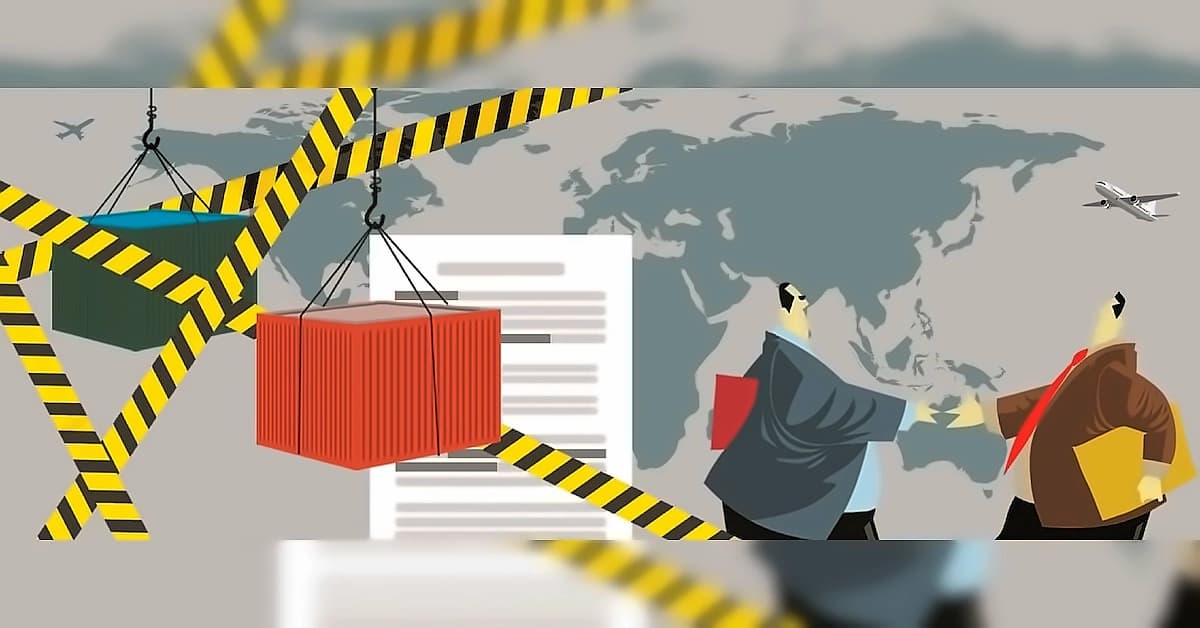
The European Union has shown remarkable flexibility in concluding FTAs over the past two years, including agreements with India, Indonesia, and Mercosur. According to Business Standard, the EU has deviated significantly from its earlier high-standard FTAs with Korea and New Zealand, which previously included strict punitive measures for non-compliance. Simultaneously, the EU is implementing unilateral and discriminatory trade instruments such as the Carbon Border Adjustment Mechanism, which lacks provisions for concessional application for less developed economies under WTO Special and Differential Treatment provisions. Recent research from the Journal of Supply Chain Management Systems indicates that electronics and semiconductor industries reported the highest geopolitical risk exposure (Mean = 4.41), while pharmaceutical firms demonstrated the highest resilience capability (Mean = 4.12), highlighting the practical importance of supplier diversification and reshoring strategies. The study emphasizes that building robust supply chain frameworks will be vital for thriving in an unpredictable geopolitical environment, with practical recommendations for supplier diversification, regionalization, inventory buffering, reshoring, and digital monitoring systems to improve resilience and competitiveness under increasing geopolitical fragmentation.
China has announced it will give up benefits of S&DT provisions in future WTO negotiations and has helped stabilize international oil prices by reducing crude oil imports in Q2 2026. As reported by Business Standard, despite weaponizing its centrality in global value chains and remaining at the core of global excess capacity challenges, China has also assisted other Asian economies in securing scarce oil supplies during the West Asian crisis. This dualistic approach reflects China's efforts to project itself as a responsible global power while maintaining its strategic position. Recent analysis from the Malaysian Journal of Economic Studies 2020 reveals that China's technological prowess is translating into capturing more value added in Southeast Asian supply chains, with revealed comparative advantage indicators showing that ASEAN's middle-income countries are no match for China's technological capabilities. The study highlights that ASEAN's domestic contribution to value added has not gained much over the years, while a rising share of Chinese inputs among intermediate goods imports embodied in ASEAN's exports has seen China displacing other import sources, suggesting China's ability to establish its own supply chains linked to Southeast Asia.