Prime Minister Narendra Modi has announced that India has boarded the Reform Express, a high-speed vehicle of national transformation driven by conviction rather than compulsion. Speaking from the ramparts of the Red Fort on the 80th Independence Day, PM Modi emphasized that "Bharat has also set a very big dream today – a dream backed by firm resolve, a dream of reaching new heights. And that dream is this: when we complete 100 years of independence in 2047, we will have built a 'Viksit Bharat'". The Prime Minister linked India's 2047 ambitions to reforms across manufacturing, technology, defence, infrastructure, green growth and soft power, announcing multi-sector reforms under the guiding vision of 'Sapta Dhara' or a seven-stream strategy. He urged entrepreneurs and conglomerates to pivot around the seven-pronged framework, stating that moving from a passive attitude to proactive, large-scale development was key in achieving goals. The PM emphasized that achieving these goals requires an aspirational society to dream big, with "sankalp" (resolve), "samarth" (capability), and "safalta" (success) as key principles. "The work which has not been done in the last 5-7 decades, we have to do that work in the coming 5-7 years," PM Modi said, describing reforms not as a compulsion but as a matter of conviction.
The first pillar focuses on manufacturing sector, with experts emphasizing cost, quality, and scale as key priorities. AK Bhattacharya of Business Standard noted that the speech carried a clear message that manufacturing, trade and micro, small, and medium enterprises (MSMEs) will be central to the next phase of India's growth. India has signed free trade agreements (FTAs) with nearly 40 countries since 2014, but experts stress the need to use these agreements to build globally competitive businesses. The Prime Minister urged MSMEs to take advantage of the free-trade agreements and bilateral agreements signed with different countries, advocating that all manufacturing firms and service providers adhere to the "reliability, durability, and quality" mantra. He emphasized that "every product and service must reach every corner of the world" with precision manufacturing and zero-defect manufacturing as goals, while "our prices must be competitive, and our product packaging must be attractive". The message from the Prime Minister was clear: "Quality, quality, quality." Anant Swarup of FICCI acknowledged that while government incentives will remain important for manufacturing, they cannot be the only answer, as companies still face challenges around land, approvals, licences and ease of doing business, particularly at the state level.
The third pillar highlighted is technology and innovation, with experts emphasizing AI literacy as a critical requirement for India's workforce development. Varun Modgil of Cognavi India noted that India's large young population can become a major economic advantage only if the workforce is trained for the jobs of the future, with AI and robotics increasingly entering different industries. The Prime Minister's plan to train one crore young people in AI over the next year could therefore become an important part of converting India's demographic advantage into productive employment. HC Mario Schmidt of Lingel Group highlighted the shortage of industry-ready workers, stating that training and skilling programmes need to be strengthened so that workers can enter factories with the skills required by manufacturers. Dhiraj Agarwal of Ambit Investment Managers noted that India has already made significant progress in renewable energy over the past 10-15 years, helping reduce the impact of higher crude prices on the economy. The PM announced that India has to transition to being an innovation hub in AI, robotics, space science, cyber security, defence, and data centres. PM Modi emphasized that India must lead in next-generation communication technology, stating that "Made in India 6G should reach every corner; this should be our goal." PM Modi highlighted the expansion of India's bioeconomy, saying its turnover had risen from ₹60,000 crore before 2014 to ₹20 lakh crore. He also highlighted electric vehicle sales had increased from 1.5 lakh units in 2009-10 to 25 lakh units in 2025-26.
The second pillar identified is agriculture and food processing, with experts emphasizing the need to leverage market-access opportunities created by India's expanding network of free trade agreements (FTAs). AK Bhattacharya stressed that manufacturing and trade are closely linked, with India needing to focus not just on costs but also on quality and scale. The emphasis comes as India seeks to raise the sector's share in gross domestic product (GDP) to 25 per cent by 2035 from around 17 per cent currently. PM Modi defined the second stream as agriculture and food processing and called Indian farmers to access global markets. "The world's markets are now open for our farmers. Due to FTAs, we are gaining access to a very large market. We must reach there," PM Modi said, stressing the need to go "from the farm to the export market." The Prime Minister said traditional cuisine, millets, spices, fruits and flowers and chemical-free agricultural produce could become global brands, provided they meet international parameters. Nirmal Kumar Minda of ASSOCHAM noted that electric mobility will require stronger research and development as well as greater localisation, with automakers and suppliers needing to work together on research and development (R&D) and proof-of-concept projects to build a more self-reliant electric vehicle ecosystem.
The fourth pillar centres on defence self-reliance, with experts calling for greater investment in advanced defence technologies and hypersonic defence capabilities. HC Mario Schmidt noted that Indian manufacturers already have stronger quality standards in some sectors, but awareness about quality products needs to improve. PM Modi highlighted defence power as the fifth strength, stressing the need for self-reliance in the defence sector and for India to emerge as a global supplier of next-generation defence technologies. "There is no alternative to being self-reliant in defence," he said. "We have to become global suppliers. We have to take leadership in hypersonic defence technologies," PM Modi emphasized. He also called for developing drones, counter-drone systems and hypersonic defence technologies, while underlining the growing importance of cyber security. The fifth pillar combines the green and blue economies, with experts emphasizing that India can achieve its renewable and alternative-energy targets for 2047, while also reducing its dependence on imported crude. PM Modi called for India to operate at a global scale in green hydrogen, renewable energy, energy storage, green mobility and green manufacturing, while continuing to provide solutions to global challenges. The sixth stream is Gati Shakti, seeking to improve road, sea, and inland waterways infrastructure, with the PM announcing roadmaps for improves road, sea, and inland waterways under Gati Shakti. PM Modi also called for a focus on port-led development, saying ports should not remain merely places for loading and unloading goods but should become engines of growth.
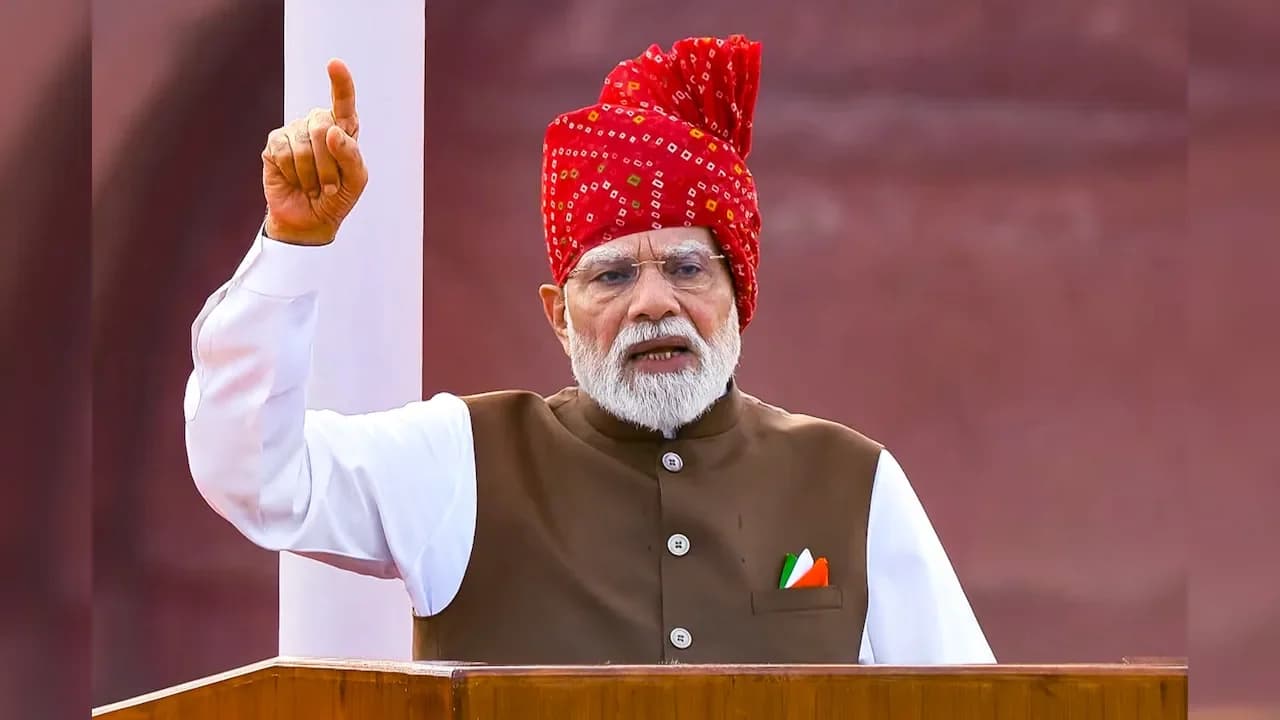
The PM announced specific economic goals for Viksit Bharat, stating that "my goal is to see 50 Indian companies feature among the Fortune 500, Indian banks be among the top three international banks, and Indian ratings, accounting, and pharma companies be counted among the leading international companies in their sectors." He emphasized that the goal of development would be fulfilled only if it reaches each person, prioritising the welfare of the most marginalised and deprived individuals in society. The 2026 speech streamlined specific economic goals, including India's transition to becoming an innovation hub in AI, robotics, space science, cyber security, defence, and data centres. The PM's message was clear: "Reform from conviction, not compulsion" - a call for structural, regulatory, and policy reforms to accelerate the transformation of India's economy and achieve the ambitious 2047 vision. PM Modi stressed that the seven streams should not be viewed as separate sectoral initiatives, adding that India needs to adopt a "holistic approach" to achieve its development ambitions and cross the scale of the targets it has set for itself. "The seven powers of 'Sapta Dhara' are not meant to make progress in just one sector," he said, asserting that the combined strength of the seven streams will help India achieve new heights and accelerate its progress towards the goal of becoming a developed nation.