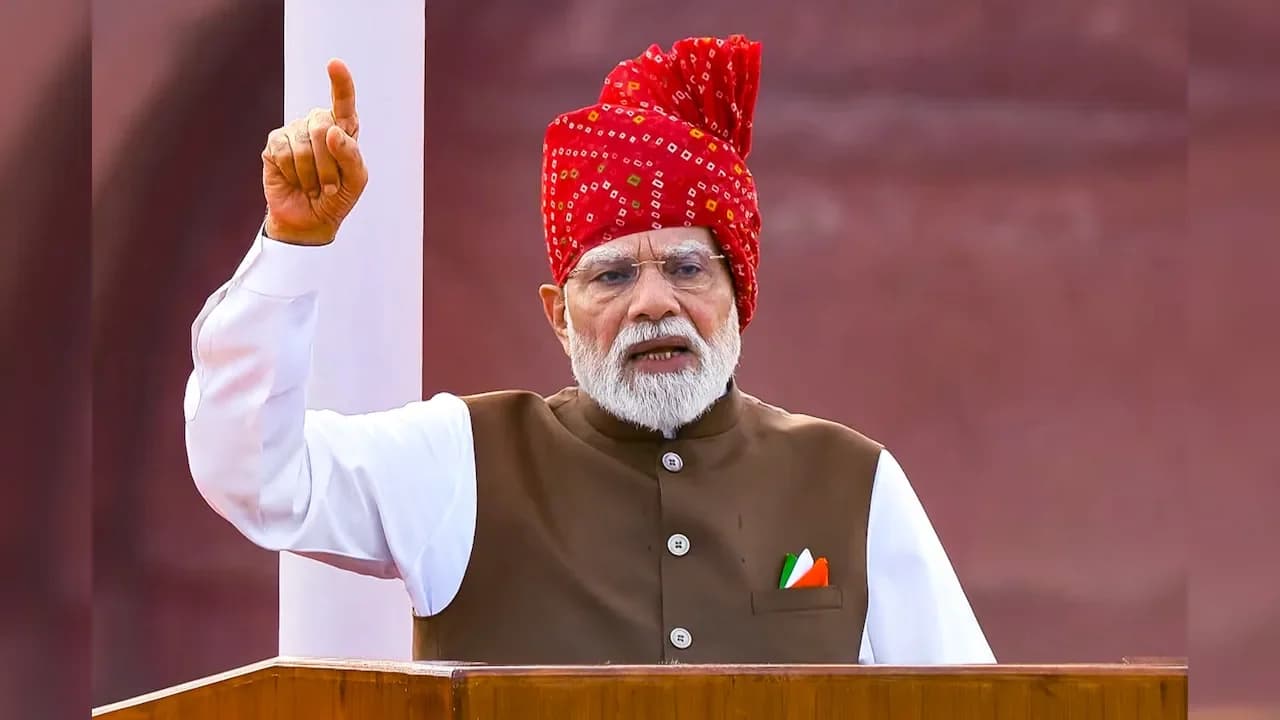
India Inc on Saturday welcomed Prime Minister Narendra Modi's Independence Day address, expressing readiness to translate his announcements into actionable programmes. According to reports from Business Standard, Chandrajit Banerjee, Director General of CII, stated that the address puts people, sustainability and India's global strengths at the centre of the development journey. Banerjee highlighted that Modi's call for Atmanirbhar Bharat, Make in India and Vocal for Local reflects growing confidence to build a self-reliant, future-ready nation that has moved from being among the 'Fragile Five' to the world's fastest-growing major economy in just over a decade. Industry leaders welcomed the Prime Minister's Independence Day address, saying they look forward to working with the government to translate his announcements into actionable programmes to boost investment, jobs, innovation and manufacturing. As reported by Business Standard, Banerjee emphasized that industry shares the prime minister's resolve to build on this momentum and is ready to match it with sustained investment in areas of strategic importance.
In his 13th Independence Day speech from the Red Fort, Prime Minister Modi outlined seven streams (sapta dhara) to drive India forward: manufacturing, power, agriculture and food processing, technology and innovation, gatishakti, defence power, green economy and blue economy, and soft power. As reported by Business Standard, Modi called for developing a vibrant and strong civil defence infrastructure and pitched for making India a global hub for defence manufacturing, placing special emphasis on self-reliance in advanced capabilities such as hypersonic technology and drone systems. The seven-stream 'Sapta Dhara' framework provides a broad-based approach to inclusive, sustainable and accelerated development, as noted by Assocham President Nirmal Kumar Minda. Modi explained that manufacturing power relates to building complete domestic end-to-end value chains, from design to components, focusing on zero-defect quality, cost, and global scale. Under agriculture and food processing, effort should be made to create integrated farm-to-export supply chains for millets, spices, and fruits while transitioning to chemical-free farming. Technology and innovation refers to evolving from a tech market into a global innovation hub leading in AI, Quantum, Space, Robotics, DPI, and Made-in-India 6G. Gati Shakti implies establishing high-speed, seamless multi-modal logistics connecting cities, highways, railways, airports, and modern industrial seaports. Defence 'Shakti' will lead to achieving complete strategic self-reliance by pioneering and exporting next-gen defence technologies like drones, counter-drone systems, and hypersonics.

According to CII's Banerjee, agriculture and food processing stand out as real opportunities with wider market access through FTAs. As reported by Business Standard, he emphasized the need to take farm produce to global markets, building global brands around millets, spices, fruits and flowers. This approach can open new opportunities for farmers and rural enterprises while strengthening India's place in global value chains. Highlighting the prime minister's focus on nuclear energy, semiconductors and the green and blue economies, Banerjee noted these sectors point to where India's next decade of growth will come from, while recognition of India's soft power adds a fresh dimension to global economic presence. The prime minister announced that India will start five nuclear reactors as the country steps up efforts to develop alternative energy sources and reduce its reliance on imports. Modi announced that India will spend ₹85,000 crore in deep-sea exploration and has already set up three semiconductor plants with production already being exported, with plans for eight more chip plants in the next seven to eight years. Modi also highlighted that India has taken a step towards becoming self-reliant in the nuclear power sector, with the Prototype Fast Breeder Reactor (PFBR) at Kalpakkam, Tamil Nadu, attaining criticality this year. The government has allowed private firms to build and operate atomic power projects as it pursues an ambitious goal of expanding nuclear power capacity eleven-fold to 100 gigawatts by 2047.
Modi emphasized the need for complete product development from design to manufacturing in the manufacturing sector, calling for both small and big products across the entire value chain. As reported by Business Standard, he stressed the importance of cost, quality, and scale while meeting global standards, with the prime minister noting that we want to create for the entire value chain, from components to big manufacturing. The government is working on FTA agreements with 40 countries, which Modi described as a big opportunity for MSMEs to reach global markets. He highlighted that seafood export opportunities have increased from Keralam to Gujarat and Tamil Nadu to Bengal, and urged Indian products to meet global standards while improving on what is available internationally. Modi also announced that India aims to start five nuclear reactors as the country steps up efforts to develop alternative energy sources and reduce its reliance on imports. The PM said that 50 Indian corporations should be in the Fortune 500 companies within the next decade, emphasizing that the Centre, state governments, and institutions of local self-government must accelerate the pace of their reforms for this to happen.
Modi announced significant education reforms, stating that nearly 650 new universities had been added over the past 10-12 years, bringing India close to the milestone of 1,000 universities compared to fewer than 350 universities between 2004 and 2014. He highlighted that the number of medical colleges had more than doubled since 2014. The prime minister announced free online coaching for aspirants preparing for competitive exams to ease financial burden on families, and said 1 crore youths will get training in Artificial Intelligence in the next one year. Modi also announced a nationwide talent hunt to train children aged 5-15 for the 2036 Olympics, emphasizing that youth will play a crucial part in these reforms. He noted that over 10,000 Atal Tinkering Labs have been made for children and highlighted that Indian youth launched their own satellite, this is a big achievement. Modi also urged political parties to help in implementing 33 per cent reservation for women in the Parliament and Assemblies.