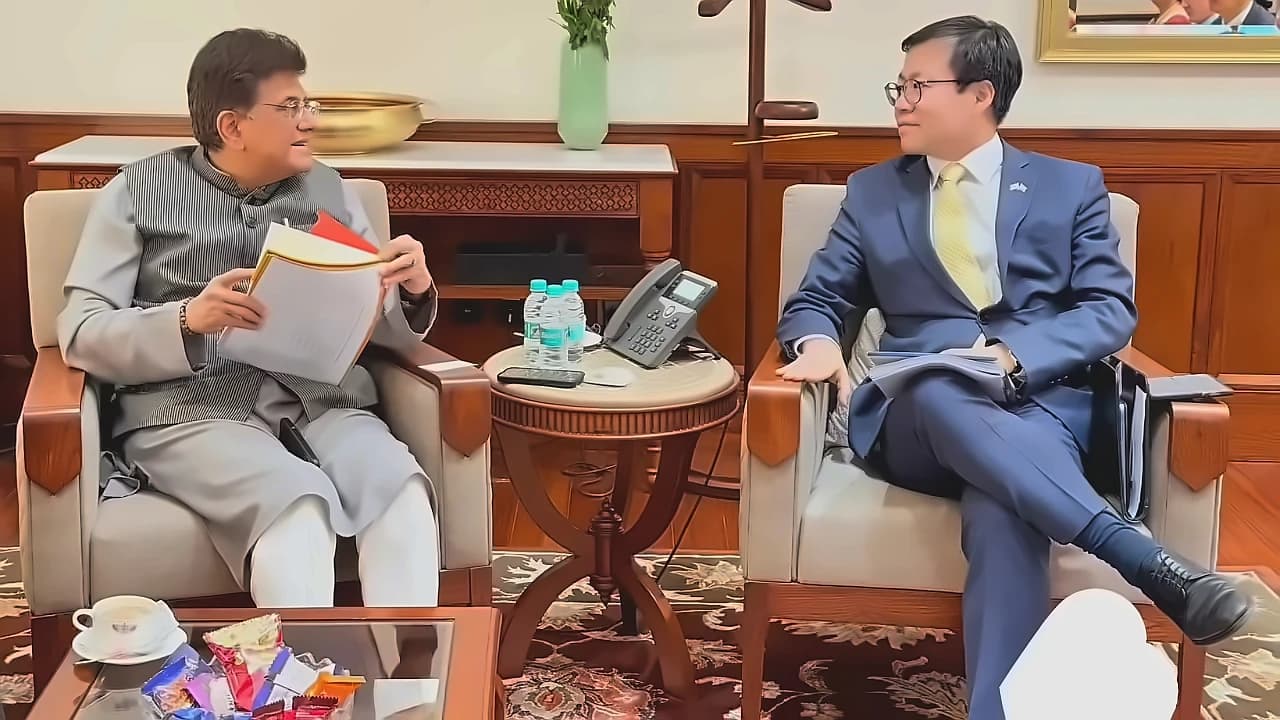
India and South Korea have successfully concluded the 12th round of negotiations to upgrade their bilateral trade pact, with South Korea committing to address India's growing trade deficit. The three-day negotiations from May 25-27, 2026 took place in New Delhi, following an agreement reached in April between Union commerce and industry minister Piyush Goyal and Korean trade minister Yeo Han-koo during the South Korean President's state visit to India. According to the Commerce Ministry statement released on Thursday (May 28, 2026), both sides acknowledged India's bilateral trade deficit, which has risen significantly since the IK CEPA came into force in 2010, and agreed to address the issue within the overall IK CEPA framework. The discussions covered trade in goods, trade in services, investment, sanitary and phytosanitary standards, rules of origin and origin procedures, with the negotiations co-chaired by Ms. Kapil Chaudhary, Joint Secretary, Department of Commerce, Ministry of Commerce and Industry, Government of India, and Mr. Park Geun-oh, Director General for Trade Agreement Policy, Ministry of Trade, Industry and Energy (MOTIE), Republic of Korea.
Both sides have reaffirmed their commitment to conclude the CEPA upgrade negotiations in a time-bound manner to achieve a modernised and mutually beneficial agreement that supports the shared vision of balanced bilateral trade and enhanced cooperation. The move is significant as India seeks to strengthen supply chain resilience and deepen industrial partnerships amid global geopolitical uncertainties and efforts by multinational companies to diversify manufacturing bases. South Korea remains one of India's key economic partners in East Asia, as Korean companies have a strong presence in automobiles, electronics and mobile phone manufacturing. The latest round was held from May 25-27, 2026, pursuant to the Joint Declaration signed on April 20, 2026 by Union Minister of Commerce and Industry Shri Piyush Goyal and Korean Trade Minister Mr. Yeo Han-koo during the State Visit of the President of the Republic of Korea to India.
Both sides have agreed to create sub-groups to expand discussions into newer areas such as digital trade, supply chain cooperation and strategic industrial cooperation, signalling efforts to widen the scope of the agreement beyond conventional tariff issues. As reported by officials familiar with the discussions, India is seeking greater market access for labour-intensive sectors and services exports while pushing for tighter rules of origin to prevent misuse of tariff concessions through third countries. South Korea is understood to be seeking improved investment protections and greater policy predictability for Korean firms operating in India. The move aligns with India's efforts to strengthen supply chain resilience and deepen industrial partnerships amid global geopolitical uncertainties and efforts by multinational companies to diversify manufacturing bases.
India's trade deficit with South Korea has expanded significantly since the CEPA implementation in 2010, with the latest figures showing the deficit has grown substantially. India's trade deficit with South Korea stood at $15.6 billion in 2025-26, compared to $5.1 billion in the financial year ended March 2010. In 2025, India had a trade deficit of $15.15 billion with South Korea, with merchandise imports worth $21.16 billion and exports of $6 billion. The deficit was primarily driven by electrical machinery and equipment, iron and steel, nuclear reactors, mechanical appliances, mineral fuels, and organic chemicals. Indian officials have increasingly expressed concern over the growing trade imbalance in favour of South Korea, particularly in sectors such as electronics, machinery and petrochemicals.
Officials said more rounds of negotiations are expected in the coming months as both countries work towards finalising a modernised CEPA aimed at correcting trade imbalances while boosting investment and economic cooperation. The negotiations are aligned with the broader "Futuristic Partnership" vision outlined by Prime Minister Narendra Modi and South Korean President Lee Jae-myung during recent bilateral engagements. The India-Korea CEPA was originally signed in 2009 and implemented from January 2010 to boost bilateral trade and investments, but the current upgrade negotiations reflect the need to address evolving economic realities and strengthen the partnership for mutual benefit.