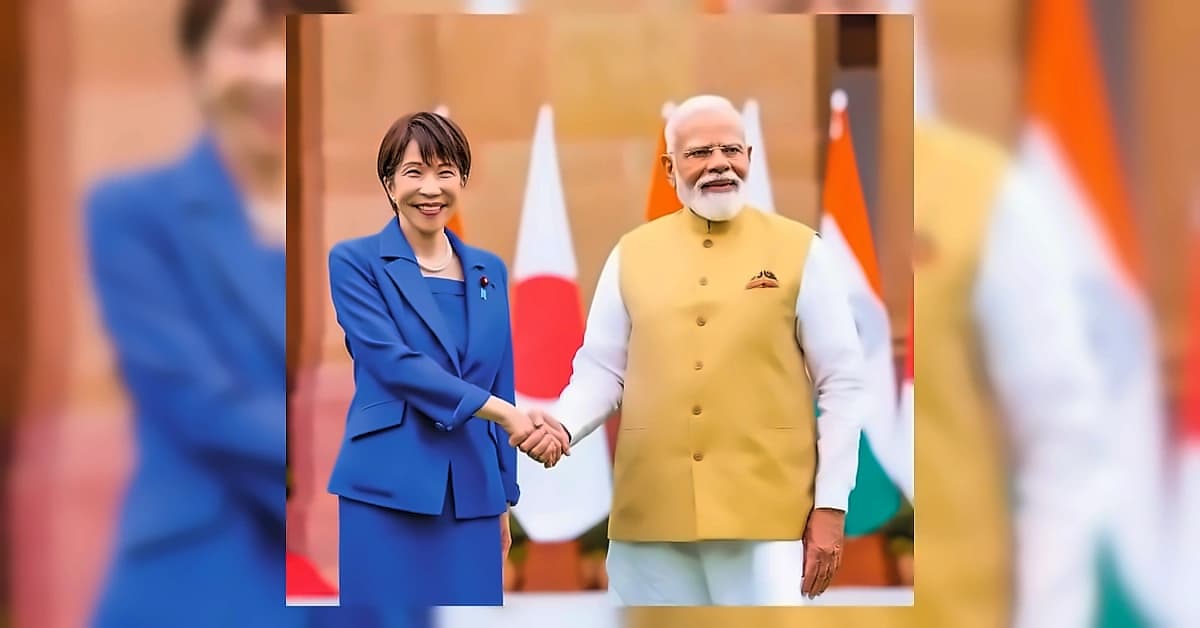
India and Japan took their trade and strategic partnership to new heights on Thursday, signing a Memorandum of Cooperation (MoC) during the 16th India-Japan Annual Summit at Hyderabad House in New Delhi. As per The Times of India, the MoC was signed in the presence of Prime Ministers Modi and Takaichi following delegation-level talks aimed at expanding strategic and global cooperation between the two countries. PM Modi welcomed the Japanese leader, calling her Japan's first female Prime Minister and a visionary, popular leader, while noting that she hails from Japan's Nara Prefecture, a vital center of the shared Buddhist heritage between India and Japan. The Prime Minister emphasized that "Today, both India and Japan are among the world's largest economies" and highlighted their shared priority of "a free, prosperous, and rules-based Indo-Pacific." The Takaichi-led delegation, which includes 50 Japanese business leaders, held talks with Indian leadership, with executives from companies including Suzuki Motor, Itochu and Toyota Tsusho participating in the discussions. According to NDTV Profit, nearly 120 cooperation agreements between Indian and Japanese companies, including investments worth around 2 trillion yen, were announced during the visit. The Prime Minister's Office will now organize a dedicated Japan Business Week to further improve the ease of doing business in India, with senior PMO officials engaging directly with Japanese businesses to understand their concerns and identify ways to improve the investment climate. PM Modi has now confirmed that India can surpass the 10 trillion yen investment target in a decade, demonstrating the growing momentum of bilateral economic cooperation.
The summit resulted in significant investment commitments, with PM Modi announcing that over 120 new business agreements have been concluded in the past year, which will bring over $10 billion in Japanese investment to India. As reported by The Times of India, the Prime Minister stated that "Today's agreement between the Financial Services Agencies will further facilitate the flow of capital and investment" and emphasized their goal to "attract 10 trillion Yen in investment from Japan to India and to double the number of Japanese companies operating in India over the next decade." Modi highlighted that "Continuous reforms in India have improved the ease of doing business, an opportunity that Japanese companies can also leverage." The agreements came as the Takaichi-led delegation, which includes 50 Japanese business leaders, held talks with Indian leadership, with executives from companies including Suzuki Motor, Itochu and Toyota Tsusho participating in the discussions. According to NDTV Profit, nearly 120 cooperation agreements between Indian and Japanese companies, including investments worth around 2 trillion yen, were announced during the visit. The Prime Minister's Office will now organize a dedicated Japan Business Week to further improve the ease of doing business in India, with senior PMO officials engaging directly with Japanese businesses to understand their concerns and identify ways to improve the investment climate. PM Modi has now confirmed that India can surpass the 10 trillion yen investment target in a decade, demonstrating the growing momentum of bilateral economic cooperation.
Japan has announced around ₹1 trillion investment plans for India through various projects spanning multiple sectors including auto, renewable energy, semiconductors, AI, and quantum technologies. As per The Times of India, some of the major projects include Daikin's R&D facility worth ₹10 billion, Sumitomo Corp's comprehensive collaboration valued at ₹38 billion, Itochu Corporation and L&T's green ammonia project at Kandla Port worth ₹189 billion, and Sumitomo Corp's renewable energy investments of ₹100 billion. The partnership also includes TOYOTA's new plant in Bidkin area with annual production of 1 lakh vehicles and 2,800 jobs, MUFG and Shriram Finance's ₹400 billion collaboration, SMBC and Yes Bank's ₹170 billion partnership, and Japan Bank for International Cooperation's survey ranking India as the most promising destination for Japanese businesses for four consecutive years. Additionally, cooperation has deepened across sectors including semiconductors, AI, and quantum technologies, with major investments in biogas and green ammonia projects. During the summit, the two sides inked an agreement on the first co-development project in the defence sector, with Modi stating that "This project for a naval radio antenna will open a new chapter in our defence technology partnership."
India and Japan have agreed to cooperate on strategic petroleum reserves, maritime energy transport and upstream investments to strengthen energy resilience amid geopolitical uncertainty. As per Business Standard, India's Ministry of Petroleum and Natural Gas (MoPNG) and Japan's Ministry of Economy, Trade and Industry (METI) agreed to cooperate in developing a strategic petroleum reserve ecosystem and joint investments across the maritime energy transport value chain. The two leaders expressed their intention to work together as major energy-consuming countries in Asia to strengthen energy resilience in light of the current geopolitical situation. "The two sides reaffirmed the importance of sharing their respective knowledge and experience and, where appropriate, promoting concrete cooperation related to stockpiling systems and reserve mechanisms for crude oil and petroleum products," the MoPNG stated. The cooperation will focus on mechanisms related to national stockpiling systems and reserves, including industry stockpiles, coordination regarding arrangements with producing countries, and emergency response and market stabilisation. On energy security, Modi announced that "Under the India-Japan Bio-gas Initiative, Japan will support the establishment of 1,000 bio-gas and organic fertiliser plants in India," which will promote sustainability, boost prosperity and strengthen rural livelihoods across Indian villages. The partnership also includes IHI and ACME's 4 lakh tons of green ammonia production worth ₹295 billion, Mitsubishi Gas Chem and ACME's green methanol project of 1 lakh ton worth ₹90 billion, and JFE Steel and JSW's integrated steelworks worth ₹160 billion. Modi noted that "Furthermore, our cooperation in batteries, green hydrogen and nuclear energy will make a vital contribution to the world's clean energy future."
Technology cooperation emerged as a key focus of the summit, with PM Modi emphasizing that "both countries see it as the strongest pillar of their future partnership." The two sides issued a joint statement on artificial intelligence, while several leading institutions from India's AI ecosystem signed agreements with their Japanese counterparts. Highlighting the potential of collaboration, Modi said that "the convergence of Japan's precision technology and India's software capabilities will impart new momentum and strength to global AI development." The roadmap focuses on joint development of vertical AI solutions for sectors such as manufacturing, healthcare and mobility, with expanded collaboration on large language models, AI governance, joint research, AI safety and cybersecurity. Separately, Tokyo is expected to facilitate the movement of 500 highly skilled Indian IT professionals to Japan by 2030, with Modi stating that "We have also taken a significant initiative regarding energy resilience to tackle situations like oil shocks." According to The Times of India, the collaboration is aimed at building a "futuristic and limitless" relationship while accelerating investment, technology cooperation and supply chain resilience across multiple sectors.
Addressing business leaders at the India-Japan Joint Economic Forum, PM Modi acknowledged India's economic resilience despite global challenges, stating that "India is the world's fastest-growing major economy. Our GDP grew by 7.7 per cent in the last financial year. Over the past 12 years, we have transformed our economic DNA by embracing the philosophy of Kaizen, or continuous improvement." He emphasized that "Recently, we introduced next-generation reforms in taxation, governance and ease of doing business. We are opening every sector to private participation, and in many areas we are providing incentives." The Prime Minister noted that "For the last four consecutive years, the Japan Bank for International Cooperation's survey has ranked India as the most promising destination for Japanese businesses." Modi acknowledged ongoing global economic challenges, including supply chain disruptions, trade uncertainty and weak global demand, but stressed that "India has remained resilient." Highlighting the growing economic partnership, Modi said that "In today's uncertain global environment, India and Japan both recognise the critical importance of economic and energy security. Keeping this in mind, we have prepared a joint roadmap on economic security that will enhance supply chain resilience in strategic sectors, including semiconductors, quantum technology and advanced materials." The two leaders also reviewed developments in the Indo-Pacific, where China's growing military presence has emerged as a key concern, with Modi stating that "Today, India and Japan are among the world's largest economies. A free, prosperous and rules-based Indo-Pacific remains a shared priority for both countries." The two sides noted the convergence of Japan's updated Free and Open Indo-Pacific (FOIP) policy and India's Indo-Pacific Oceans' Initiative (IPOI) and Mutual and Holistic Advancement for Security and Growth Across Regions (MAHASAGAR).
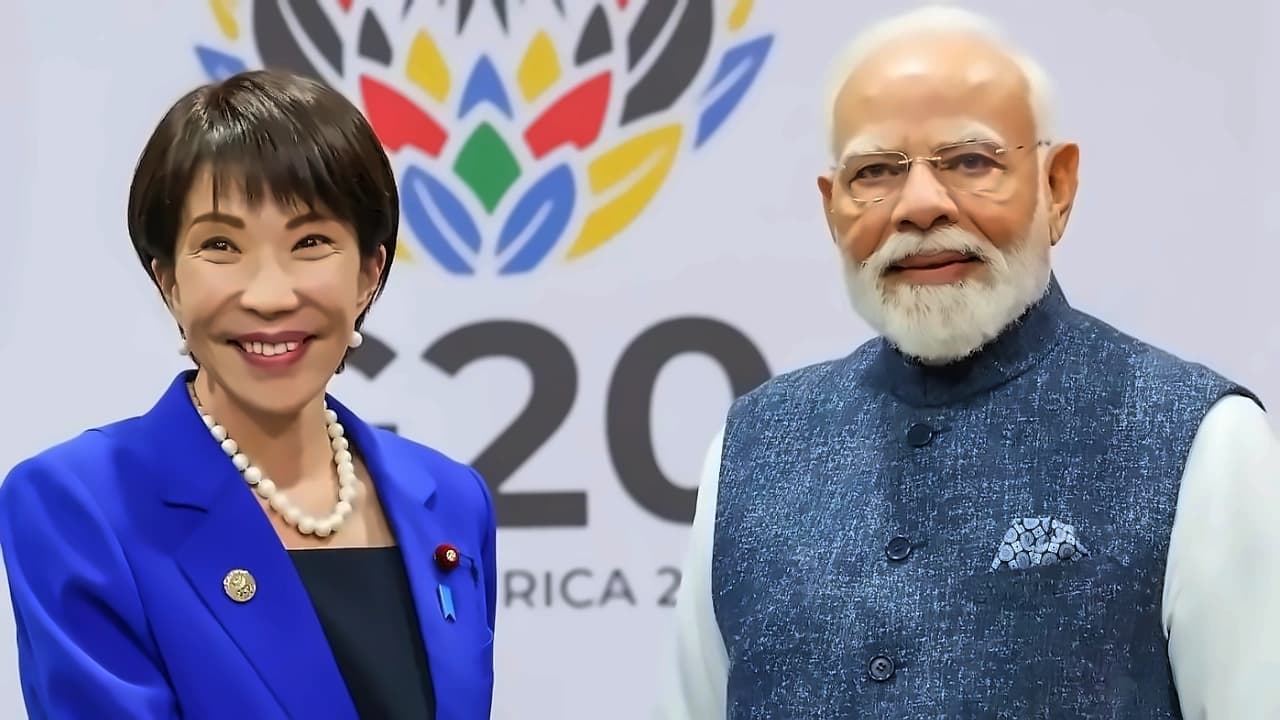
During their discussions, Modi welcomed Japan's review of the Three Principles on the Transfer of Defence Equipment and Technology and expressed hope that it would further deepen the defence partnership between the two countries. The two sides agreed to expedite the Unified Complex Radio Antenna (UNICORN) project and finalized a mobility framework to facilitate cooperation in shipbuilding, aviation and logistics. Modi said that "We have also taken a significant initiative regarding energy resilience to tackle situations like oil shocks." The two sides resolved to strengthen cooperation in energy security, AI, defence, supply chains, mobility and investments while advancing economic resilience and Indo-Pacific stability. They agreed to build more resilient supply chains to reduce dependence on China for critical minerals and active pharmaceutical ingredients (APIs) and on West Asia for their energy needs. The two leaders also reiterated the importance of ensuring unimpeded freedom of navigation and the uninterrupted flow of global commerce, including through the Strait of Hormuz. Modi began his address by referring to Takaichi as "meri chhoti behen," or my younger sister, and hailed her as a "visionary and popular leader." Takaichi responded by saying "The small meeting before and the big meeting... we confirmed that we are on the same page to develop this relationship as brother and sister."