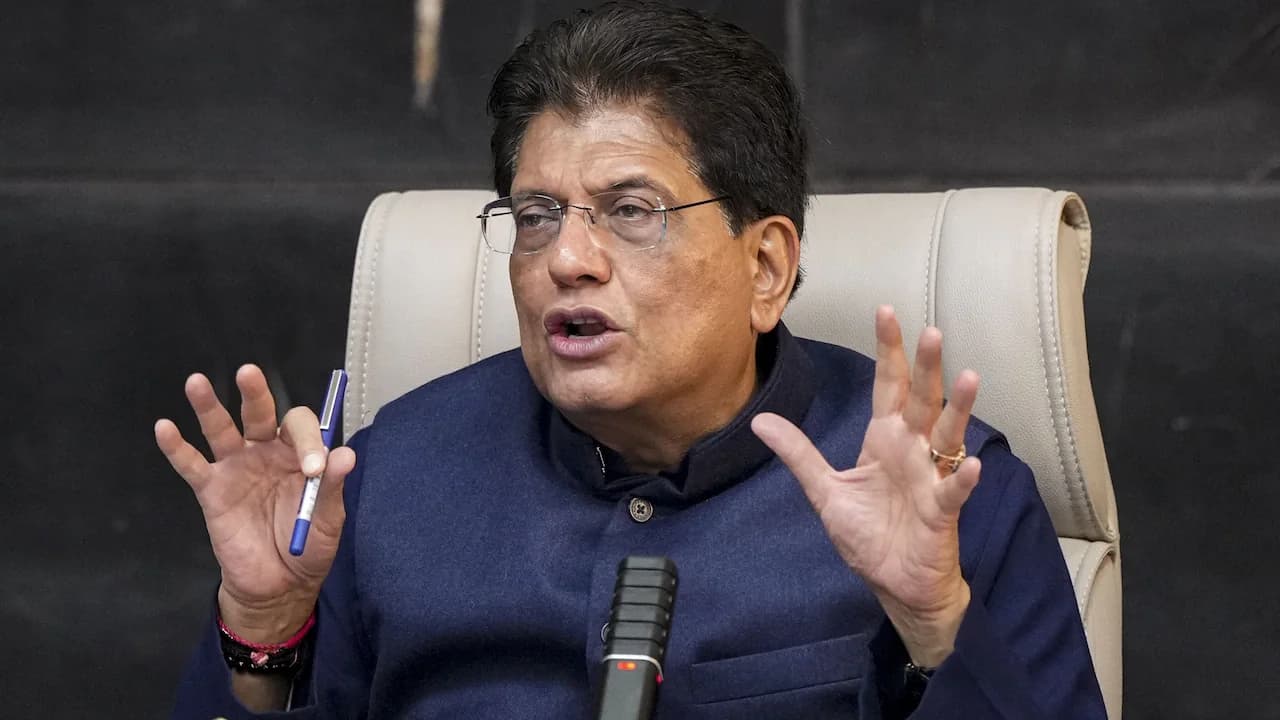
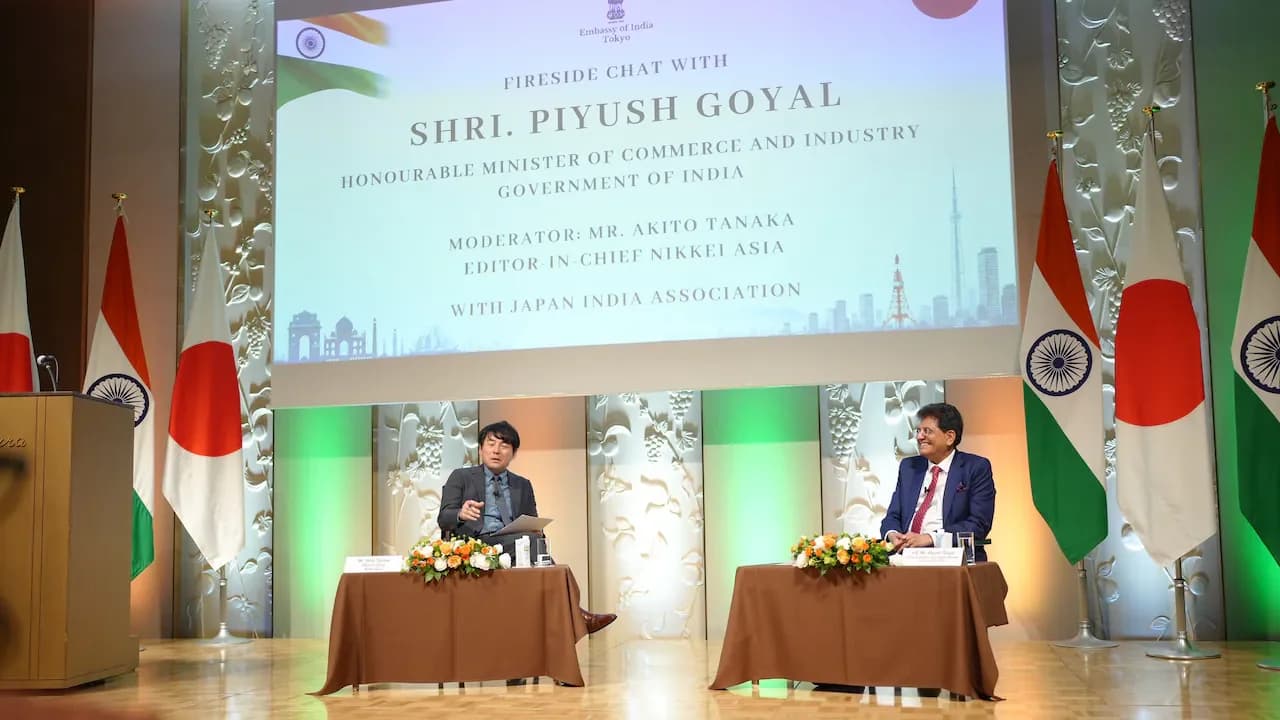
Union Minister of Commerce and Industry Piyush Goyal announced that the Bureau of Indian Standards (BIS) has been directed to outline a framework for exemption of BIS certification to support hi-tech industries. At the semiconductor and artificial intelligence roundtable in Tokyo, Japan on Tuesday, Goyal stated, "I have noted some of the concerns that were flagged today. The concerns about BIS certification. I'm happy to share with you that we have taken action yesterday itself. We have already instructed BIS and the Ministry of Commerce and Industry to work on a framework to support high-tech industry, not necessarily only Japanese companies, but high-tech industries coming in to promote the Make in India program, to create a framework of exemption from BIS certification required for all the equipment and components that they need to bring to India to promote their manufacturing in India." The Minister emphasized that "It's a very logical step, given that companies that come to make high-quality semicon products are going to get high-quality products into the country. You are not going to compromise on quality even if it comes cheaper."
The proposed framework is specifically designed to support overseas companies looking to manufacture high-tech products in India, as revealed by Commerce Minister Piyush Goyal. The plan follows Japanese semiconductor manufacturer Tokyo Electron's Corporate Officer and Executive Vice President Takeshi Okubo flagging concerns about BIS certification to Goyal on Monday. Goyal emphasized that "We will be creating a framework which will either give company-level or industry-level exemptions. We will work on the framework as I get back to India and find a solution for bulk exemption or product- or project-based exemption or company-based exemption." The objective is to ensure timely availability of equipment, goods and services for high-tech companies setting up manufacturing operations in India and support the government's 'Make in India' initiative. The move would be particularly relevant for semiconductor companies requiring specialized equipment and components.
BIS Certification is currently a mandatory legal requirement for hi-tech, IT, and electronic hardware industries, as administered by the Bureau of Indian Standards. Goyal highlighted that the government will work towards providing bulk, product, project or company-specific exemptions from BIS certification. The Minister noted that states across political affiliations are aligned on this issue, indicating broad government support for the initiative. Uncertainties about certification norms arise principally on account of quality-control orders (QCOs), which have grown rapidly from 70 to 790 between 2016 and 2025, according to a reported NITI Aayog assessment. Nearly 70 per cent of QCOs concern raw materials, intermediates or capital goods rather than finished products, making them uniquely disruptive as they prevent manufacturing, import, sale or handling of products without BIS standard certification under valid licence. The fact that the BIS statute is mandated by different ministries and the process can take up to six months adds to investment complexities.
The Global Trade Research Initiative (GTRI) has called for a comprehensive review of India's quality control orders (QCOs) to address growing concerns about trade barriers. As per GTRI Founder Ajay Srivastava, "Mandatory quality certification under these orders raises costs, hurts MSMEs and makes goods more expensive." The think tank emphasized that if other countries adopt similar orders, Indian exporters could be forced to obtain separate country-specific certifications even when their products already meet recognised international standards, and bear huge travelling and per-diem costs for visiting officers, licensing, renewal and testing fees. This would raise export costs, delay shipments and create new barriers to trade. GTRI noted that as per a Japan External Trade Organization (JETRO) survey for fiscal 2025, 71.9 per cent of Japanese manufacturers in India said BIS certification had affected, or was expected to affect, their operations. The initiative calls for "a top-level review to ensure that QCOs protect consumers without becoming import restrictions or licensing barriers."
Speaking on both countries' collaboration in the semiconductor space, Goyal emphasized the natural alliance between India and Japan in building a trusted and resilient global semiconductor industry. Goyal stated that India's semiconductor demand is expected to grow to $150 billion by 2032. The Union Cabinet has approved Semicon 2.0 for the development of India's semiconductor design and manufacturing ecosystem, with a total budget outlay of ₹1,27,500 crore. Goyal noted that "Apart from that, states give incentives, and in the aggregate, we believe that Semicon 2 should be in a position to seed about USD 50 billion of investments." Semicon 2.0 will have six pillars including design of chips, manufacturing, R&D, chemicals and gases, and setting up more fab units - with the first fab scheduled to be commissioned in 2028. Goyal emphasized that "The world is showing greater confidence in India. We will make efforts to attract more manufacturers to come to India to set up fabs and manufacture chips, including silicon fabs, compound semiconductor fabs, discrete component fabs, display fabs, etc."