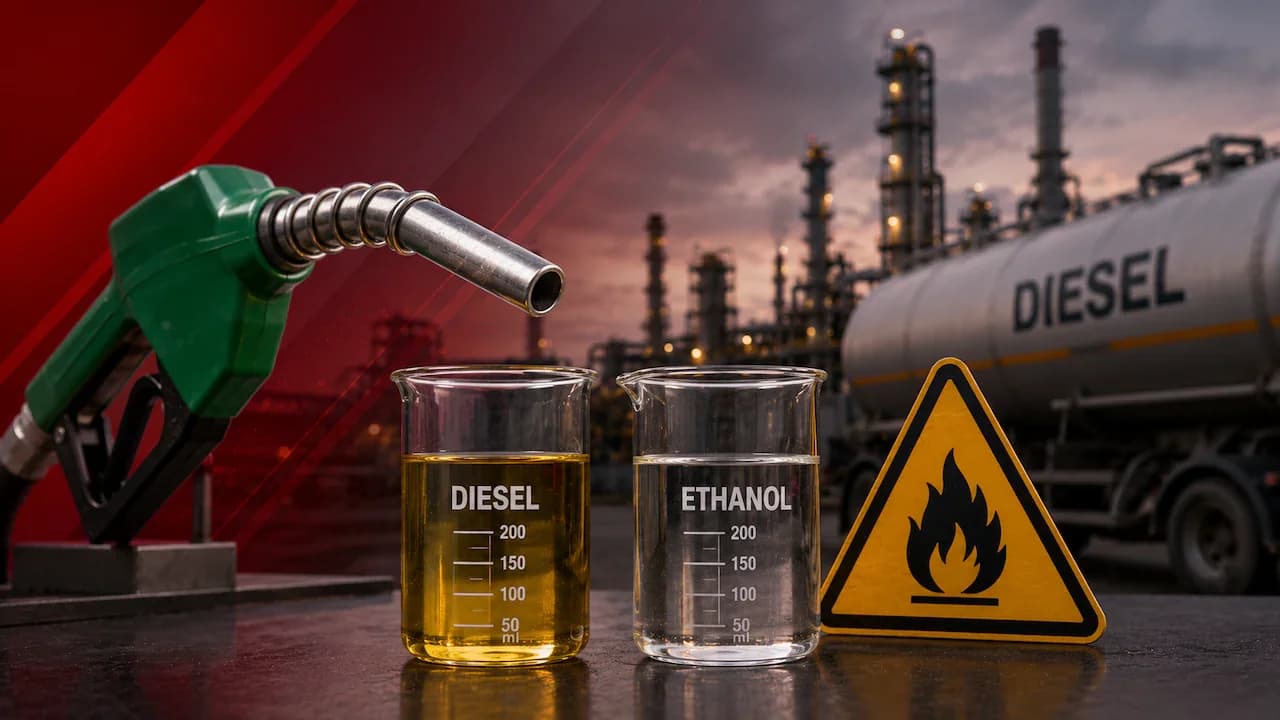
The government has formally notified standards for higher ethanol-blended petrol variants, including E22, E25, E27 and E30, as reported by NDTV Profit and Business Standard. According to a Bureau of Indian Standards (BIS) notification issued on May 15, new specifications have been established under IS 19850:2026 for "E22, E25, E27 and E30 Fuel, Admixture of Anhydrous Ethanol and Motor Gasoline for Usage in Positive Ignition Engine Powered Vehicles." These specifications refer to petrol with ethanol blends of 22%, 25%, 27% and 30% respectively, laying down a regulatory framework for the next phase of India's ethanol blending programme. The move represents a major shift in India's fuel diversification strategy as the country intensifies efforts to reduce dependence on imported crude oil amid continuing volatility in global energy markets. The BIS document specifically notes that "there are plans to ethanol blend higher than 20 percent" and that E20 was implemented across the country in 2025, establishing the technical base for next-generation petrol blends.
The move comes as India accelerates efforts to cut its dependence on imported crude oil, which currently accounts for more than 85% of the country's total requirement, as reported by NDTV Profit. The government has repeatedly maintained that higher ethanol blending can help lower import bills, support domestic agriculture and reduce vehicular emissions. In the foreword of the BIS notification, the bureau emphasizes that ethanol is an "alternative fuel source" and notes that higher blending is being pursued to "reduce emissions, improve environmental performance, encourage Make in India products and cut the import bill." India had earlier advanced its E20 blending target from 2030 to the ethanol supply year 2025-26, with official data released by the Ministry of Petroleum and Natural Gas earlier this year showing the country had already crossed the 18% ethanol blending mark nationally. The standards define fuel specifications for petrol blends containing ethanol concentrations higher than the currently targeted E20 fuel, making this a key pillar of the Centre's energy diversification strategy.
The Centre had launched E20 fuel at select retail outlets in 2023, following which automobile manufacturers began rolling out E20-compatible vehicles across segments, according to NDTV Profit. Public sector oil marketing companies have been scaling up supply and procurement infrastructure to support higher ethanol blending. All India Distillers' Association (AIDA) welcomed the development, calling the publication of BIS standards for E22 to E30 fuels "a significant and timely step towards advancing India's ethanol blending roadmap." AIDA emphasized that the move is "not just a technical notification but a progressive and forward-looking step" that reinforces the government's long-term commitment to higher ethanol adoption and lower crude dependence. The association highlighted E25 as an interim relief point for the industry because it can help absorb current surplus sugar and ethanol production capacities. AIDA argued that the longer-term target should move decisively toward E85 and E100, with flex-fuel vehicles becoming the key enabler for higher ethanol consumption and a sustainable domestic biofuels market.
The standard establishes comprehensive operational requirements, including retail visibility mandates where dispensing pumps must be clearly labelled with "E22 PETROL," "E25 PETROL," "E27 PETROL" and "E30 PETROL" as applicable. The notification also pushes compliance upstream, requiring refineries to issue quality certificates for each batch and allowing additives only under prescribed conditions. This transition is framed as a standards-and-certification exercise first, with retail adaptation to follow. The move is very likely to nudge automakers toward a broader flex-fuel strategy, especially if India eventually moves toward E85 and E100. For carmakers, this means more work on engine calibration, fuel-system compatibility and cold-start performance, while for the industry it strengthens the case for flex-fuel ICEs that can handle a wider range of ethanol blends. The near-term change is likely to be more visible in fuel labelling and product segregation than in an overnight switch at every pump, with the longer-run question being whether India can move from standards to scale.