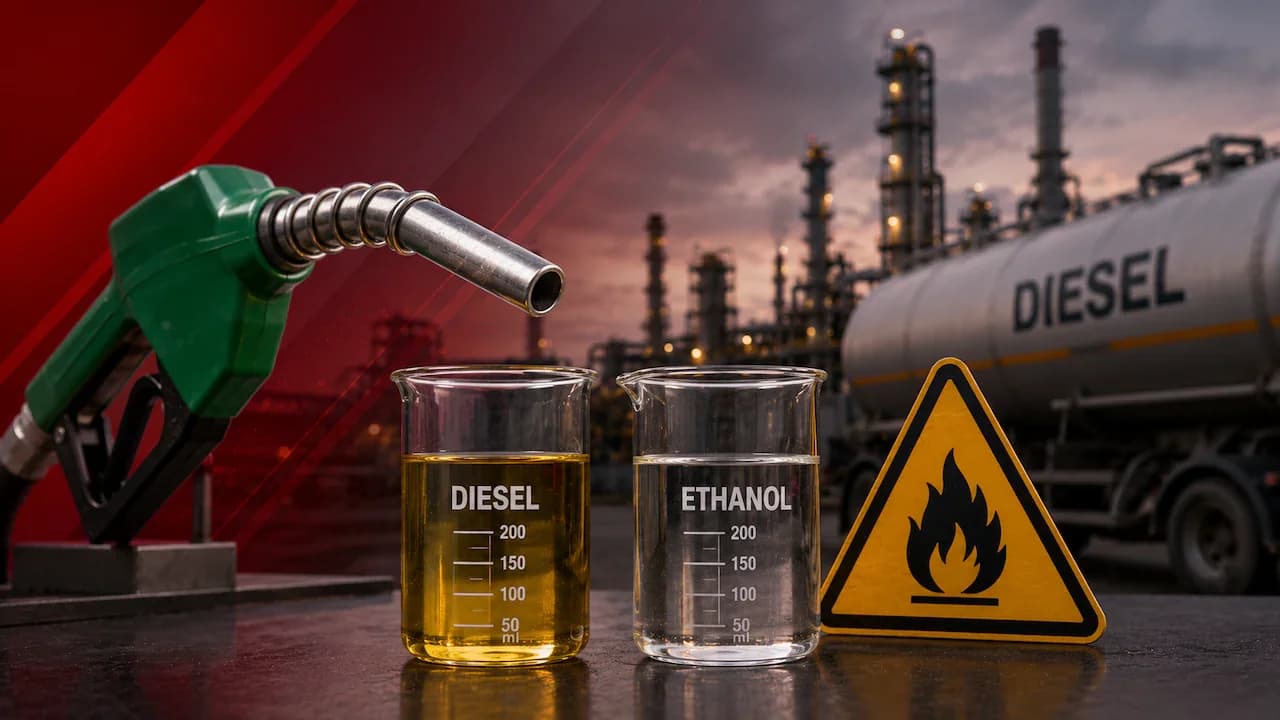
The Centre has ruled out ethanol blending with diesel after oil marketing companies found that ethanol sharply lowers diesel's flash point, potentially increasing fire risks during storage, transport and handling. According to reports from NDTV Profit, Minister of State for Petroleum and Natural Gas Suresh Gopi informed the Rajya Sabha that oil marketing companies had evaluated different ethanol-diesel blends through their research and development centres. The testing was carried out in collaboration with accredited laboratories and automobile manufacturers, with findings showing that ethanol-blended diesel did not meet required diesel flash-point specifications. Based on the test findings, the government has decided against pursuing ethanol blending with diesel after determining that the fuel's flash point limitations make it unsuitable for commercial use. As per NDTV Profit, the sharp reduction in diesel's flash point was found to be inconsistent with the prescribed safety and quality requirements, making ethanol-diesel blending unsuitable under the current specifications.
A fuel's flash point is the minimum temperature at which it can produce enough vapour to ignite. As reported by NDTV Profit, Gopi explained that "it was observed that ethanol blended diesel was not meeting diesel flash point as its flash point lowered drastically due to the presence of ethanol." A significant reduction in the flash point can therefore increase the risk of fire during fuel storage, transportation and handling, making ethanol-diesel blending unsuitable for commercial use. The Centre has now ruled out the possibility of blending ethanol with diesel after these safety concerns were confirmed through comprehensive testing by public sector oil marketing companies.
While rejecting ethanol-diesel blending, the government is exploring ethanol as a potential clean cooking fuel alternative to conventional fossil fuel-based cooking fuels. According to a Rajya Sabha response, oil marketing companies including Indian Oil Corporation, HPCL and BPCL are working on developing ethanol-based cooking fuel solutions. The government is examining whether ethanol can find applications beyond transportation, including household and commercial cooking, as part of efforts to diversify India's cooking fuel options and promote cleaner alternatives. However, the development of ethanol-based cooking fuel would require appropriate technologies, safety standards and distribution systems before it can become a commercially viable alternative to LPG. The initiative comes against the backdrop of India's broader push towards cleaner energy sources and reduced dependence on imported fossil fuels.
The government has also not taken a decision to raise ethanol blending in petrol beyond the current 20% level. According to NDTV Profit, Gopi stated that any move towards higher ethanol blends would be considered only after detailed scientific and technical studies, involving consultations with automobile manufacturers, oil marketing companies and research institutions. India's Ethanol Blended Petrol programme has been rolled out in phases with participation from NITI Aayog, automobile manufacturers, OMCs, the Automotive Research Association of India (ARAI), the Society of Indian Automobile Manufacturers (SIAM), the Indian Institute of Petroleum (IIP) and other technical institutions.
While rejecting ethanol-diesel blending, the government maintains that E20 petrol is safe for use under prescribed standards. As reported by NDTV Profit, laboratory studies and field trials conducted by ARAI, SIAM, Indian Oil Corporation, IIP and vehicle manufacturers have evaluated E20 across several parameters including engine durability, drivability, startability, corrosion resistance, material compatibility, emissions and fuel efficiency. The government states that studies have not found any significant variation in the performance of older vehicles or abnormal wear and tear attributable to E20.
According to the government data reported by NDTV Profit, E15-plus petrol has been widely used for more than three-and-a-half years, while E19-E20 blends have been in use for more than two-and-a-half years. The minister stated that more than 20 crore two-wheelers and over 3 crore petrol cars are operating on these ethanol blends. There is no verified evidence of widespread engine failures or vehicle breakdowns caused by ethanol blending, supporting the government's position that ethanol blending will continue in petrol within the existing framework. The government's position therefore remains clear: ethanol blending will continue to be used in petrol within the existing framework, but ethanol-diesel blending will not be pursued because of the fuel's flash-point limitations.