According to a NITI Aayog-IIM Ahmedabad mid-course assessment released on Thursday, the Production Linked Incentive (PLI) scheme has mobilised substantial investment and production across 14 manufacturing sectors. As of March 2026, the schemes have attracted ₹2.40 trillion in investment, representing 76% of the full-tenure target, and generated production worth ₹22.66 trillion, or 64% of the target. However, employment outcomes remain significantly below expectations, reaching only 8.49 lakh individuals, which is just 28% of the target of around 30.2 lakh. Incentives disbursed stood at ₹35,354 crore, representing 18.5% of the total outlay of about ₹1.91 lakh crore. The assessment found that 58% of the aggregate implementation period had elapsed as of the assessment, with outcomes not necessarily progressing linearly due to gestation periods involved in manufacturing facility setup. The report emphasizes that subsidies alone cannot make Indian manufacturing competitive, making a clear case for balancing supply-side incentives with demand-side support.
The government demonstrated improved disbursement efficiency in FY26, with ₹15,519 crore disbursed against a planned ₹15,472 crore, achieving 100% of the annual plan. This represents a significant improvement from FY25, when incentives worth ₹10,114 crore were disbursed against a planned ₹14,277 crore, representing 71% of the planned amount. In FY24, disbursement stood at ₹9,721 crore against a planned ₹15,401 crore, or 63%. The cumulative disbursement across all schemes reached ₹35,354 crore as of March 2026, with the report noting an increase in annual incentive disbursements during the year. The assessment highlights that capital expenditure generally takes place before the factories become fully operational, while production and hiring gather pace as capacity utilisation improves.
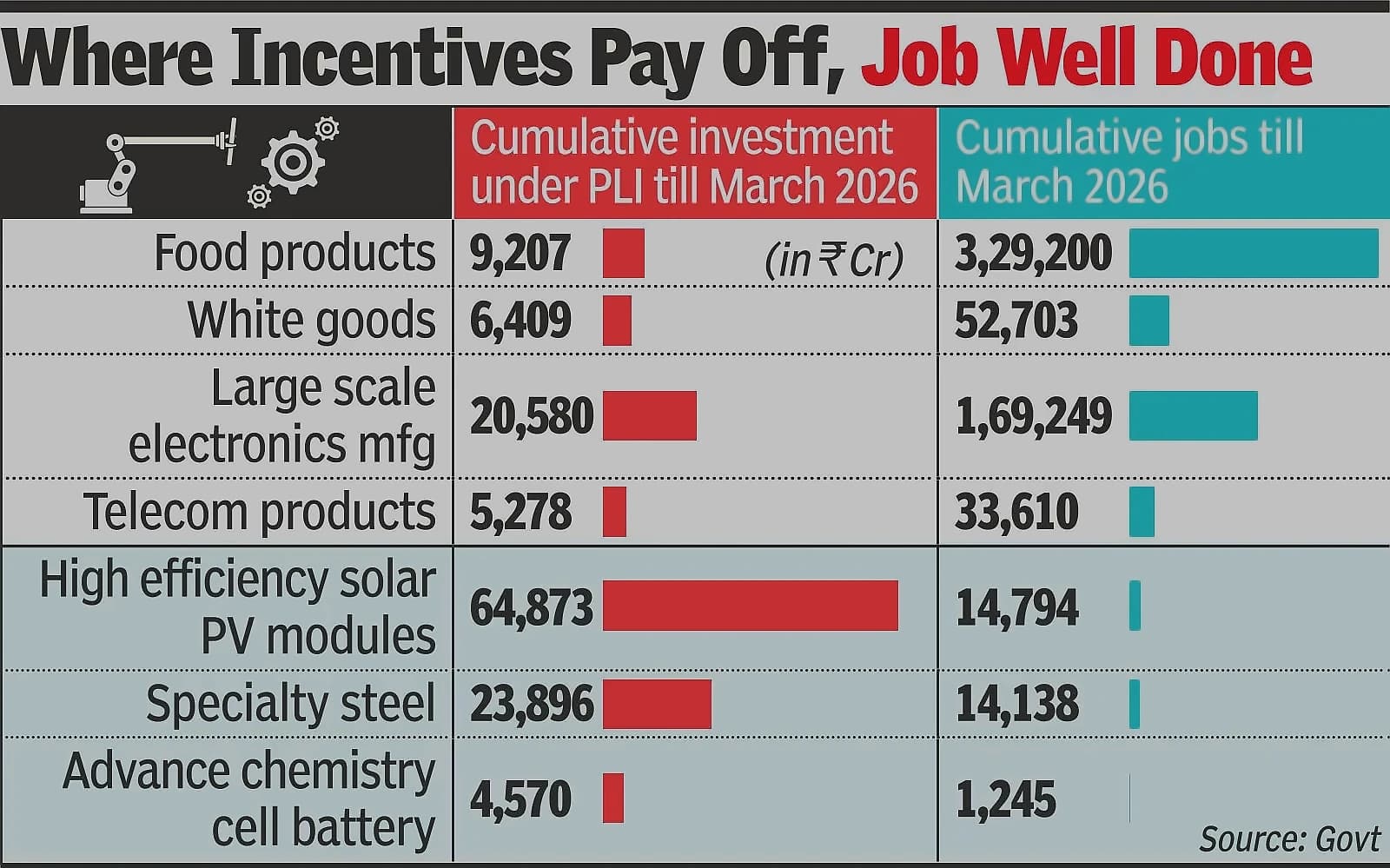
The automobile and auto components scheme recorded investments of ₹44,326 crore against its target of ₹42,500 crore, though incremental sales stood at ₹52,414 crore against a target of ₹2,31,500 crore, while employment was 67,820 against a target of 1,48,147. In the pharmaceutical sector, cumulative investment reached ₹45,158 crore with production at ₹3,64,588 crore and employment at 1,14,880, with the report highlighting that 191 pharmaceutical products were manufactured domestically for the first time in India under the scheme. The solar photovoltaic module manufacturing sector recorded investments of ₹64,873 crore by March 2026, with overall domestic module manufacturing capacity increasing from around 8 GW before the scheme to nearly 116 GW by October 2025, with approximately 24 GW attributed directly to PLI-supported projects. Food processing achieved cumulative investment of ₹9,207 crore with production at ₹4,82,051 crore and employment at 3,29,200, while creating around 35 lakh tonnes of annual processing and preservation capacity.
According to NITI Aayog Vice Chairman Ashok Kumar Lahiri, manufacturing has long been recognised as an engine of employment, innovation and productivity-led growth. For India advancing towards the vision of Viksit Bharat @2047, strengthening manufacturing capabilities will be central to sustaining high, inclusive and broad-based growth. The PLI scheme, introduced across 14 sectors to realise India's vision of becoming a manufacturing hub, aims to strengthen domestic manufacturing, attract investment, create employment, promote exports and build globally competitive production capabilities. The report's overall assessment pointed to positive but varied outcomes across the PLI schemes, recommending a sector-specific approach to scheme design and implementation taking into account differences in manufacturing capabilities, investment cycles and sector requirements. It also called for demand-side measures alongside supply-side incentives, greater participation of industry in setting scheme targets, improved coordination between the Centre and states, and standardised reporting and monitoring mechanisms. NITI Aayog Programme Director Ishtiyaque Ahmed noted that 70% of players and indicators are on track, while CEO Anurag Jain indicated that coordination between NITI Aayog and line ministries would address any schemes requiring tweaking. The translation of investment into sustainable jobs, particularly in labour-intensive industries, needs closer monitoring as noted in the assessment.