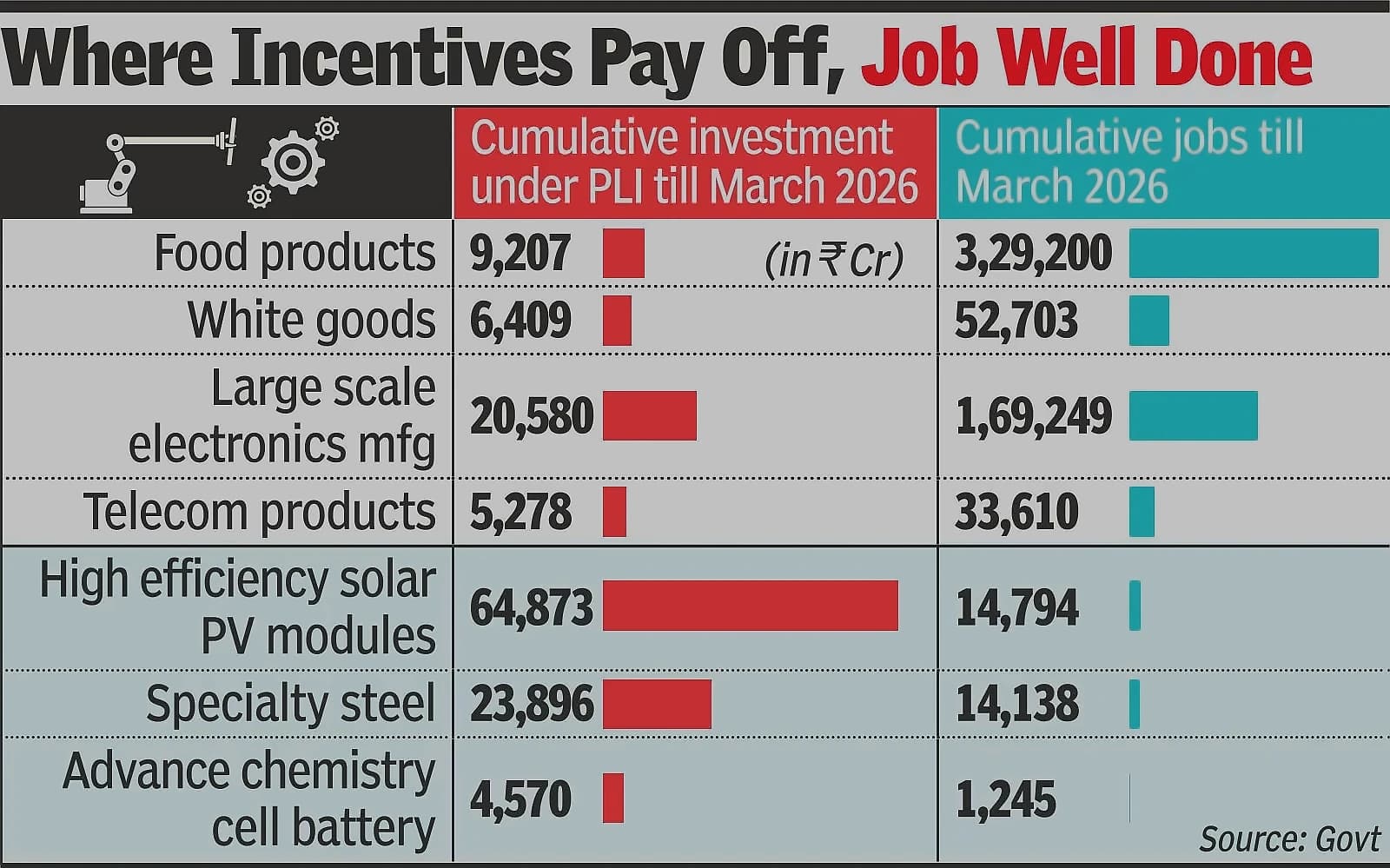
The government's Production Linked Incentive (PLI) scheme for electronics manufacturing has demonstrated significant success, with large-scale electronics manufacturing companies receiving ₹19,090.98 crore in incentives up to June this year. According to data from the department for promotion of industry and internal trade (DPIIT), this represents the highest payout among all sectors covered by the scheme. The sector has also attracted investments worth ₹20,580.20 crore, highlighting strong investor confidence in India's electronics manufacturing capabilities. As per The Times of India, this performance reflects the scheme's effectiveness in boosting domestic manufacturing and attracting substantial investment.
The large-scale electronics manufacturing (LSEM) scheme, introduced in 2020 to boost domestic mobile phone manufacturing, has approved 32 companies as beneficiaries. The scheme was initially designed to run for five years from 2020 to 2025, but its tenure was extended by one year to 2025-26. This extension reflects the government's commitment to sustaining the momentum in domestic electronics manufacturing and supporting the sector's growth trajectory. The government provides fiscal incentives to eligible PLI beneficiary firms on incremental sales over the base year, with the scheme specifically targeting domestic mobile phone manufacturing capabilities.
India's electronics manufacturing push has yielded remarkable results in export performance. According to reports, smartphone exports from India increased to about $30 billion in 2025-26 from $5.5 billion in 2021-22, representing a five-fold increase over a four-year period. This dramatic growth has positioned India as the world's second-largest mobile manufacturer, with smartphones becoming one of the country's top exported commodities. The sector's transformation from a domestic market focus to a significant global player demonstrates the effectiveness of the PLI scheme in attracting investment and driving manufacturing scale.
The electronics sector's performance within the broader PLI framework is particularly notable. According to DPIIT data, across all 14 PLI schemes launched in 2020, the government has disbursed a total of ₹36,754 crore to beneficiary companies till June 30 this year. The government launched the PLI programme for 14 sectors, including electronics and pharmaceuticals, with an approved outlay of ₹1.91 lakh crore. This substantial investment demonstrates the government's strategic focus on manufacturing-led growth and the electronics sector's central role in achieving this objective. As reported by The Times of India, the government's PLI schemes aim to enhance manufacturing capabilities, attract investment, promote exports, generate employment, and reduce import dependence across various sectors.