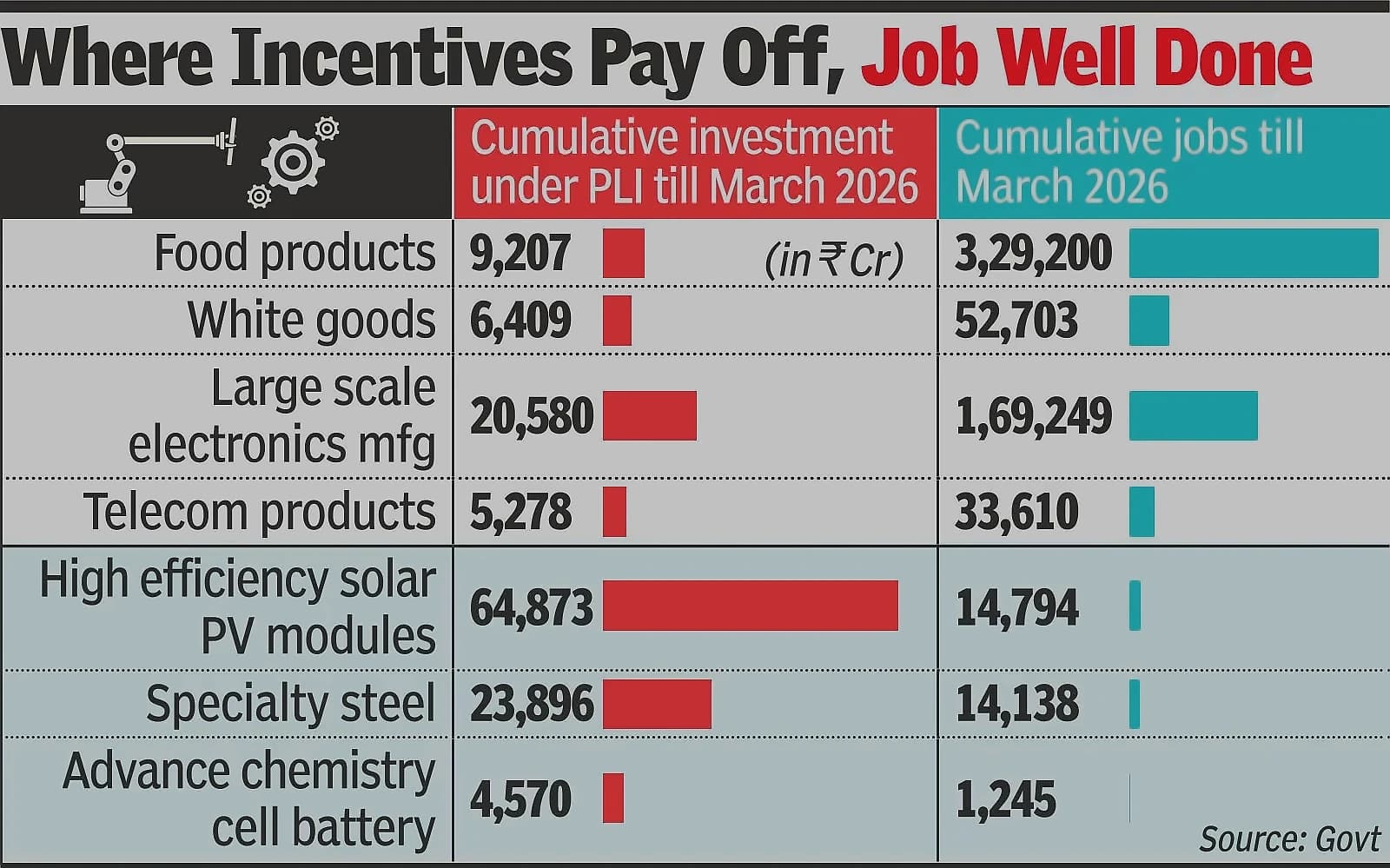
According to the Department for Promotion of Industry and Internal Trade (DPIIT), PLI schemes have achieved remarkable results with cumulative exports of over ₹15.2 lakh crore since their launch. As reported by NDTV Profit, this represents a dramatic surge from ₹4 lakh crore as of March 2024 to ₹15.2 lakh crore by March 2026. The schemes have attracted investments exceeding ₹2.40 lakh crore and created over 14.15 lakh jobs, both directly and indirectly, demonstrating their significant impact on India's manufacturing ecosystem. The government confirmed these achievements across 14 key manufacturing sectors through regular reviews and periodic monitoring by a Cabinet Secretary-chaired committee.
According to the latest DPIIT data, solar photovoltaic (PV) modules have emerged as the primary investment driver under the PLI scheme, attracting ₹64,873 crore in investments. The pharmaceutical sector followed with ₹45,158 crore in investments, while the automobile and auto components segment attracted ₹44,326 crore. As reported by NDTV Profit, the electronics manufacturing sector focused on smartphones created 1.7 lakh jobs while attracting investments of ₹20,580 crore. This pattern continues with the overall PLI framework, where capital-intensive industries may not necessarily translate to proportionate employment generation, with the schemes operating on a performance-based incentive model offering incentives as a percentage of incremental sales over a base year.
According to government data reported by The Times of India, food products have emerged as the primary job creator under the production linked incentive (PLI) scheme, despite receiving relatively modest investments. This sector has demonstrated the most effective job generation capacity among all PLI-supported industries, highlighting its significant contribution to employment generation in India's manufacturing sector. The latest data confirms this trend continues with the overall PLI framework's substantial job creation achievements, with over 14.15 lakh direct and indirect jobs created across various sectors.
The PLI Textiles scheme has emerged as a significant employment generator, attracting ₹8,117.64 crore in investments and creating 33,427 new jobs across 170 approved companies as of March 31, 2026. According to data provided by the Ministry of Textiles, Tamil Nadu leads employment generation with 7,930 jobs from 17 approved companies and investments of ₹1,277.16 crore. Madhya Pradesh recorded the second-highest employment at 4,970 jobs with 22 approved companies and investments of ₹658.45 crore. Gujarat, which has the highest number of approved companies at 46, attracted investments of ₹1,903.38 crore and generated 4,493 jobs. The scheme has demonstrated effective state-wise distribution, with Karnataka generating 5,611 jobs through six approved companies, while Goa reported investments of ₹1,355.87 crore despite having only one approved company.