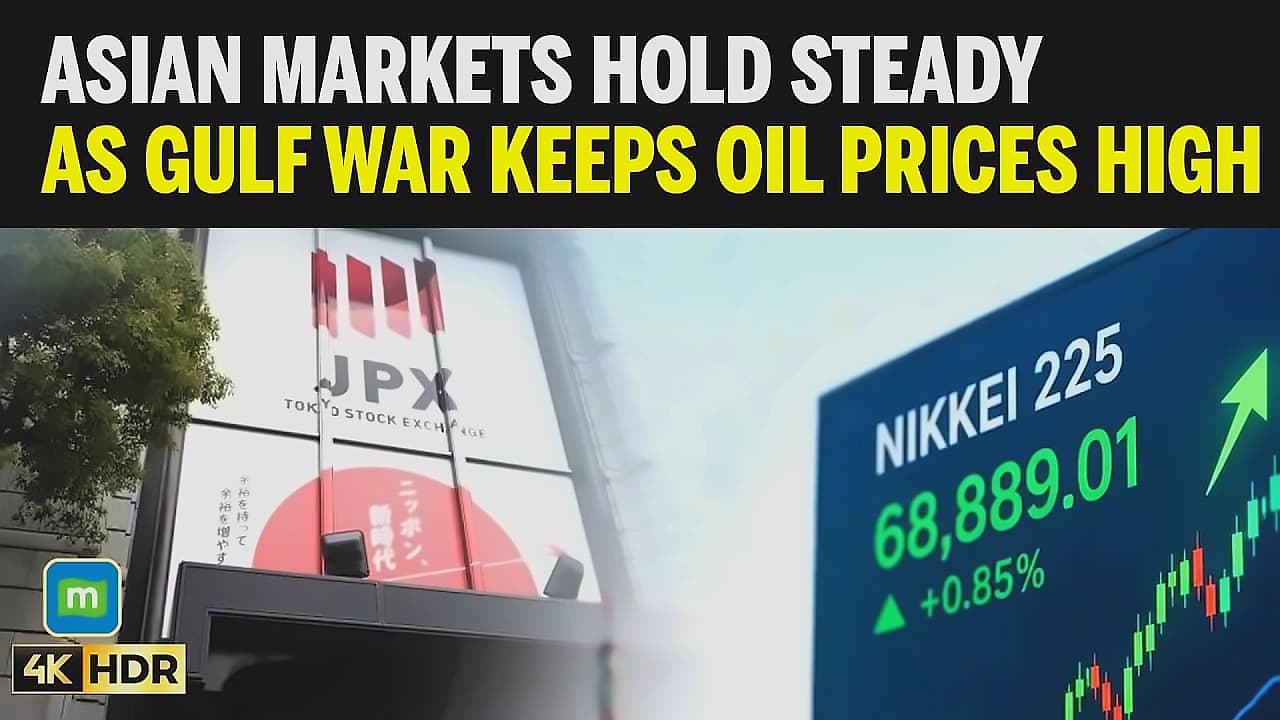
Asian stock markets traded mostly lower on Tuesday as renewed concerns over Middle East conflict kept oil prices elevated, raising prospects of persistent inflation and tighter monetary policy. The MSCI Asia Pacific Index slipped 0.2%, with Japan's Nikkei 225 edging up just 0.2% after fluctuating between gains and losses, as reported by The Economic Times. However, South Korea's KOSPI bucked the broader trend, climbing 1.2%, as reported by The Economic Times. The mixed performance reflects investor uncertainty over the escalating Middle East tensions and their potential impact on global markets. Oil prices moved higher for a third consecutive day as trading resumed in Asia, with Brent crude futures edging up 0.04% to $97.04 a barrel, after hitting a six-week high on Monday, as reported by The Economic Times. Westpac analysts noted that "the weekend's tit-for-tat strikes between the U.S. and Iran continued to put upward pressure on oil prices, acting as a drag on risk sentiment more broadly."
Oil prices climbed significantly following escalating threats from Iran in the Persian Gulf after the US and Iran traded tanker attacks over the weekend. Iran threatened to retaliate against any new attacks by targeting energy infrastructure across the Gulf, including U.S. oil and gas interests, according to The Economic Times. The latest attacks came after Iran's Revolutionary Guard Corps Navy said it had struck three oil tankers using an unauthorised route through the strait, along with several US-linked vessels, in response to earlier American strikes on Iranian tankers. The IRGC added that it had also targeted a US naval drone and an unmanned surface vessel attempting to enter the waterway. Iran's top security official Mohsen Rezaee said Tehran would declare a new restricted zone outside the strait in the coming days, with the conflict keeping energy markets on edge. According to Investing.com, oil could hit $120 a barrel on rising Mideast shipping risk as the insurance premium remains very much alive despite Hormuz remaining open. The latest moves came as Iran said an agreement with Oman to oversee shipping through the Strait of Hormuz was close, raising uncertainty over how Washington might respond following its strikes on Iranian vessels over the weekend.
Stock markets rallied while bond yields fell on Thursday as Federal Reserve Governor Christopher Waller signaled a willingness to remain patient on raising interest rates. According to reports from CNBC TV18, Waller said in remarks for a Reuters NEXT Newsmaker event that if upcoming data confirmed inflation pressures were cooling off, he was inclined to argue in favor of keeping interest rates steady at the US central bank's next policy meeting. Expectations for a rate increase at the Fed's mid-September meeting came down after the comments, with the market now pricing in a roughly 50% chance for a hike, versus about 63% in the prior session, according to CME FedWatch. As per The Economic Times, the yield on the U.S. 10-year Treasury bond was up 0.6 basis points at 4.788%, with traders still pricing an implied 60% probability of a 25-basis-points hike at its next two-day meeting on September 16, about the same chance as a week ago. As per The Economic Times, the U.S. dollar index, which measures the greenback's strength against a basket of six currencies, was trading around a two-week low of 98.82.

The Japanese yen jumped as much as 0.6% to 153.51, its strongest level since February 18, adding to market volatility as investors sought safe-haven assets amid geopolitical tensions. According to Business Standard, Japan's Nikkei 225 fluctuated between gains and losses before edging up 0.2%, as the yen's strength reflected broader risk-off sentiment in Asian markets. MSCI's broadest index of Asia-Pacific shares outside Japan was up 0.2%, led by South Korea's KOSPI, while S&P 500 e-mini futures were down 0.1% after a holiday in the US on Monday. The yen's surge came as the weekend's tit-for-tat strikes between the US and Iran continued to put upward pressure on oil prices, acting as a drag on risk sentiment more broadly, as noted by Westpac analysts.
Over in Australia, shares slumped 0.6% after a measure of local consumer sentiment fell sharply in September, according to The Economic Times. S&P 500 e-mini futures were down 0.1% after a holiday in the U.S. on Monday, as reported by The Economic Times. Gold was up 0.5% at $4,428.23, while in cryptocurrencies, bitcoin nudged 0.1% higher to $79,333.01, while ether climbed 0.2% to $2,498.94, as reported by The Economic Times. The decline in Australian markets reflects broader concerns about consumer confidence and regional economic resilience amid global uncertainties.