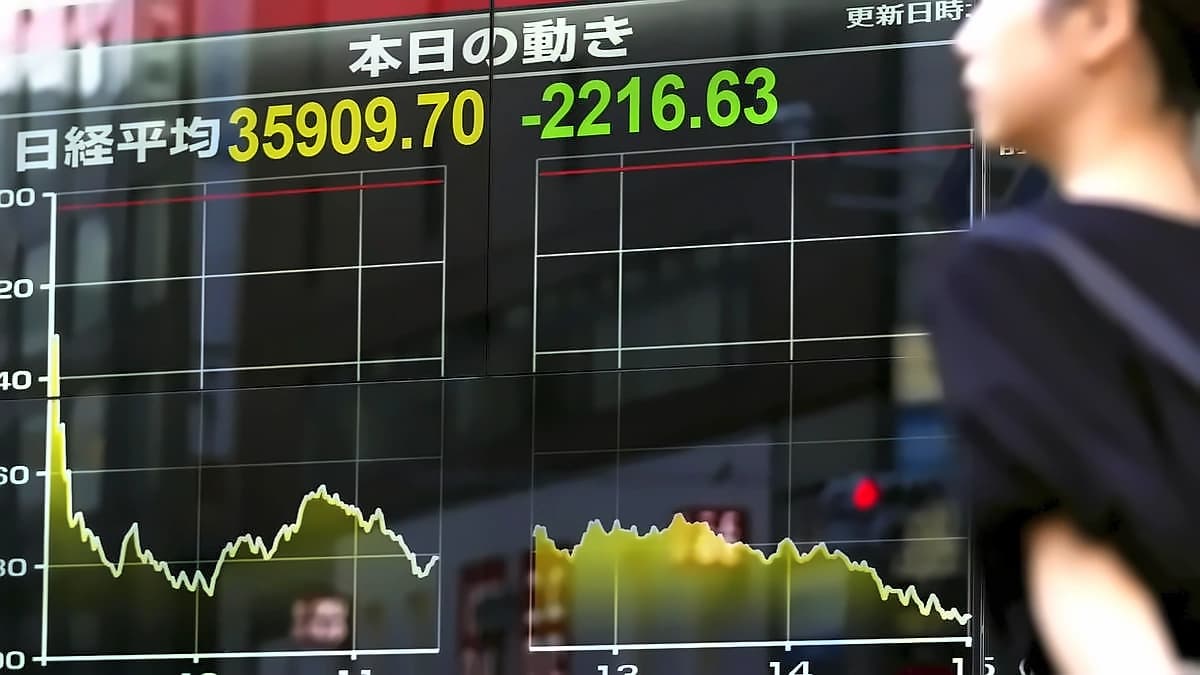
Global equity markets traded mostly lower at the start of the week as Federal Reserve Chair Kevin Warsh's hawkish remarks reinforced expectations of another US interest rate hike. According to reports from Anadolu Agency, Warsh signaled at the Jackson Hole Economic Symposium that additional policy measures may be needed if inflation fails to ease toward the Fed's target. Money markets raised the probability of a Fed rate hike in September to around 60%, with the US two-year Treasury yield rising to 4.35% from 4.22% shortly before Warsh's speech. The benchmark 10-year Treasury yield climbed five basis points to 4.73% before trading at around 4.71% at the start of the week. Wall Street closed lower at the end of last week after Warsh's speech, with the Dow Jones Industrial Average slipping 0.02%, the S&P 500 falling 0.25% and the Nasdaq declining 0.52% on Aug. 28. On Monday, the Dow Jones Industrial Average fell 348 points, or 0.7%, as of 9:51 a.m. Eastern time, while the S&P 500 index fell 0.4% and the Nasdaq declined 0.3%, with nearly every sector within the benchmark S&P 500 losing ground.
Asian government bonds followed Treasuries lower as renewed geopolitical tensions drove oil prices higher, fueling inflation concerns and expectations for further monetary tightening. According to The Economic Times, Japan's 10-year government bond yield touched 3% for the first time since 1996, marking a significant milestone in global bond markets. The yield on the 10-year Japanese government bond rose to 2.965% after touching a three-decade high in the previous session. Masahiko Loo, senior fixed income strategist at State Street Investment Management in Tokyo, explained that this move represents more of a normalisation story than a crisis. "A 10-year JGB yield at 3% is undoubtedly a milestone, but I would view it more as a normalisation story than a crisis story. Markets are repricing for a higher inflation regime, a higher neutral rate and growing confidence that the BOJ has further to go," Loo said. The other underappreciated factor is Japan gradually ceasing to be the marginal buyer of foreign bonds, with less incremental demand from one of the world's largest pools of savings helping push term premium higher globally.
In the domestic market, frontline indices remained under pressure throughout the session with buying momentum failing to sustain. As reported by Live Mint, the Nifty 50 settled 0.39% lower at 24,080, while the Sensex lost 0.40% to close at 76,957. The weakness dragged down benchmarks' monthly performance, with both indices wrapping up August with losses of more than 1.40%, snapping their two-month winning run. The broader markets remained mixed, with the Nifty Midcap 100 gaining 0.24%, while the Nifty Smallcap 100 fell sharply by 0.74%. European equities were supported by strong corporate earnings at the end of last week, while attention is turning to the European Central Bank's upcoming monetary policy decision amid growing macroeconomic concerns. The eurozone economic sentiment indicator rose 1.3 points month-on-month to 98.4 in August, while minutes from the ECB's latest meeting signaled the possibility of a rate hike next month.
Concerns over crude oil prices remained at the forefront after oil surged more than 3.5% on Monday following renewed military exchanges between the United States and Iran. According to reports from Reuters, Brent crude futures rose $3.15, or 3.58%, to $91.25 a barrel by 0903 GMT, while U.S. West Texas Intermediate crude gained $2.96, or 3.55%, to $86.36. The gains followed U.S. strikes on two Iranian launchers on Larak Island in the Strait of Hormuz on Sunday, the first known U.S. strikes on Iran since late July. Iran subsequently attacked two U.S. air bases in Jordan, Iranian media reported Monday, citing Iran's Revolutionary Guards. The renewed hostilities revived concerns over energy supplies through the Strait of Hormuz, one of the world's most important oil shipping routes. The war has curtailed traffic in the Strait of Hormuz, which accounts for about 20% of the world's oil shipments, making everything from gasoline to shipped goods more expensive. The military action further fueled uncertainty after expectations that Washington would rely on additional economic sanctions rather than further strikes against Iran.
A surge in global bond yields, led by Japan's 10-year yield touching 3% for the first time since 1996, may keep Indian markets under pressure as investors brace for tighter global liquidity, higher crude prices and fresh inflation risks. For India, the bigger issue is that bond yields are rising together across major markets at a time when crude oil is high, the Middle East conflict is dragging on and the US Federal Reserve is again sounding hawkish on inflation. When Japan, US and Europe yields rise together, global investors demand higher returns to hold risk assets, which can hit foreign flows into Indian equities and bonds, lift domestic bond yields, put pressure on the rupee and hurt valuation multiples in stocks. The combination of these factors exerts pressure on Indian equities, challenging investor sentiment despite India's resilient 7.8% GDP growth. Energy stocks gained ground with Exxon Mobil rising 2.9% and Chevron gaining 3% on Monday, while gold fell 3.2% to $4,455 per ounce on Aug. 28 following Warsh's remarks at Jackson Hole.
According to Rupak De, Senior Technical Analyst at LKP Securities, Nifty continues to remain weak as it trades below critical moving averages. As reported by Live Mint, De noted that the index found initial resistance around the recent low, but the RSI has formed a positive divergence on the hourly chart, indicating a possibility of a near-term pullback. He expects the index may witness a minor pullback towards 24,180–24,200, with a sustained move above 24,200 potentially triggering a further rise of around 100 points. On the downside, support is placed at 23,990, while a sustained break below this level could resume correction. The US dollar index climbed to 99.7 on Aug. 28, its highest level since Aug. 14, before edging down 0.1% to 99.6 at the start of the week, as reported by Anadolu Agency. Vatsal Bhuva, technical analyst at LKP Securities, highlighted that Bank Nifty closed with a long bullish candlestick, supported by strong buying during the closing auction session, with the index closing at its falling trendline resistance while sustaining above its crucial 50 DMA and 200 DMA.