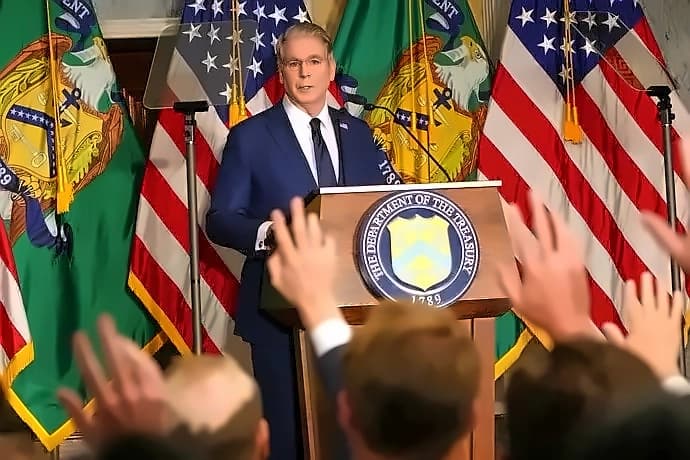
President Donald Trump and Chinese President Xi Jinping have established a comprehensive framework for bilateral relations during Trump's visit to Beijing. According to the latest White House statement, the leaders agreed that Iran cannot possess a nuclear weapon and called for the reopening of the Strait of Hormuz, stating that no country or organization should be allowed to impose tolls there. The statement confirmed their shared goal to denuclearise North Korea, though it notably made no mention of Taiwan. As reported by Business Standard, Trump and Xi chartered two new institutions to optimise the bilateral economic relationship: the US-China Board of Trade and the US-China Board of Investment. According to ABC News, Trump's top trade envoy clarified that the U.S. president exacted a commitment from the Chinese to not provide material support to Iran, though the United States did not seek China's direct help to reopen the Strait of Hormuz. Flying back from Beijing on Friday, May 15, after two days of talks with Xi, Trump said he was considering whether to lift US sanctions on Chinese oil companies buying Iranian oil, noting that China is the biggest buyer of Iranian oil.

The new trade and investment boards will provide structured mechanisms for managing bilateral economic relations. The Board of Trade will allow the United States Government and the Government of China to manage bilateral trade across non-sensitive goods, while the Board of Investment will provide a government-to-government forum for discussing investment-related issues. According to the fact sheet, President Trump negotiated a broad package of commitments aimed at creating high-paying American jobs and opening new markets for US goods. China has also approved an initial purchase of 200 American-made Boeing aircraft for Chinese airlines, which will drive high-paying, high-skilled US manufacturing jobs. The White House described these as key parts of the economic framework aimed at supporting "strategic stability" based on fairness and reciprocity. As reported by Rappler.com, Trump said he was not asking for favors because "when you ask for favors, you have to do favors in return" when asked whether Xi had made a firm commitment to put pressure on the Iranians to reopen the strait.
China has committed to purchase at least USD 17 billion per year of US agricultural products in 2026, 2027, and 2028, in addition to soybean purchase commitments made in October 2025. The fact sheet noted that China restored market access for US beef by renewing and expanding the listings of more than 400 US beef facilities, and will work with US regulators to lift all suspensions on these facilities. China has also resumed imports of poultry from US states determined by the USDA as free of highly pathogenic avian influenza. On critical minerals, the fact sheet said China would address US concerns about rare earth shortages, listing yttrium, scandium, neodymium, and indium among the minerals involved. China will also address restrictions on selling rare earth production equipment and processing technologies that are part of US concerns.
The Iran crisis has created significant global economic disruption, with Iran effectively shutting the Strait of Hormuz, which carried one-fifth of global oil and liquefied natural gas supply before the US and Israel launched attacks on February 28. The disruption has caused the biggest oil supply crisis in history, pushing up oil prices significantly. According to Rappler.com, 78 commercial ships had been redirected and four disabled to ensure compliance with the US blockade as of Saturday. Iranian Foreign Minister Abbas Araqchi said Tehran had received messages from the US indicating Washington was willing to continue talks, with Pakistan mediating between Washington and Tehran. Iranian Interior Minister Eskandar Momeni held "detailed" discussions with his visiting Pakistani counterpart on Iran-Pakistan relations and the prospects for resuming peace talks. Iranian parliament's national security committee head Ebrahim Azizi said Tehran had prepared a mechanism to manage traffic through the strait along a designated route that would be unveiled soon, with only commercial vessels and parties cooperating with Iran benefiting and fees collected for specialized services.
The latest White House statement confirmed that Trump will welcome Xi for a visit to Washington this fall, and both countries will support each other as hosts of the G20 and APEC summits later this year. According to the document, both leaders called that no country or organisation can be allowed to charge tolls, establishing principles for international cooperation. In later media interviews, Trump called a possible Taiwan arms sale a negotiating tool, describing it as a "negotiating chip" with China, raising concerns in Taiwan. However, the announcement appears to contradict China's commerce ministry statement from Saturday, which confirmed agricultural and aircraft deals but did not mention specific tariff reductions, suggesting some details remain unconfirmed by the Chinese government. Iran's stock market is set to reopen on Tuesday after suspension from the beginning of US-Israeli airstrikes, with the Securities and Exchange Organization citing protection of shareholders' assets and prevention of panic-driven trading as reasons for the suspension.