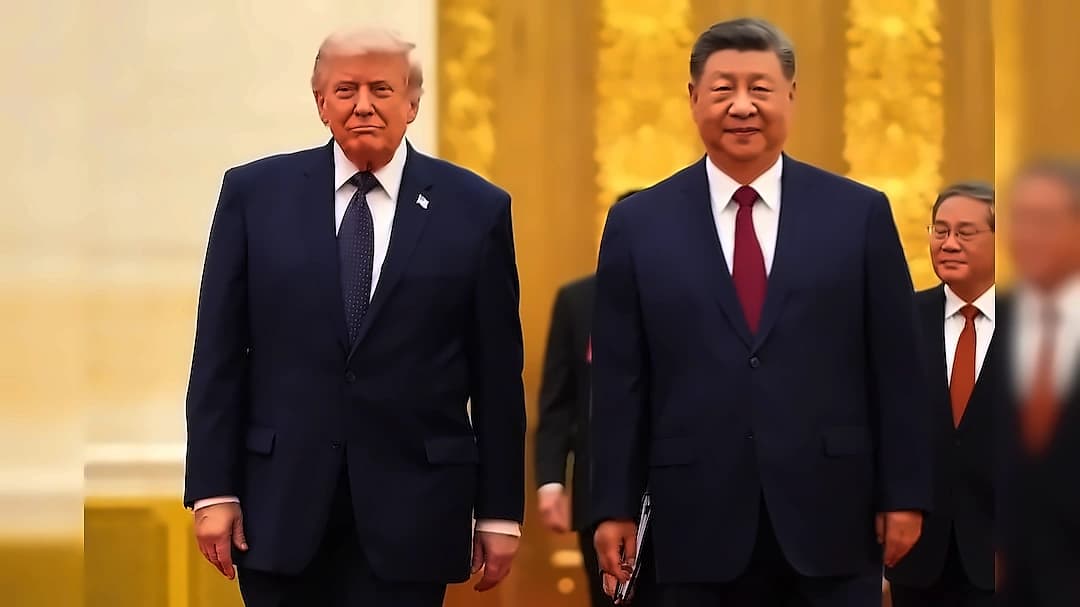
President Donald Trump returned to Washington after a summit in China, where discussions included sanctions, Taiwan, and the war in Iran, and now claims to be on the same page with China on resolving the conflict. According to a New York Times report, Pentagon officials have drafted plans for a possible resumption of strikes under a renewed military campaign after 'Operation Epic Fury' was paused during the April ceasefire. Trump has yet to make a final decision, with officials from interested countries trying to broker a compromise that could lead Iran to reopen the Strait of Hormuz. Trump reiterated to reporters aboard Air Force One that Iran's latest peace offer was unacceptable, stating 'I looked at it, and if I don't like the first sentence I just throw it away.' Speaking to reporters on his journey back to Washington, Trump claimed Chinese leader Xi Jinping said he would like the Strait of Hormuz to be reopened and that he agrees Iran should not develop a nuclear weapon, but administration officials noted these were statements China had made previously. As reported by CNN, Trump told Fox News' Bret Baier that 'We don't need help' from China, stating 'He would like to see it end. He would like to help. If he wants to help, that's great. But we don't need help.'

If Trump decides to resume military strikes, options include more aggressive bombing campaigns targeting Iranian military and infrastructure sites, with another option involving US Special Operations troops to secure highly enriched uranium believed to be stored deep underground at Iran's Isfahan nuclear facility. As reported by the New York Times, several hundred Special Operations personnel were moved to the Middle East earlier this year to prepare for such contingencies. However, military officials acknowledge that any ground operation would carry big risks of casualties and require thousands of support troops. War Secretary Pete Hegseth told lawmakers this week that the US military had 'a plan to escalate if necessary' while keeping options open to scale back deployments. There's rising urgency within Trump's orbit to find a way out of the conflict as time ticks toward the midterm elections, with some administration officials arguing for a more aggressive approach including targeted strikes that they hope would further pressure Iran into compromising. Two Middle East officials report that the United States and Israel are engaged in intense preparations — the largest since the ceasefire took effect — for the possible resumption of attacks against Iran as early as next week.
Since the cease-fire began, Iran has regained operational access to 30 of its 33 missile sites along the Strait of Hormuz, with US intelligence assessments indicating Iran has restored access to most of its missile launch facilities and underground military infrastructure. As reported by the New York Times, Iranian officials have signalled readiness for renewed hostilities, with Mohammad Bagher Ghalibaf, the speaker of Iran's Parliament, posting on social media that 'Our armed forces are ready to deliver a well-deserved response to any aggression.' The military would need more boots on the ground to hold strategic locations like Kharg Island, a hub of Iranian oil exports. Iran's latest response to the US proposal, and its rhetoric in recent days, has led many officials to question Tehran's commitment to a serious deal, with some officials noting that 'He's tried bluster, that didn't work. He's tried negotiations, that's hasn't worked.'
The war has taken a significant toll on Trump's approval rating as voters feel the economic squeeze, with US gas prices topping $4.50 a gallon on average and likely to rise higher as Iran maintains its grip on the strait. Inflation is picking up at a concerning pace, exceeding Americans' wage gains in April for the first time in three years, creating additional pressure on the president. According to CNN, a Trump adviser acknowledged ''''''''When I'm driving down the street and see $5 gas, that scares the hell out of me.'''''''' While the broader stock market is largely holding onto its gains, corporate leaders have grown more insistent behind the scenes as they press Trump and his advisers to find a resolution, with one adviser noting ''''''''They just want the war over.'''''''' Republicans are anxious that they'll suffer the consequences come November, adding urgency to find a resolution before the midterm elections. Trump has frequently downplayed the domestic impact, telling reporters ''''''''I don't think about Americans'''' financial situation. I don't think about anybody. I think about one thing: We cannot let Iran have a nuclear weapon.'''''''
During his Beijing summit, President Trump discussed Iran with President Xi Jinping of China, a strategic partner of Tehran that depends on oil and gas shipped through the strait. According to the New York Times report, Trump said after talks with Chinese President Xi Jinping that both Washington and Beijing agreed the strait must reopen, with Trump stating 'We don't want them to have a nuclear weapon, we want the straits open.' However, China publicly stopped short of indicating it would pressure Iran directly, with Iranian foreign minister Abbas Araqchi saying Tehran remained open to diplomacy but did not trust Washington after previous negotiations were followed by air strikes. The two presidents put on a display of warmth and respect during their two-day summit in Beijing. Trump departed Beijing on Friday, claiming 'a lot of good' came from his China visit and 'we've settled a lot of different problems that other people wouldn't have been able to solve'. Trump also claimed numerous deals had been struck between the US and China, including China buying 200 Boeing jets as well as US oil and soya beans, though this deal has not been confirmed by either China or Boeing. Flying back from Beijing on Friday, Trump said he was considering whether to lift US sanctions on Chinese oil companies buying Iranian oil, noting 'I'm not asking for any favors because when you ask for favors, you have to do favors in return.'