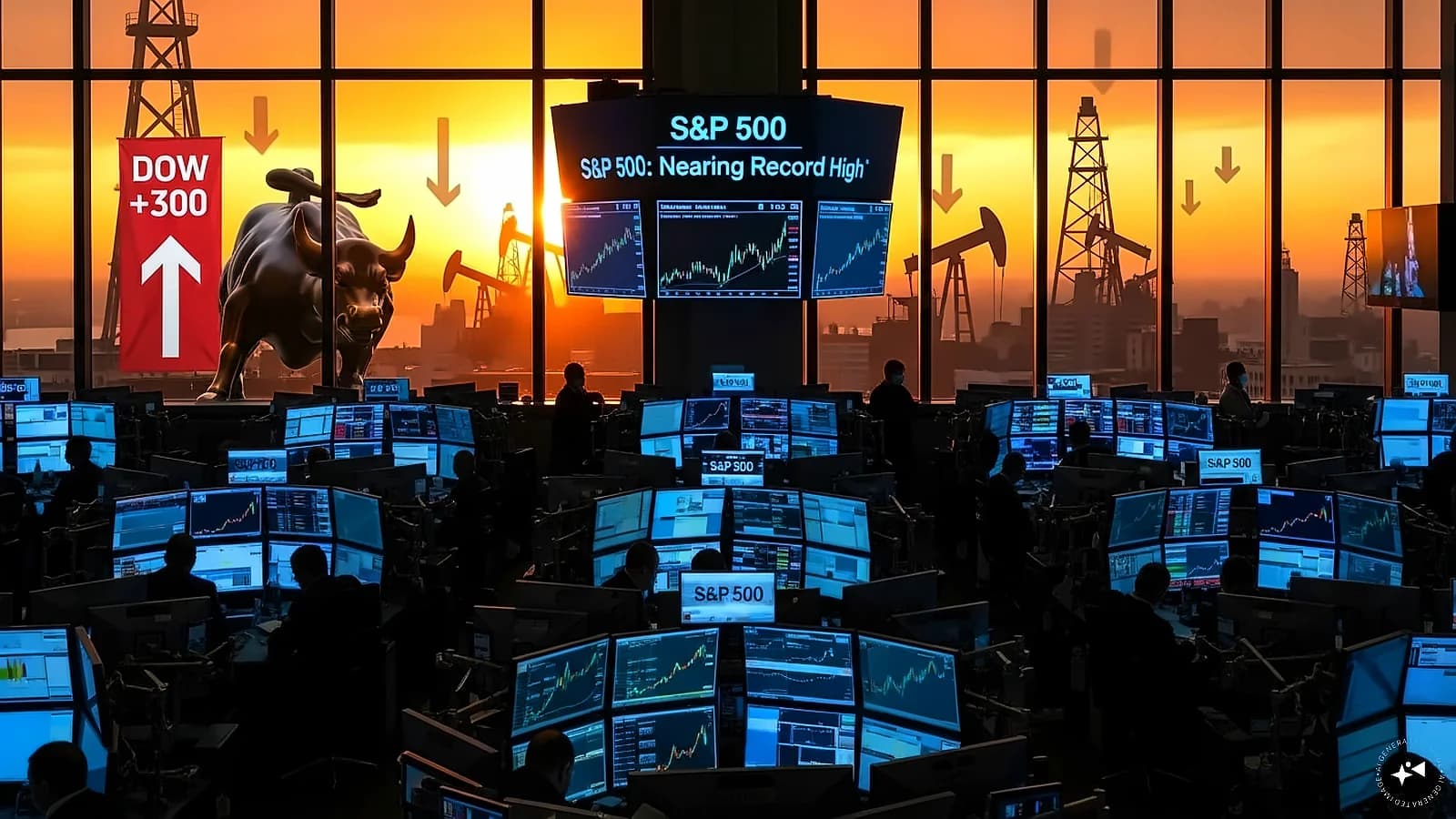
Wall Street advanced on Thursday as progress toward ending the Iran war buoyed investor sentiment, with the blue-chip Dow surging to a record closing high with a boost from healthcare and financial stocks. According to Reuters, the S&P 500 posted more muted gains, while the Nasdaq ended essentially unchanged. The U.S. House of Representatives passed a measure on Wednesday that would block President Donald Trump from continuing the war on Iran, while a U.S.-mediated ceasefire agreement between Israel and Lebanon bolstered optimism of a near-term resolution. However, the truce was rejected by the pro-Iran Hezbollah, which said it would not withdraw troops from Lebanon. Preliminary data showed the S&P 500 gained 31.14 points (0.41%) to end at 7,584.82 points, while the Dow Jones Industrial Average rose 875.09 points (1.73%) to 51,562.16, and the Nasdaq Composite lost 19.72 points (0.07%) to 26,834.26. A drop in front-month crude futures reflected hopes that tanker traffic through the crucial Strait of Hormuz could shortly resume.
The AI theme remains the dominant force driving equity markets, with Nvidia's total value topping $5 trillion and Nvidia's CEO Jensen Huang suggesting Marvell Technology could be the next trillion-dollar company, helping drive Marvell Technology's 32.5% surge for its best day since 2000. However, chipmaker Broadcom missed revenue expectations, sending its shares tumbling and casting a pall over the AI frenzy, which has sent chip stocks soaring so far this year. Paul Nolte, senior wealth adviser at Murphy & Sylvest, noted that "About the only blemish on the market at this point is Broadcom, and I think investors are buying the dip." He added that "I don't think investors have given up on chips yet, but what they've yet to come to grips with, 'Is this real? Are these valuations legitimate?'" Chipmaker Marvell Technology gained, while Advanced Micro Devices, Micron Technology and Qualcomm lost ground on the day.

Initial jobless claims unexpectedly rose 6.1%, while first-quarter labor costs and productivity were revised sharply lower. According to Reuters, a report from Challenger, Gray and Christmas showed layoffs announced by U.S. corporations jumped 11% in May to 97,006, with nearly 40% of those layoffs attributed to AI. The healthcare sector got a boost from UnitedHealth after Bank of America raised its rating on the healthcare conglomerate's shares to 'buy'. The financial index's rebound followed a sharp selloff in the previous session due to revived concerns over private credit, with Blackstone shares advancing after it became the latest asset manager to cap withdrawals from its flagship private credit fund following a rise in redemption requests.
The manufacturing activity expanded at its fastest pace in four years with new orders accelerating and production improving, while input costs remained elevated. According to Investing.com India, combined with higher oil prices, the report reignited speculation that the Federal Reserve's next move could be upward rather than downward. This economic strength creates additional complexity for monetary policy decisions, particularly as manufacturing activity reached its fastest pace in four years with new orders accelerating. The Cleveland Federal Reserve President Beth Hammack indicated that the U.S. central bank may need to raise interest rates soon to combat inflation pressures that are already too high and trending in a worrisome direction.
Indexes rose across much of Europe and Asia, with Hong Kong's Hang Seng jumping 2.5% for one of the world's biggest moves. According to Business Standard, in the bond market, Treasury yields were relatively steady with the yield on the 10-year Treasury slipping to 4.45% from 4.47% late Monday. The yield briefly jumped after a report said that U.S. employers were advertising many more jobs at the end of April than economists expected, a potential signal of continued health for the U.S. labor market. However, it quickly pulled back to where it was just before the report's release. This mixed asset class performance reflects the stark divergence between stocks reaching fresh record highs and bonds and commodities signaling growing caution.