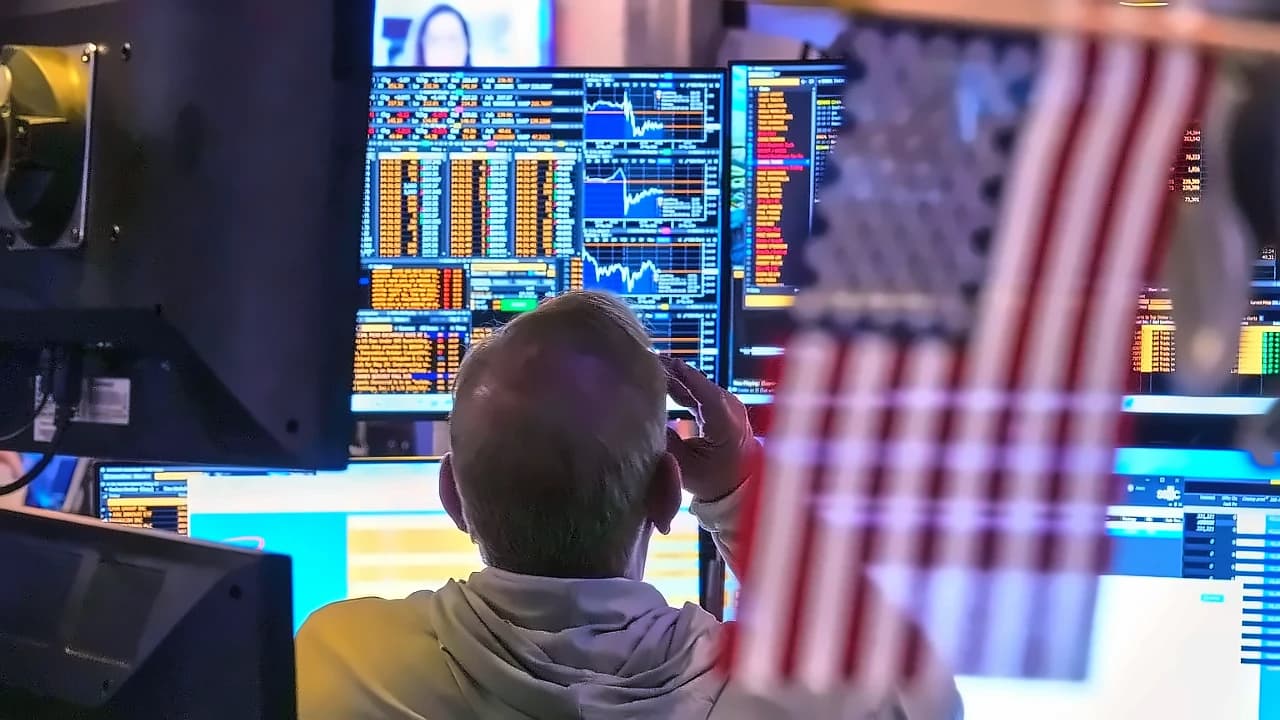
Wall Street posted its best rally in two months on Thursday as President Trump announced the cancellation of planned strikes against Iran, sending oil prices sharply lower and boosting investor confidence. The Dow Jones Industrial Average surged 929.97 points, or 1.9%, to 50,848.75, while the S&P 500 jumped 127.31 points, or 1.8%, to 7,394.30. The Nasdaq Composite rallied 640.16 points, or 2.5%, to 25,809.66, demonstrating broad-based recovery across all major indices. As per Business Standard, Trump said on his social media network that "discussions with the Islamic Republic of Iran have been brought to the highest level of Iranian leadership and approved" and that the time and place of a signing will "be announced shortly." Oil prices dropped sharply following the announcement, with benchmark US crude sinking 2.6% to $87.71 per barrel and Brent crude falling 2.9% to $90.38, though it remains above its roughly $70 price from before the war. A deal to end the war with Iran could reopen the Strait of Hormuz and allow oil tankers to carry crude again from the Persian Gulf to customers worldwide, according to Business Standard.
AI stocks experienced significant volatility with Marvell Technology climbing 11.1% after a manic stretch where it plunged 16.7%, soared 9.6%, and fell more than 5% for two straight days. Lam Research leaped 12.7% and KLA climbed 12.9%, helping offset an 8.5% drop for Oracle despite the company reporting stronger quarterly profits than analysts expected. Oracle also announced plans to raise $40 billion in cash this fiscal year through borrowing and stock sales, following its $48 billion raise last fiscal year for AI investments. The big concern remains whether such stocks shot too high, too fast because of AI mania, with their careening moves sometimes reversing direction by the hour. Companies involved in chip-making jumped to some of the market's biggest gains as they helped offset the AI sector volatility, according to Business Standard.
Treasury yields eased sharply as falling oil prices meant less upward pressure on inflation, with the yield on the 10-year Treasury dropping to 4.45% from 4.55% late Wednesday. A sustained drop in oil prices could allow the Federal Reserve to keep its main interest rate on hold this year, instead of hiking it as many traders suspected it may have to because of high inflation and a solid US job market. Following Trump's announcement, traders ratcheted back their bets for a possible increase to the federal funds rate this year, according to data from CME Group. The Fed could even resume its cuts to interest rates under its new chair, Kevin Warsh, if inflation pressures subside enough, with Trump appointing Warsh and calling for lower interest rates. Smaller companies can feel the biggest benefit from easier interest rates because many need to borrow money to grow, and the Russell 2000 index of the smallest US stocks jumped a market-leading 3% on Thursday, as reported by Business Standard.
Oil prices fell on Friday, extending losses from the previous session after US President Donald Trump cancelled plans to strike Iran, reducing fears of an escalation of hostilities following tit-for-tat attacks earlier in the week. Brent futures fell $1.21 or 1.3% to $89.17 a barrel at 0042 GMT, while US West Texas Intermediate (WTI) crude fell $1.23, or 1.4%, to $86.48. On a weekly basis, Brent was 4.2% lower, while WTI was down 4.4%, according to The Hindu BusinessLine. Trump, who had threatened to hit Iran "very hard," called off planned strikes on Thursday, saying discussions with Iran had progressed. Iran's semi-official Fars news agency reported that Tehran had not approved the text of any agreement, adding uncertainty to the situation. On Wednesday, Iran announced the closure of the Strait of Hormuz, saying any vessel attempting to pass through would come under fire, though the US military said commercial ships continued to transit the waterway. War-driven oil prices have fueled inflation, with Thursday's wholesale price data coming in hotter than expected and the European Central Bank becoming the first major central bank to respond with a rate hike, as reported by Business Standard.