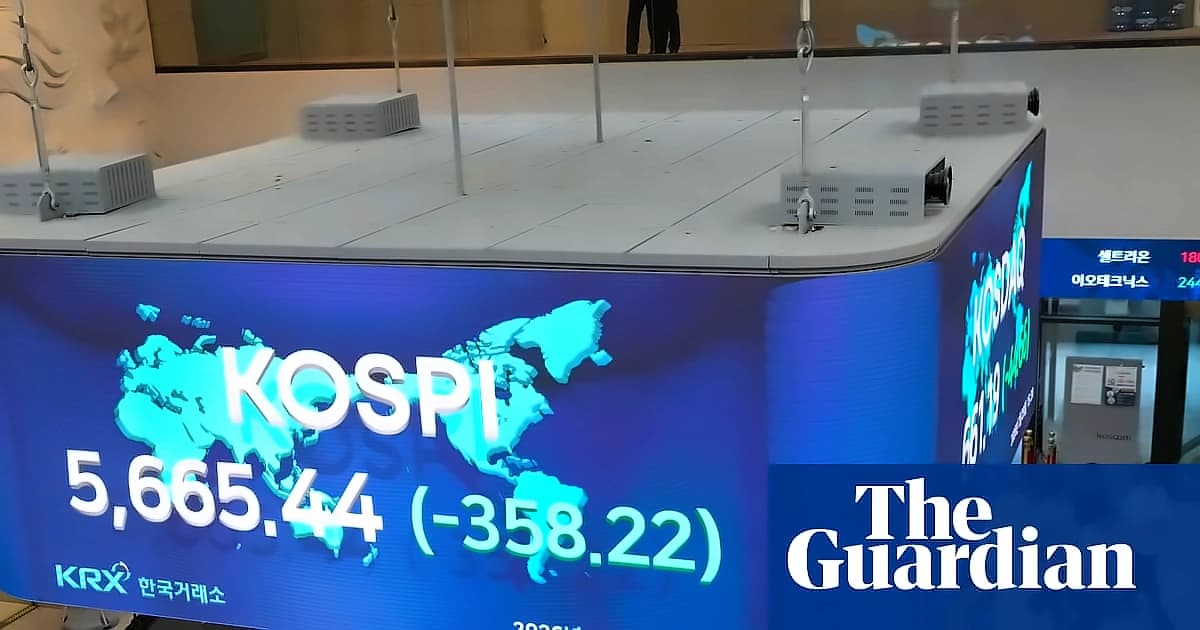
Asian markets experienced a broad-based selloff on Monday, with the Hang Seng Index falling 1.20% to HK$24,466, marking its lowest level since March 30 after peaking at HK$26,856 on May 14. The decline mirrored weakness across global markets, with South Korea's KOSPI Composite Index plunging over 8%, representing its worst-day performance in years. In Japan, the Nikkei 225 Index retreated by over 3%, with Softbank and Kioxia being the top laggards. The selloff reflects ongoing investor rotation from technology companies and rising geopolitical risks, particularly the ongoing US-Iran tensions.
Technology companies faced significant selling pressure across major Asian markets, with Baidu plunging 7% and down nearly 30% from its highest point this year, forming a risky head-and-shoulders pattern that points to further weakness. In South Korea, the market decline was primarily driven by substantial losses in semiconductor and technology companies, as reported by Business Standard. Chipmakers Samsung Electronics and SK Hynix, which together account for more than 50% of the benchmark, fell more than 9% each. The semiconductor sector faced particularly severe selling pressure, with chip stocks leading the broader market decline and contributing significantly to the overall market downturn. Most index heavyweights fell, with battery maker LG Energy Solution down 7.24%, while Hyundai Motor and sister automaker Kia Corp declined 7.55% and 6.38% respectively.
Trading in the Korean stock market was suspended due to the severe market decline, as reported by Business Standard. At 0310 GMT, the index triggered circuit breakers for the second time this week, halting trading for 20 minutes. This was the fifth time that circuit breakers were activated on the benchmark this year and the 11th in history amid heightened market volatility. Of the total 915 traded issues, only 61 shares advanced while 848 declined, with foreigners being net sellers of shares worth 3 trillion won. The current decline represents a significant shift in South Korea's market performance, with the KOSPI falling 9.4% so far this week, heading for its biggest weekly loss since early March. However, as noted by market analysts, realized volatility reached record levels during this period, with the market showing both extreme turbulence and remarkable resilience.
The sell-off was amplified by concerns over a possible reclassification of South Korea in MSCI indices, debate around capital-gains taxation and expectations of large pension fund rebalancing, all of which fuelled panic selling in a market increasingly concentrated in AI-linked stocks. According to ET Now, profit-taking, not a bubble burst, appears to be the primary driver of the correction. Adrian Mowat, Emerging Market Equity Strategist, noted that the moves in Micron, SanDisk, SK Hynix and Samsung shares are all consistent with very dramatic positive earnings revisions due to tight supply-demand dynamics for memory chips used by AI data centres. SK Hynix shares have surged more than 300% in 2026, while several global storage and memory names have posted gains of several hundred per cent, fuelled by insatiable demand for chips used in AI servers and data centres. However, Mowat cautioned that valuations in Korean memory-chip stocks remain far from bubble territory, with their P/E multiples looking quite reasonable.

The current selloff was primarily attributed to overnight losses in US tech stocks prompting investors to book profits, as reported by Business Standard. However, analyst Han Ji-young from Kiwoom Securities noted that "Today's slump can be mostly explained by high volatility amid concentration in the chip sector, while worries about memory demand declining are a bit excessive." The technical outlook remains bearish, with the Hang Seng Index moving below the 50-day Exponential Moving Average (EMA) and forming a head-and-shoulders pattern with support at HK$24,465–24,400 and a downside target near HK$24,000. Despite the weekly decline, the index remains up 95% so far this year, after rising 76% last year, according to Business Standard. Market experts caution against confusing turbulence with imminent correction, noting that late bull markets are often characterized by wild volatility and price swings that can be irrational.