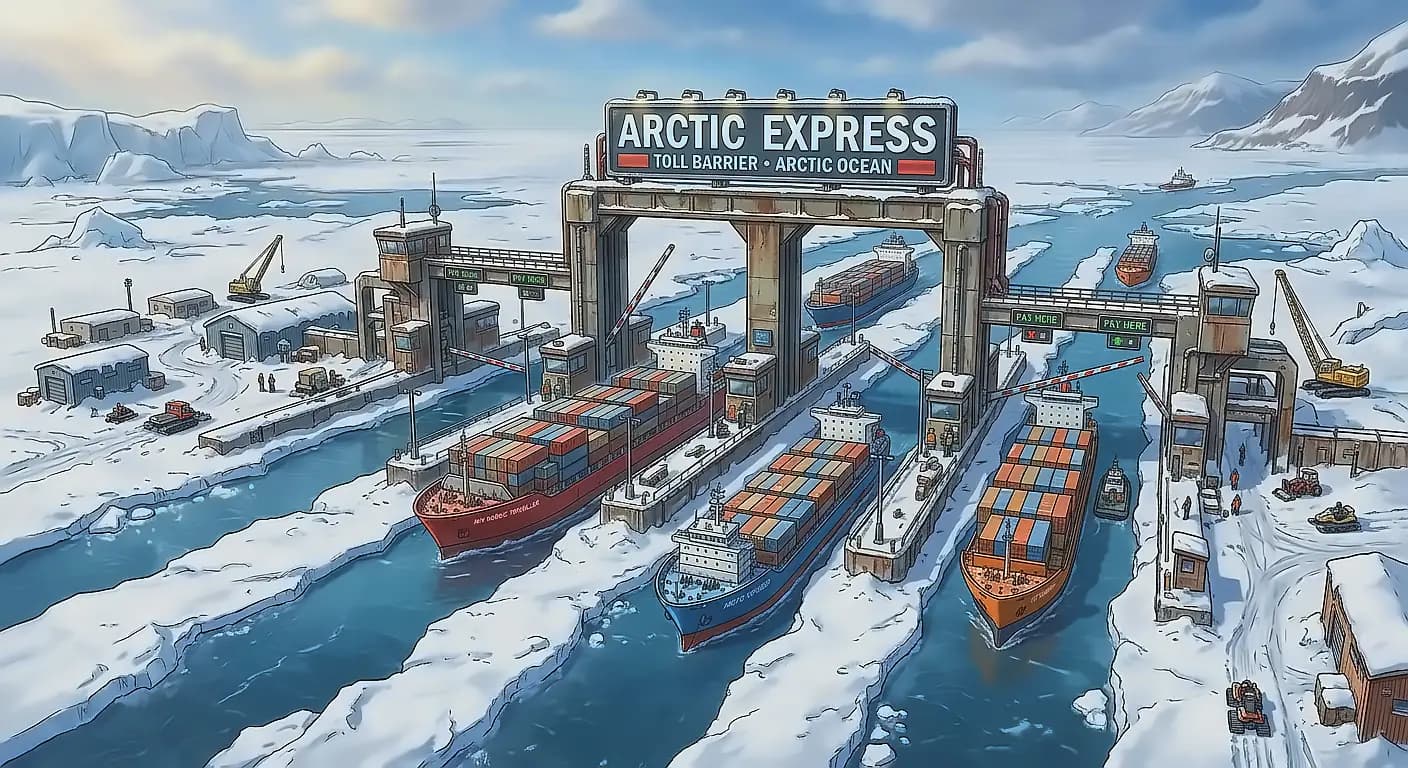
A South Korean container ship set sail on Saturday for Europe via the Arctic, marking the nation's first commercial voyage on this route to test its viability. According to reports from Reuters, the PanStar Acro will sail north from the port of Busan, hugging eastern Russia's Kamchatka peninsula, cross the Bering Sea, and take the Northern Sea Route. The ship is scheduled to stop in Felixstowe in Britain, Rotterdam in the Netherlands and Poland's Gdansk before returning on a journey expected to take 40 to 45 days. An official from the group noted that around September, when this voyage will mainly take place, Arctic sea ice is at its lowest level of the year, making safer navigation possible. The ship departed at 8 pm (1100 GMT) Saturday unless there were unforeseen circumstances, as confirmed by an oceans ministry official to AFP.
President Lee Jae Myung has made Arctic shipping a priority for South Korea, a shipping powerhouse, as reported by Reuters. Officials indicate this project could help transform Busan into a global maritime hub and position the Arctic as a regular trade route by 2030. The 2,758 TEU container ship operated by South Korea's PanStar has secured 837 TEU of cargo including automobile parts, chemical products and about 100 empty containers on the government-backed voyage. The company told Reuters it is seeking at least 1,300 TEU of cargo along with shipments from China and Japan. According to AFP, South Korea's Vice Oceans Minister Nam Jae-hon stated that the Arctic route was "bound to become an alternative" to Middle Eastern shipping lanes as geopolitical risks and technological advances make it increasingly competitive.
According to Norway's Centre for High North Logistics data reported by Reuters, 88 vessels made 103 transits through the Arctic route last year, up from 97 in 2024 and 43 in 2022. The increased shipping activity is primarily from nations such as Russia and China, with melting Arctic ice making passage through the north easier. However, scientists note that the increased shipping in turn accelerates global warming. South Korea's Oceans Ministry said the Arctic route could shorten voyages by up to 35% over the traditional Suez Canal route and require less fuel, though commercial feasibility could be harder to assess due to factors such as vessel size limits and insurance costs. The Northern Sea Route (NSR) is believed to be accessible only during the time of year when the ice is melted enough to allow transits without icebreakers, as noted by South Korean environmental group Paran Ocean Citizen Science Center.
The project risks friction with Western allies hoping to keep Russia isolated during its war in Ukraine, as reported by Reuters. Western diplomats are unhappy with the plan, with one European diplomat stating "We want to isolate Russia, we don't want engagement with Russia," citing Russia's war in Ukraine. Western concerns have been voiced to South Korean officials, with arctic shipping experts warning that South Korea could be at risk of breaching sanctions if the ship sought Russia's help to tackle problems encountered on the route, such as getting stuck in ice. According to AFP, some experts warn South Korean ships using the Arctic route could risk breaching Western sanctions on Russia as they would receive Russian navigation and weather services involving payments, albeit small ones. South Korea's foreign ministry declined to comment when asked about these concerns involving Russia. Vladimir Tikhonov, Korean Studies professor at the University of Oslo, told AFP that "strictly speaking, US and EU sanctions are not international law, unlike UN sanctions."

Industry experts remain skeptical about the commercial prospects of Arctic shipping, with Coface credit insurance group estimating that just 3.5 percent of current traffic between East Asia, northern Europe and North America could actually shift to Arctic routes. According to AFP, Paul Tourret from the French marine institute noted that "one swallow does not a summer make, and one Chinese container ship doesn't create a Polar Silk Road." The route faces significant constraints including seasonal availability from August to October only, requiring expensive ice-class ships that exclude larger vessels like Supramax container ships. Most container ships using the NSR need to be escorted by Russia's fleet of nuclear-powered icebreakers, with the Chinese container ship "Dubai Tower" having one-tenth the capacity of typical global traffic. Despite these challenges, the NSR could attract bulk liquid vessels carrying oil and liquefied natural gas, who could see costs slashed by 45 to 50 percent in some cases, as noted by Coface. However, environmental groups warn that growing traffic along the shorter NSR could accelerate Arctic sea ice loss already driven by global warming, with soot emissions that settle on the ice cap trapping heat from sunlight.