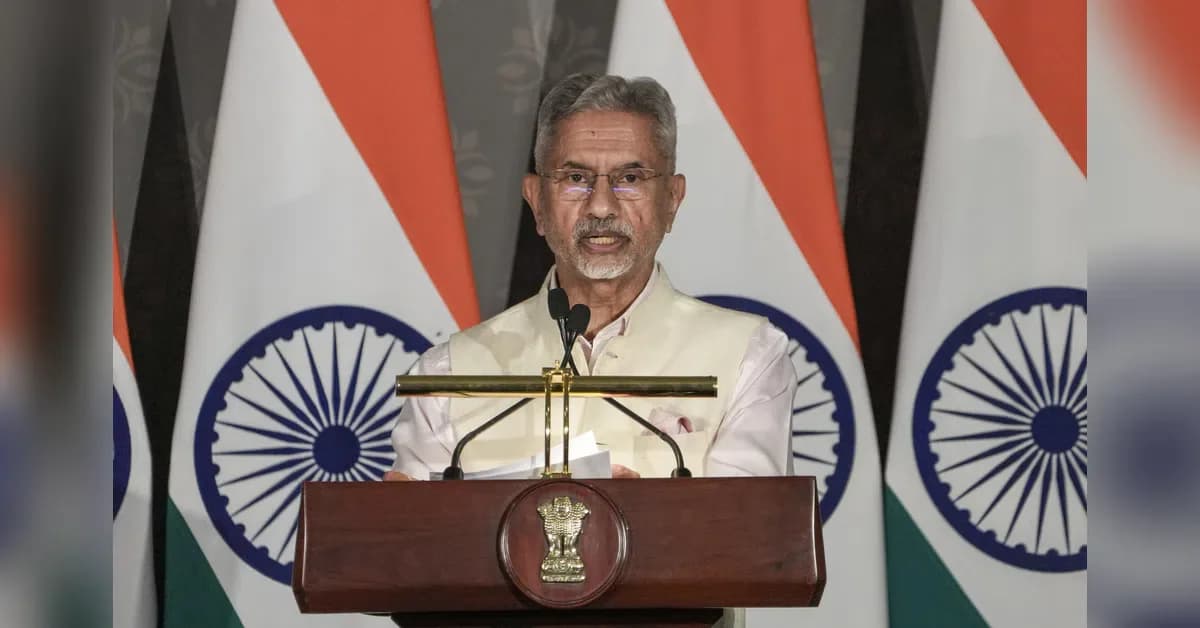
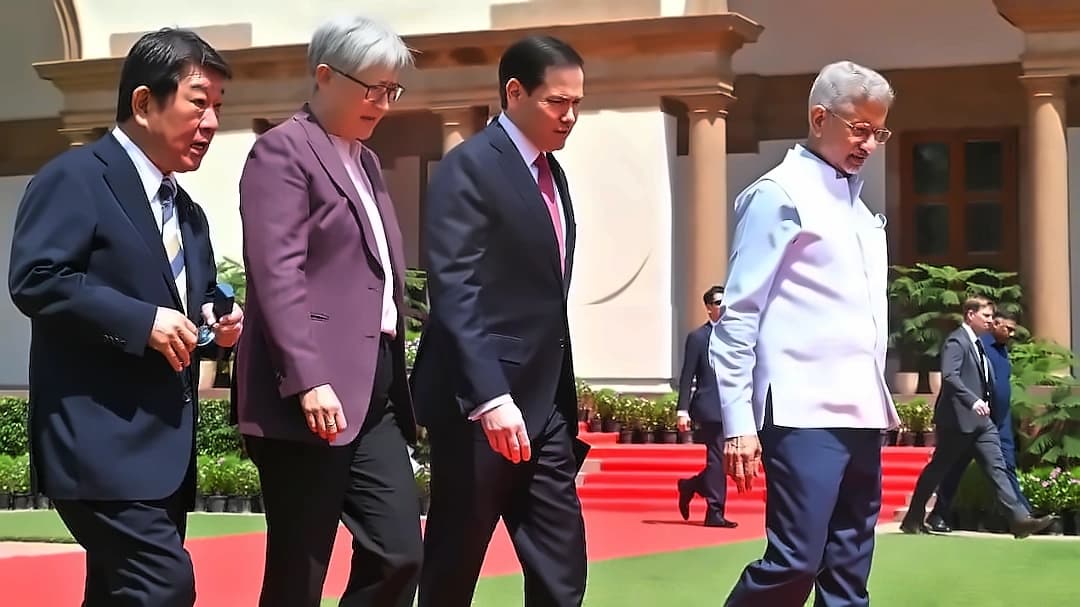
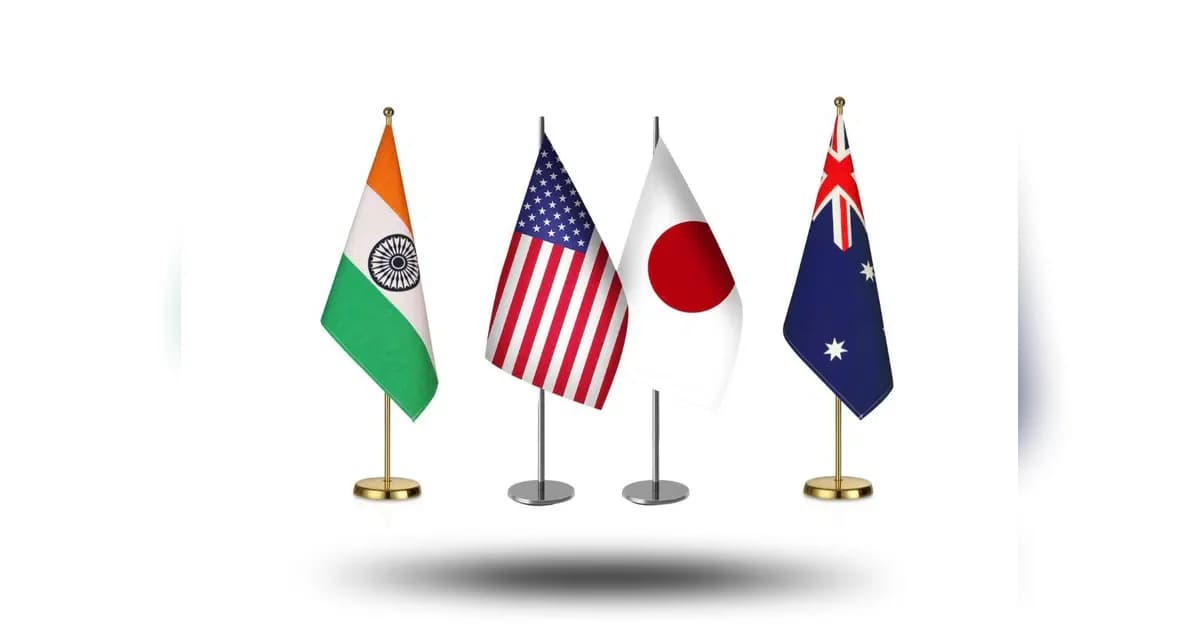
Foreign ministers from the four Quad nations are meeting in New Delhi on Tuesday at a moment of growing geopolitical uncertainty across the Indo-Pacific and West Asia. The meeting brings together External Affairs Minister S. Jaishankar, U.S. Secretary of State Marco Rubio, Australian Foreign Minister Penny Wong and Japanese Foreign Minister Toshimitsu Motegi. According to reports from Reuters, this marks the third such gathering since September 2024 and is being viewed as a significant attempt to restore momentum to the strategic grouping. The meeting is expected to last less than an hour and will be followed by statements from the four countries' diplomats. The gathering is particularly notable as it coincides with US Secretary of State Marco Rubio's four-day visit to India, with Rubio having described the Quad as an important strategic partnership and indicating another meeting is planned later this year.
At the beginning of the Quad meeting, Indian Foreign Minister S Jaishankar emphasized the need to address "connectivity choke points" and resource concentration. As reported by Reuters, Jaishankar stated that the countries need to address issues like supply chain resilience, connectivity choke points, manufacturing and resource concentration and gaps in critical infrastructure. Unlike earlier rounds that largely focused on broad statements of cooperation, this meeting is expected to centre on more operational outcomes, particularly in areas such as maritime surveillance, supply chain resilience, strategic minerals and regional security coordination. According to Reuters, Rubio recently said the U.S. would like the Quad to take "concrete actions" on issues like maritime security and critical minerals, adding that diplomats would work toward a leaders' meeting later this year. "Our goal collectively over the last year has been to turn this from a forum in which we meet and talk about problems to one where we actually do something about it," Rubio said in his opening statement. However, as noted by Business Standard, substantive progress remained conspicuously absent, with a key purpose of this meeting being to set a date for the leaders' summit, which has been indefinitely postponed since 2025.
The meeting comes at a critical juncture as the Trump administration has been heavily focused on other foreign policy priorities, including the ongoing conflict in Iran, while simultaneously working to reset ties with China. As reported by analysts, Trump, in his second term, has worked to describe Beijing as an economic competitor rather than a direct strategic adversary, raising speculation among analysts about whether the Quad still carries the same strategic significance it did when Trump revived the grouping in 2017. The bloc was originally re-established largely in response to concerns over China's expanding military presence and growing economic influence across the Indo-Pacific region, though member countries have consistently maintained that the grouping is not a formal military alliance. Beijing has criticized the Quad as a Cold War-style construct aimed at containing its development, while India has territorial disputes with China, though Modi had signaled a willingness to improve ties with Beijing amid his tensions with Trump. According to Business Standard, the détente between the US and China, as reflected in President Donald Trump's meeting with his Chinese counterpart, Xi Jinping, in Beijing earlier this month, has added to Quad nations' concerns about the grouping's relevance. Central to this development is the status of Taiwan, with its continuation as an independent nation remaining critical to Indo-Pacific security, yet during Trump's visit, Xi and the Chinese press sought to emphasise the "One China" principle.
The urgency surrounding the talks has increased sharply due to the ongoing tensions involving Iran and the continued disruption of shipping movement through the Strait of Hormuz. According to Reuters, the closure of the crucial maritime route has upended energy markets and disrupted the global economy, an issue that is likely to feature prominently in Quad discussions. The countries share concerns about the U.S. and Iran circling around a possible deal to end their three-month conflict and reopen the Strait of Hormuz. Previous Quad meetings have put forward initiatives to maintain "the free and open maritime order" in the Indo-Pacific by improving information gathering on what is happening in their waters. The joint US-Israeli war on Iran, which began on February 28, has led to a substantial drawdown in the US defence armada from the Asia-Pacific to West Asia. As reported by Business Standard, with US forces using up more than half their pre-war stockpiles of critical munitions in the war against Iran, Quad allies, notably Japan, have become increasingly worried that they will not be able to count on the US to come to their defence in the event of Chinese aggression in the South China and East China Seas.
Tokyo is especially eager to diversify its supplies of critical minerals after Beijing stopped shipments of some materials used in aerospace, defence and chip-making industries to Japan following a diplomatic dispute. As reported by Reuters, Japan, in particular, is expected to emphasise the need for alternative sourcing networks for rare earths and other strategic materials after Beijing imposed restrictions on exports of certain minerals. Tokyo views the issue as a major national security concern because these materials are critical to advanced manufacturing sectors and military technologies. The urgency is compounded by China's expanding naval footprint and assertive actions in contested waters, with officials from the four nations expected to discuss developments in the South China Sea and East China Sea. According to Reuters, the closure by Tehran of the crucial waterway has upended energy markets and disrupted the global economy, an issue that is likely to feature prominently in Quad discussions.
Analysts suggest that the talks in New Delhi could pave the way for a long-delayed Quad leaders' summit, with a summit having been expected last year but postponed amid trade tensions between India and the US. While there is still no confirmation on whether leaders will meet this year, analysts indicate that India would likely seek greater clarity once the foreign ministers conclude their discussions in New Delhi. The meeting represents an important signal that the Quad intends to remain active despite rising global instability and evolving geopolitical priorities, with officials viewing the latest ministerial dialogue as an important step toward maintaining the grouping's institutional relevance in the Indo-Pacific region. "I don't have a date on that yet, but hopefully this year we'll find a time for all four leaders to get together," Rubio said regarding a potential leaders' meeting. According to Reuters, analysts have questioned whether a lack of leader-level engagement has downgraded the Quad's importance, making this meeting particularly significant for the grouping's institutional continuity. As noted by Business Standard, there is some irony in Quad's predicament in Mr Trump's second term, as it was in his first term that the grouping, which was largely moribund for a decade, was revived during a 2017 East Asia Summit in the Philippines.