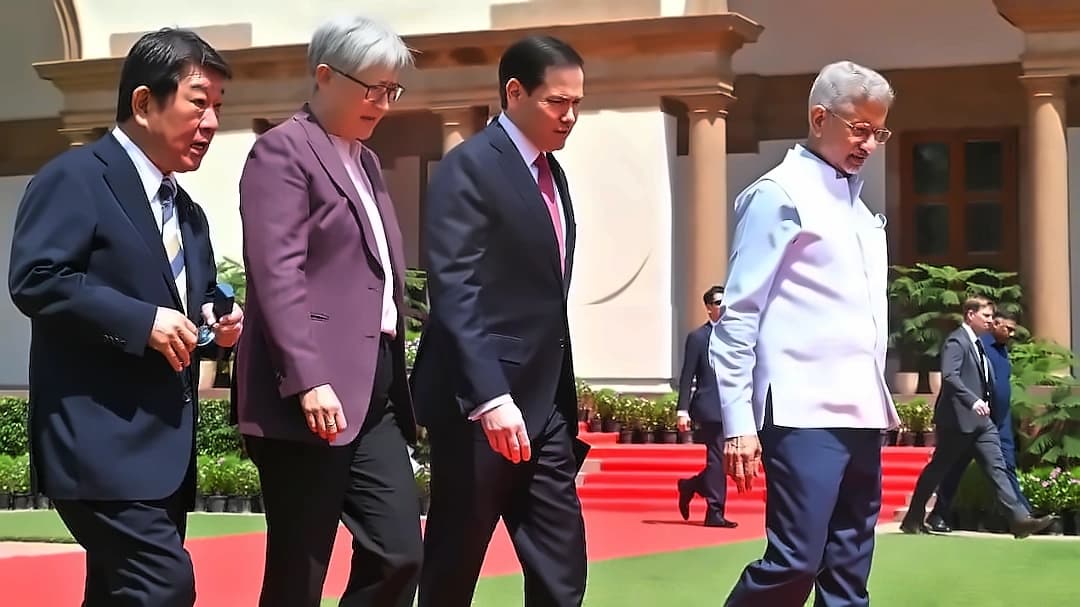
The Quad nations have finalized their critical minerals cooperation framework pledging up to $20 billion in public and private capital to strengthen supply chains. The framework was finalized at a meeting of the grouping's foreign ministers in New Delhi, chaired by External Affairs Minister S Jaishankar and attended by US Secretary of State Marco Rubio, Australian Foreign Minister Penny Wong, and Japanese Foreign Minister Toshimitsu Motegi. According to Kyodo News, the four nations intend to 'mobilize up to $20 billion in government and private sector support through new and existing efforts' to strengthen supply chains, including in mining, processing and recycling. The agreement represents a significant escalation in the Quad's efforts to address global supply chain vulnerabilities and reduce dependence on any single country for critical minerals.
The Quad nations voiced 'grave concern' over what they described as economic coercion, arbitrary export restrictions and price manipulation targeting critical minerals, in a veiled reference to China's export control regime in the sector. As reported by Kyodo News, Japanese Foreign Minister Toshimitsu Motegi specifically shared serious concerns over export restrictions on critical minerals, as China has tightened controls on rare earth exports. The statement emphasized the group's opposition to policies that create artificial market barriers and undermine global trade norms. The concerns were specifically directed at practices that disrupt global industrial sectors and supply chains, with the grouping expressing particular concern about China's dominance in the global critical minerals supply chain, accounting for around 70% of global rare earth mining. Australian Foreign Minister Penny Wong also expressed opposition to any plan to impose transit fees in the Strait of Hormuz, which Iran has effectively closed.
The Quad nations underlined the need for 'diversified and reliable global supply chains' and stressed the importance of avoiding excessive dependence on any single country for critical minerals and related technologies. According to Kyodo News, the foreign ministers discussed closer cooperation on energy security as tensions in the Middle East continue to raise concerns over fuel supplies and prices. Since the launch of U.S.-Israeli strikes on Iran on February 28, fuel price surges have underscored vulnerabilities in energy security. The framework specifically aims to advance the vision for fair and diversified critical minerals markets through coordinated economic policy tools and investment strategies. The grouping also agreed to cooperate on port infrastructure development in the Pacific island nation of Fiji, demonstrating their commitment to regional infrastructure development and supply chain resilience.
Under the initiative, the grouping will identify projects operated by companies headquartered in Quad partner countries or supplying Quad markets that address critical mineral supply chain gaps. As reported by Kyodo News, the framework will support strategic critical minerals projects through export credit agencies, development finance institutions, mobilization of private capital, or other public supporting tools such as guarantees, loans, equity participation, insurance and subsidies. The framework will also explore new mechanisms to help mobilize private capital and strengthen critical minerals supply chains in Quad partner countries and regionally. Quad partners intend to work together to improve the recovery and use of critical minerals from e-waste and other scrap materials to enhance the supply chain and promote recycling of contained critical minerals. The foreign ministers also laid the groundwork for the next Quad summit, with no date yet decided, though the previous summit was held in September 2024. US Secretary of State Marco Rubio emphasized that 'Our goal collectively over the last year has been to turn this from a forum in which we meet and talk about problems to one where we actually do something about it'.
Critical minerals are considered vital for high-end technology products including electric vehicles (EVs), drones, and battery storage, making their secure supply essential for advanced technologies and economic growth. The Quad nations also welcomed the progress made under the Quad Open Radio Access Networks (Open RAN), especially cooperation under this framework with Palau. According to Kyodo News, Japanese Foreign Minister Toshimitsu Motegi stated that 'It was an excellent opportunity for the countries that share common values and possess both the will and the capability to address regional challenges -- to reaffirm their commitment to strongly advancing practical cooperation toward realizing a free and open Indo-Pacific.' The framework also emphasizes the importance of trusted collaboration in critical and emerging technologies underpins our ability to protect security interests, strengthen supply chains, and sustain competitive, strong economies. In response to the gathering, Chinese Foreign Ministry spokeswoman Mao Ning stated that 'We do not support exclusive small blocs or bloc confrontation,' adding that any cooperation should not harm mutual trust among regional countries and should not target any third party.