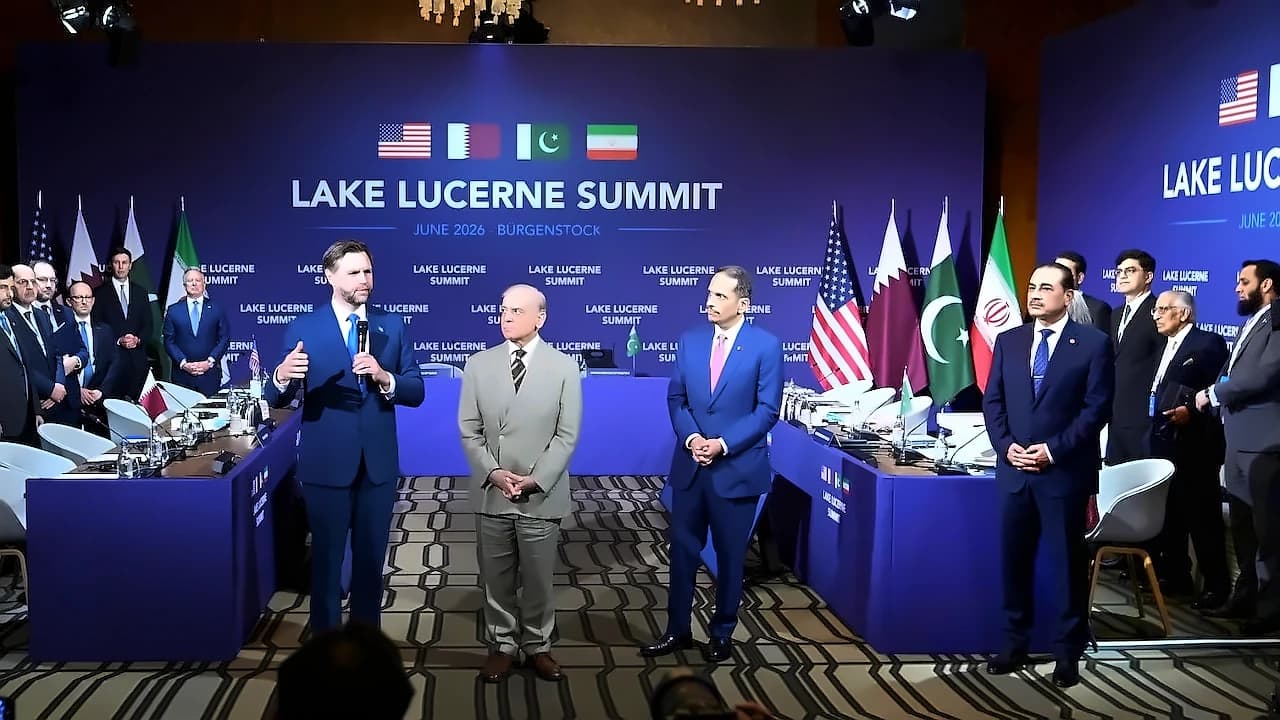
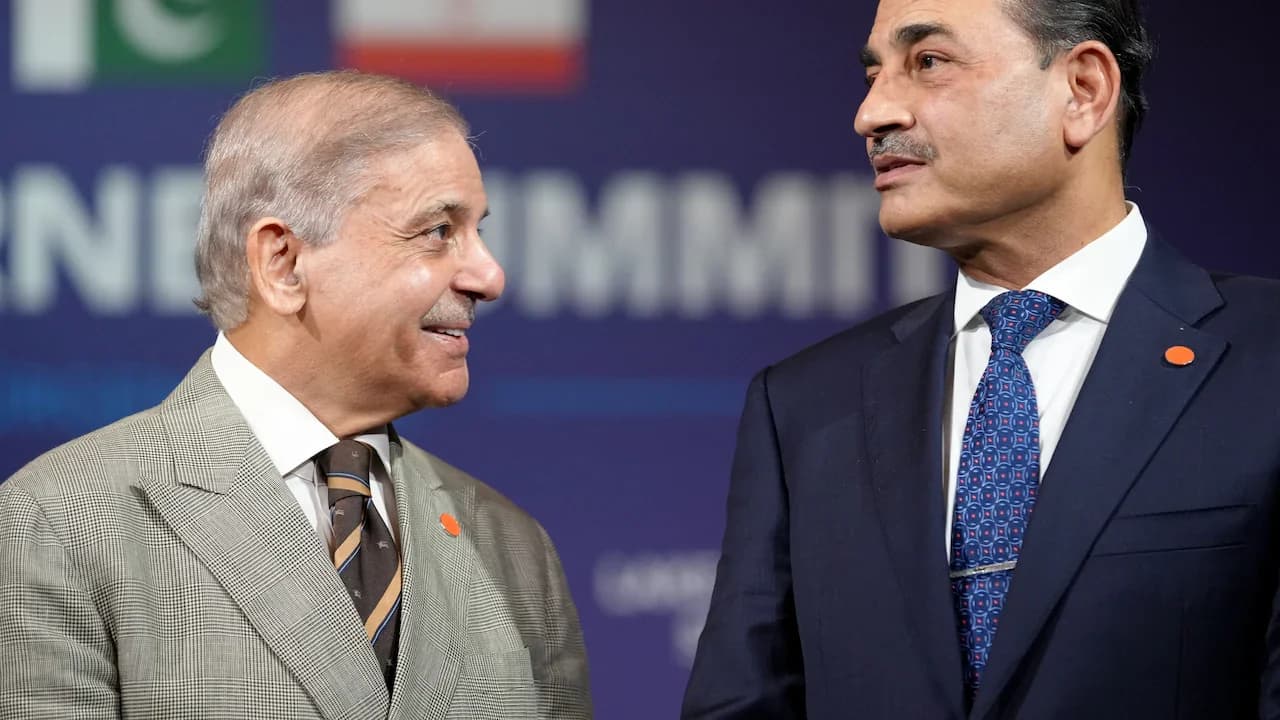
Prime Minister Shehbaz Sharif has declared that Pakistan has emerged as a 'peacemaker' in the world following its successful mediation efforts in the Iran-US peace process. Speaking at the Pakistan Naval Academy passing out parade in Karachi on Saturday, Sharif emphasized that Pakistan's efforts for peace in West Asia culminated in the signing of an agreement between the US and Iran. According to Business Standard, the Iranian President Masoud Pezeshkian's recent trip to Pakistan was an acknowledgement of Pakistan's important role in promoting peace in the region. Sharif noted that Pakistan was navigating conflicts and multi-faceted security challenges, marked by a dangerous combination of international and internal threats. The PM also accused India of using 'proxies' to undermine the stability in Pakistan, without providing evidence to support his allegations.
Iranian President Masoud Pezeshkian has arrived in Islamabad for his first overseas visit since the US-Israel war began on February 28, marking a significant diplomatic milestone following the Islamabad Memorandum of Understanding (MoU) signed on June 18. According to Al Jazeera, the timing is deliberate as Pezeshkian seeks to convert the fragile agreement into political capital both domestically and internationally. During his visit, Pezeshkian will meet with Prime Minister Shehbaz Sharif, who mediated the Switzerland talks, as well as President Asif Ali Zardari, Senate Chairman Yousaf Raza Gilani, National Assembly Speaker Sardar Ayaz Sadiq, and Deputy Prime Minister and Foreign Minister Ishaq Dar. The visit is expected to focus on discussing the Switzerland talks and ways to deepen bilateral cooperation in trade, energy, border security, and regional connectivity.
The US and Iran have agreed on a roadmap aimed at reaching a final agreement within 60 days following high-level talks mediated by Qatar and Pakistan, held in Switzerland last week. As per Business Standard, the high-level talks were held under the framework of the Islamabad Memorandum of Understanding (MoU), signed by the US and Iran on June 18. Speaking to lawmakers during his address to the National Assembly, Sharif expressed hope that the Islamabad Memorandum of Understanding (MoU) will turn into a long-lasting agreement during this period. The announcement comes following 'successful' Switzerland talks that concluded early Monday, with agreements on several mechanisms aimed at advancing negotiations toward a final deal under the Islamabad MoU. The first round of talks in Burgenstock, Switzerland, which concluded on Sunday, produced several outcomes: a high-level political committee, working groups on nuclear issues and sanctions, a communication line on the Strait of Hormuz, and a de-confliction mechanism for Lebanon.
Pakistan Prime Minister Shehbaz Sharif has strongly defended Iran's ballistic missile capabilities, stating that Iran's missile programme was never part of the US agreement. Speaking alongside Iranian President Masoud Pezeshkian in Islamabad, Sharif emphasized that ballistic missiles were 'never on the table' during negotiations between Iran and the US. According to reports from The Times of India, Sharif warned against what he called 'double standards' on missile capabilities, arguing that Iran should not face restrictions that do not apply to other nations. 'There cannot be double standards where some countries can have ballistic missiles and Iran should not,' Sharif stated, warning against what he called 'duplicity' in international relations. Iran's missile programme remains a major concern for Israel, which faced hundreds of missiles during the recent conflict, as noted by Business Standard. Iranian Foreign Ministry spokesman Esmaeil Baqaei has previously stated that 'Iranian missiles are only for firing, not for negotiations' and that 'Iran's defence capability will not be discussed in any way, in any process or with any party'.
The visit represents Pezeshkian's second trip to Pakistan as Iranian president, following his first visit after the 12-day Iran-Israel war in June 2025, when he chose Pakistan as his first foreign destination. During that initial visit, twelve bilateral agreements were signed and a target of $10 billion in annual trade – up from roughly $3 billion – was pledged. As reported by Al Jazeera, Pakistan is the first country chosen by President Pezeshkian to come and personally express his gratitude and appreciation for the Pakistani political, military, and people of Pakistan for their commitment, for their help, for their efforts to pursue the mediation mission. The diplomatic efforts have been extensive, with Sharif and Pezeshkian speaking by phone at least seven times since the US-Israel attacks began on February 28, often in conversations lasting up to an hour. Pakistan's army chief, Field Marshal Asim Munir, travelled to Tehran at least twice, while Interior Minister Mohsin Naqvi also made multiple visits as part of Pakistan's mediation efforts. Prime Minister Sharif also announced that he will visit Iran next month to attend the funeral of assassinated Supreme Leader Ali Khamenei, demonstrating the strengthening diplomatic ties.
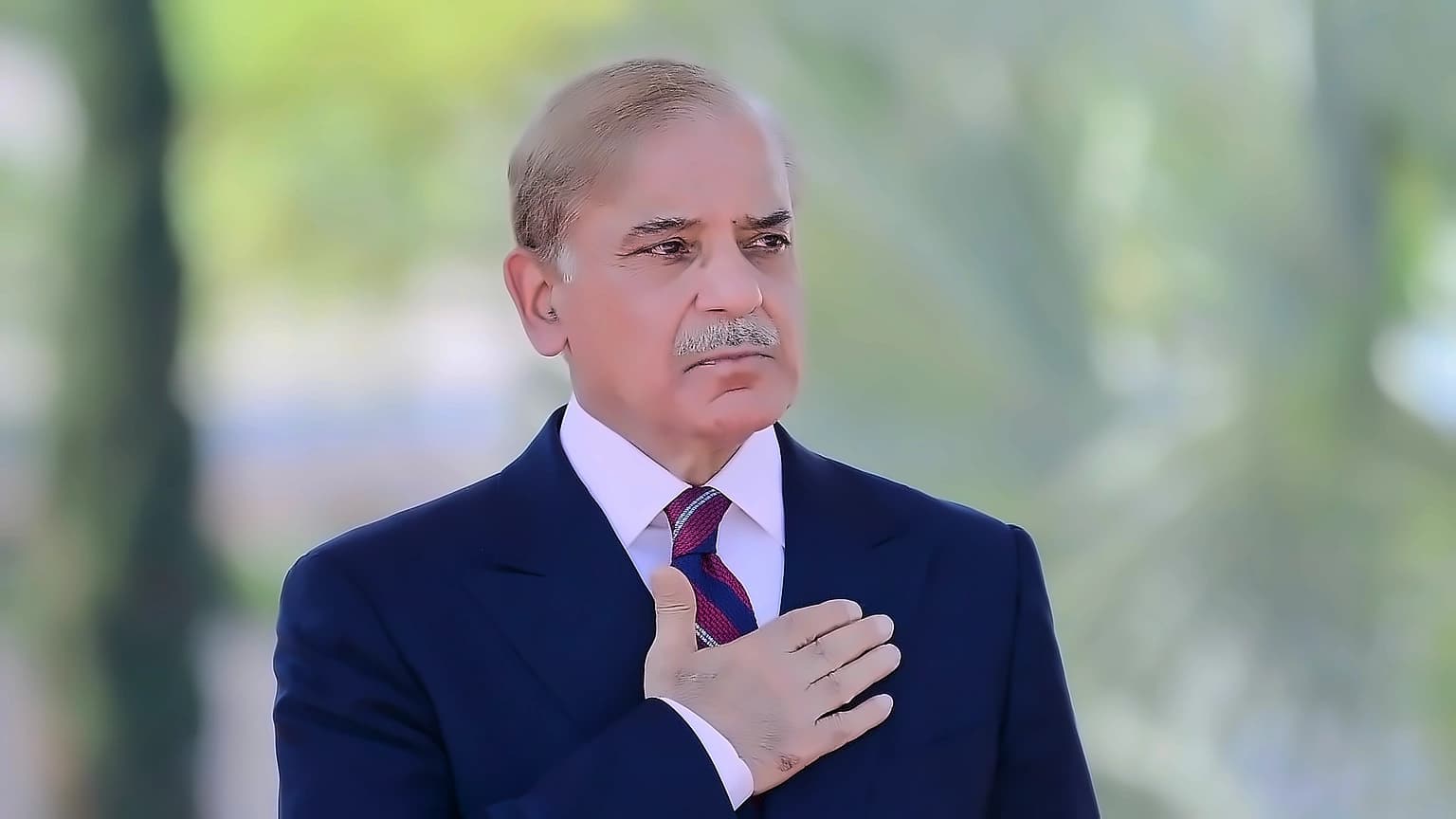
The visit validates Pakistan's evolution from a facilitator to a recognised regional mediator, as analysts note that Iran is signalling that Islamabad has become politically invested in the outcome of the process. According to Al Jazeera, 'Pakistan is no longer just facilitating messages,' with Iran's choice of Islamabad demonstrating political trust-building capabilities that technical negotiations cannot achieve. Former Pakistani ambassador to Iran Asif Durrani remains cautiously optimistic, noting that Iran is 'comfortable not adopting the nuclear weapon route' and would comply with IAEA safeguards, while the bigger prize is sanctions relief, with Iran already allowed to export oil for 60 days following the MoU signing. Prime Minister Sharif praised the 'sagacious' leadership of Pezeshkian and his colleagues and highlighted Pakistan's role as an 'honest and sincere mediator' in the US-Iran peace process. 'The peace deal between the US and Iran would bring a new era in the region,' Sharif stated, recalling that 'this war has come to an end, which could have engulfed the entire region and beyond'. The Islamabad Memorandum of Understanding, which the US and Iran signed on June 17, represents a significant step toward resolving regional tensions, with Sharif warning that 'spoilers all over the world' wanted to 'scuttle this peace deal' and prevent Iran from emerging stronger after the conflict.