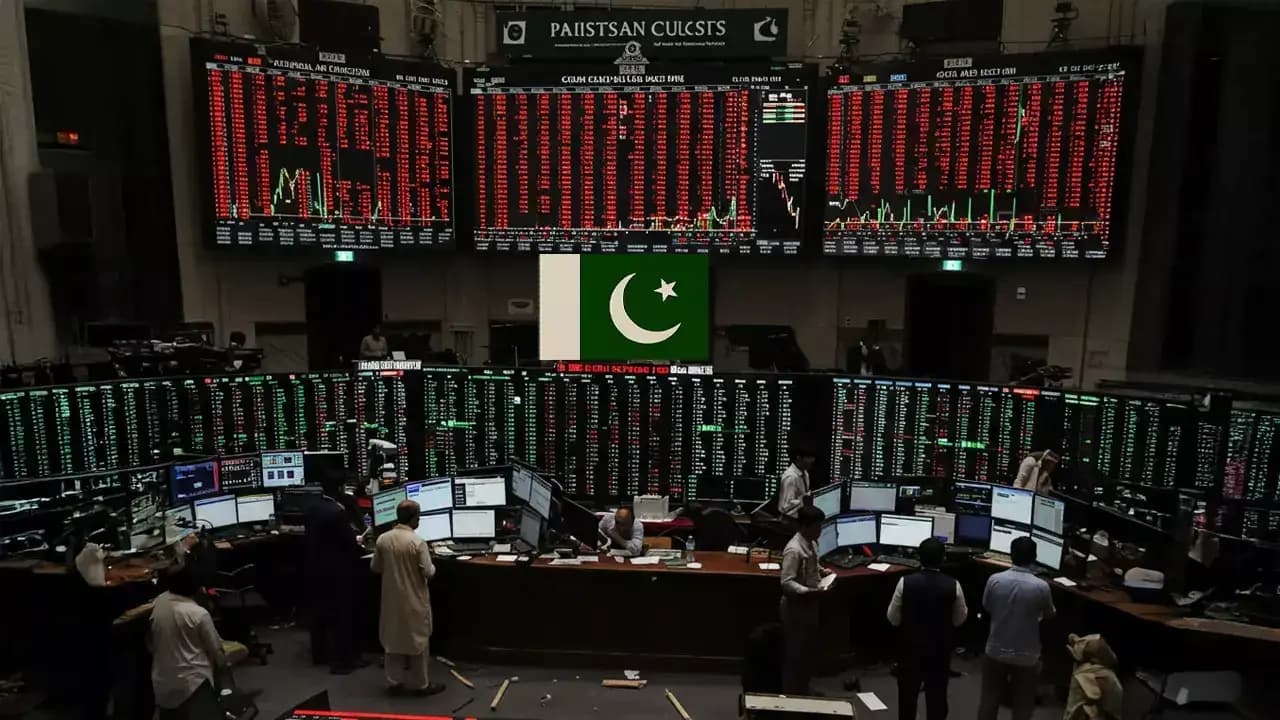
Pakistan's stock markets experienced a dramatic turnaround on Tuesday, with the benchmark KSE 100 surging nearly 4,000 points in early trade amid renewed hopes of fresh talks between Iran and the United States. According to The Economic Times, this rally comes after the index had plunged over 6,000 points in the previous session after peace talks collapsed over the weekend. The optimism follows an earlier round of negotiations—brokered by Pakistan's Prime Minister Shehbaz Sharif and army chief Asim Munir—that failed to produce a peace agreement. US President Donald Trump said that his administration received a call from Iran who is now eager to negotiate after the US imposed a naval blockade on Iranian ports, telling reporters at the White House that "they'd like to make a deal very badly."
Pakistan's fragile economic recovery is facing severe pressure as volatile global oil markets and geopolitical tensions strain the country's fragile finances. The March Economic Outlook released by Pakistan's Finance Division highlights growing uncertainty in global energy markets, noting that crude oil remains highly volatile amid multiple supply disruptions and intensifying tensions between Iran and the United States. As reported by Business Recorder, the outlook points out that global oil markets are "on tenterhooks," with supply outages and geopolitical risks continuing to influence price movements. The March 30 IMF observation warned that economies in West and South Asia remain particularly vulnerable to external shocks, with countries facing heightened risks when global financing conditions tighten.
The cooling of geopolitical tensions has provided significant relief to global energy markets, with Brent crude futures declining nearly 2% to trade at $97.5 per barrel and WTI Crude futures dropping more than 2% to $97 per barrel on Tuesday morning. According to The Economic Times, the cooling oil prices and rising hopes for peace talks have boosted global markets, providing much-needed relief to Pakistan's economy. For Pakistan, higher oil prices translate directly into increased import costs, adding pressure on the current account deficit and currency stability. The renewed tensions in the Strait of Hormuz, a critical global oil transit route, have added to volatility, raising concerns about sustained disruptions in supply chains.
Pakistan's external financial position has deteriorated significantly this month with the United Arab Emirates requesting a $3.45 billion loan recall from Pakistan. According to Business Recorder, there was reportedly no request to cut the $800 million owed by Etisalat to Pakistan since the privatization of PTCL decades ago. Additionally, an additional $1.4 billion was repaid on maturing Eurobonds this week past. This development underscores the ongoing strain on Pakistan's external finances, with the country's foreign exchange reserves standing at $16.4 billion as of March 19, 2026. As reported by Business Recorder, a significant portion of these reserves is supported by external inflows and rollover arrangements, with over $12 billion of these reserves linked to annual rollovers from three allied countries.
Despite Pakistan's challenging economic conditions, international investment sentiment appears to be improving. Jefferies' top global equity strategist Christopher Wood, known as an India bull, recently said he views Pakistan as a high-beta opportunity tied to support from the IMF, while remaining marginally positive on India over the long term. According to The Economic Times, Wood argued that although India has vastly outperformed Pakistan for decades, Pakistan's equity market tends to deliver outsized returns when IMF bailout programmes help restore macroeconomic stability. This positive outlook comes as Pakistan's foreign exchange reserves have improved dramatically from under $3 billion on February 3, 2023, to $16.4 billion as of March 19, 2026, though these reserves remain structurally weak with the IMF noting that countries with limited reserves face heightened risks when global financing conditions tighten.