European markets are edging closer to their pre-war record highs as technology shares climb and easing geopolitical tensions send oil prices lower. According to Bloomberg, the Stoxx Europe 600 index was up 0.3% as of 9:22 a.m. in Paris, just 0.6% away from its February peak. ASML Holding NV and Infineon Technologies AG were among the biggest contributors to the benchmark, after Micron Technology Inc. rallied to top $1 trillion in market value in the US. Autos rose after data showed European car sales climbed for the third consecutive month in April as consumers continued to snap up more electric and hybrid models, with Volkswagen AG, Stellantis NV and Ferrari NV gaining more than 1%. The energy sector was among the biggest laggards as Brent crude oil dropped 2% to about $97 per barrel on optimism that the US and Iran will sign a peace deal. Global investors are increasingly looking beyond geopolitical tensions and focusing on the powerful earnings momentum being driven by artificial intelligence investments, according to BofA Global Research.
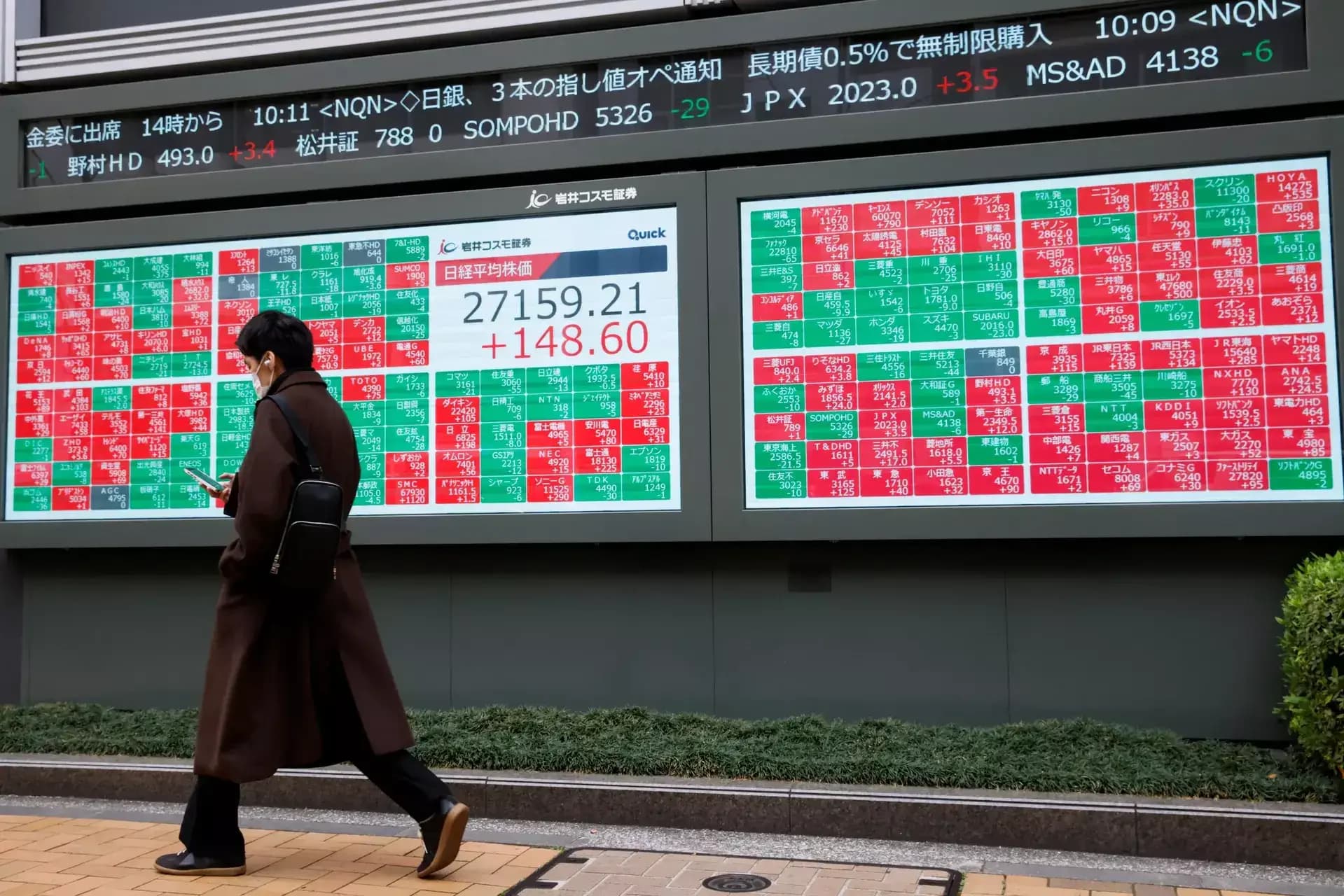
Japan's Nikkei index retreated from its record high on Wednesday, closing at 64,999.41 after rising as much as 2.2% earlier in the session to hit a record intraday high of 66,428.81. According to The Economic Times, the broader Topix fell 0.52% to 3,918.01, with investor caution emerging about the rapid rise in AI-related stocks. Of the nearly 1,600 stocks trading on the Tokyo Stock Exchange's prime market, 45% rose, 50% fell, and 3% traded flat. SoftBank Group slid 7.26%, weighing most on the Nikkei and marking the index's biggest percentage loss, while chipmaking equipment maker Tokyo Electron and chip-testing equipment maker Advantest ended up 2.1% and 4.05% respectively, making them the biggest contributors to the Nikkei. Banks and financials dragged the Topix lower, with Sumitomo Mitsui Financial Group losing 1.9%, Mitsubishi UFJ Financial Group and Mizuho Financial Group slipping 0.98% and 1.93% respectively.

Markets experienced a significant rally on Monday as reports emerged of a potential breakthrough in US-Iran negotiations, with Brent crude futures falling 4.7% to $95.54 a barrel despite the decline from recent peaks above $100. According to Investing.com, US stock futures surged dramatically, with Dow futures jumping 399 points (0.8%), S&P 500 futures climbing 70 points (0.9%), and Nasdaq 100 futures surging 407 points (1.4%). The rally came as 30-year U.S. Treasury bond futures ticked up by a full point, while spot gold rose 1.0% to $4,555.21 an ounce. However, Wall Street continues to remain hopeful of a peace deal between the US and Iran, with the former continuing to cite progress in negotiations, though Secretary of State Marco Rubio stated that any accord will take a few days to finalise. The fragility of the peace negotiations was evident on Tuesday after the two sides exchanged strikes on Monday, with US and Israeli jets striking Iranian targets hours after President Donald Trump signaled negotiations with Tehran on an interim agreement were progressing. According to BofA Global Research, 54% of fund managers expect the war to end by the end of June, though the actual timeline remains uncertain.
The market is experiencing solid gains on expectations of a deal with Iran, as well as "the continued explosion in optimism for all things AI," according to Vital Knowledge founder Adam Crisafulli. AI optimism "is driving additional parabolic gains in chip and infrastructure stocks," with semiconductors helping push the S&P 500 higher and chipmakers among the top performers in the benchmark. The S&P 500 has rallied 14% since the beginning of April, leaving some on Wall Street to question whether investors have already priced in a peace deal. "Don't expect an agreement to immediately send the S&P 500 running to 8,000," wrote Tom Essaye, founder of the Sevens Report, while noting that "the end of the war would allow investors to focus on strong earnings growth, which will increase the rally potential for the market." However, caution emerged for the high-pitched rally as the market sold AI-related shares that have gained in the latest sessions, according to Ichiyoshi Securities. High-flying memory maker Kioxia dropped 3.06%, while fibre-optic cable maker Fujikura reversed early gains to end 3.55% lower. According to BofA Global Research, AI-led growth is spreading beyond large technology firms to companies across different sectors, with industries tied to the AI supply chain also benefiting from the earnings acceleration.
Despite optimism on AI investments, rising bond yields remain an important risk factor for equities, according to BofA Global Research. "We are definitely concerned about rising long-term bond yields," Browning noted, pointing to historical trends that suggest weaker equity returns once US 10-year yields move above 4%. There is no doubt that the monetary conditions are tighter today than we thought they would be at the beginning of the year and that is a direct result of the war and increased inflation. While Browning's base case still assumes no Federal Reserve rate hikes this year, she admitted the probability of further tightening has increased. Global recession risks still appear limited, with BofA expecting GDP growth of about 2.2% in 2026 and 2027. The AI capex boom is expected to continue for at least another 12 to 18 months, with S&P earnings growth forecast at 22% for the full year. However, the long-term monetization potential of AI remains uncertain, with Browning noting that "we do not know the answer to that for at least another year or so."
Investors are closely watching the Federal Reserve's policy trajectory as energy-driven inflation concerns persist. According to CNBC TV18, sentiments were also aided by a fall in Treasury yields as traders pared back on hopes of the Fed hiking interest rates in the near future on fears of inflation. Treasury yields slipped but remain elevated as the curve signals a higher-for-longer warning on rates, with Morgan Stanley strategists led by Mike Wilson noting that the stock market can handle higher yields as long as strong economic growth is the main catalyst. The US dollar fell against major currencies on Monday as hopes of a deal to reopen the Strait of Hormuz pushed oil prices below $100 per barrel. The US dollar index fell about 0.2% to 99.059, while the euro rose 0.31% to $1.11639 and the British pound gained 0.42% to $1.34865. The Australian dollar advanced 0.5% at $0.7162, while its kiwi counterpart tacked on 0.37% to $0.58685.