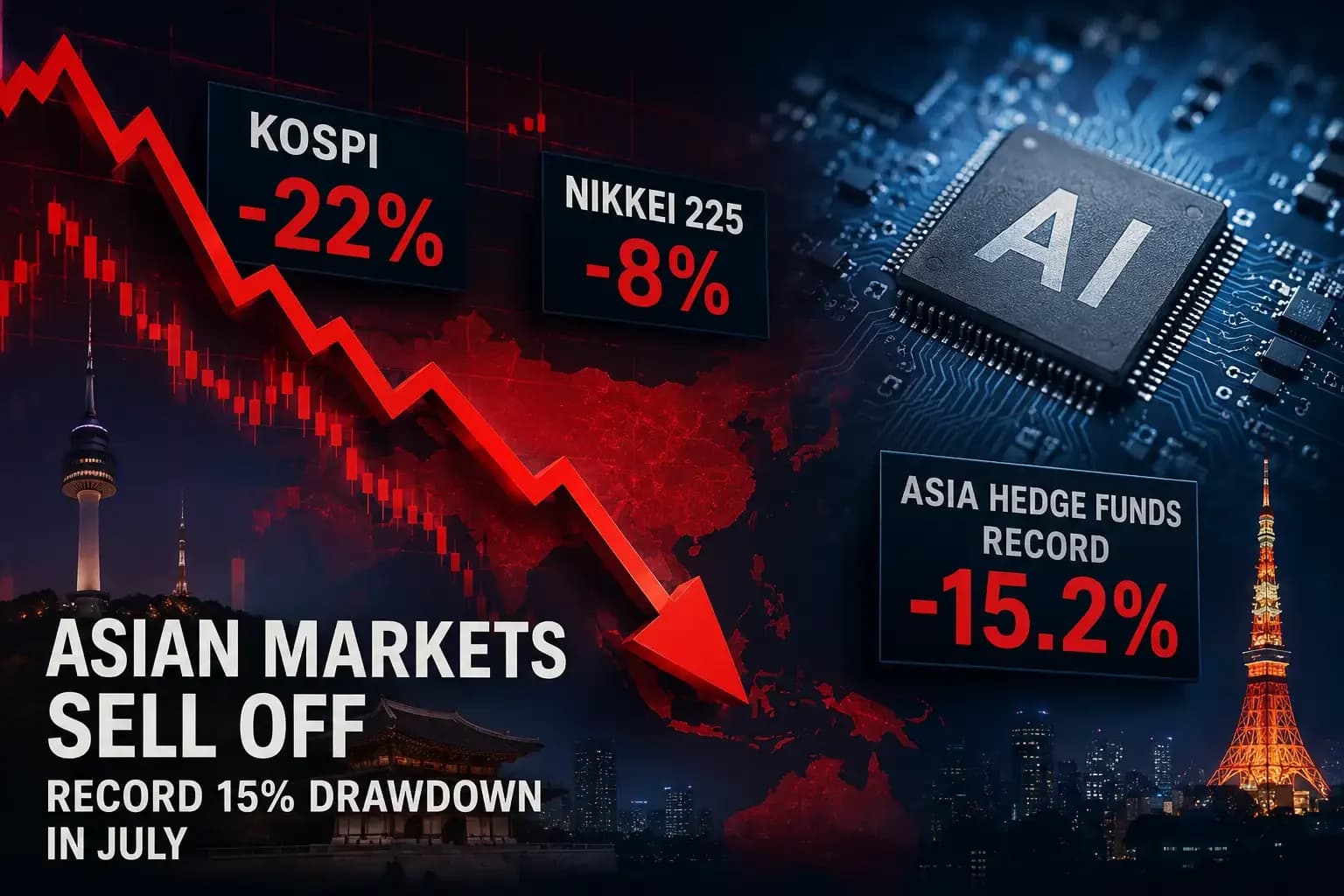
Asian markets experienced a sharp selloff on Wednesday, with the MSCI Asia Pacific gauge declining 1.2% as surging bond yields triggered widespread profit-taking, particularly in technology and export-oriented sectors. According to latest reports, South Korea's KOSPI index experienced one of the sharpest selloffs, plunging nearly 2% during early trade, compounded by an announced labor strike at regional technology giant Samsung Electronics. Japan's Nikkei 225 fell 1.7% as a weakening yen and shifting monetary policy expectations forced domestic equity liquidations, while Australia's ASX 200 dropped 1.27% pulled lower by heavy selling in financial and technology sectors. Hong Kong's Hang Seng Index slid 0.8% below 25,600, reflecting a generally cautious mood regarding regional economic growth. India's Nifty 50 declined 0.3% to near 23,550, adding to the regional underperformance as escalating US-Iran tensions dampened market sentiment.
The principal driver of the current market retreat remains the fixed-income sector, where global bond yields surged significantly as investors reassess corporate valuations ahead of pivotal technology earnings reports. In the United States, the yield on the 10-year Treasury note climbed to 4.69%, a fresh over-a-year high that reflects growing expectations that the Federal Reserve will deliver at least one interest rate hike this year. The 30-year U.S. Treasury yield advanced past 5.2%, reaching its highest level since the sub-prime crisis. According to the CME FedWatch tool, the odds of the Fed delivering at least one interest rate hike this year is 56.3%, a sharp turnaround from two interest rate cuts anticipated before the Middle East war onset. This dramatic upward shift reflects rising concerns that elevated energy costs will compel central banks, particularly the Federal Reserve, to consider interest rate hikes rather than the long-anticipated cuts. Brent crude settled at approximately $106.36 a barrel, a massive increase compared to its $70 benchmark last year, intensifying global consumer price index pressures.
Escalating fears of US-Iran war resumption have significantly dampened market sentiment, with US President Donald Trump stating on Tuesday that Washington may have to give Iran another big hit, if it doesn't agree to a deal. This geopolitical uncertainty has compounded the impact of surging bond yields and contributed to the broad-based selloff across Asian markets. The potential for renewed military action in the Middle East region has created additional headwinds for risk assets, particularly given the region's heavy dependence on oil prices and global energy supply chains. However, President Trump announced on Monday that "serious negotiations" are taking place regarding Iran's nuclear program, with "a very good chance" of a deal, which has injected some optimism into markets. Oil prices have rallied on uncertainty about the talks, with Brent crude closing above $112 per barrel and West Texas Intermediate dropping below $103 after Trump called off a planned strike on Iran following appeals by Persian Gulf allies.
Despite Asian weakness, European markets showed minor resilience during their previous closing session, with the pan-European Stoxx 600 index remaining flat at 611.34. Regional performance remained mixed, with Germany's DAX gaining 0.38% to reach 24,400.65, while London's FTSE 100 edged up just 0.07% to close at 10,330.55. On Wall Street, the major indexes registered their third consecutive loss, with the S&P 500 index declining 49.44 points (0.7%) to close at 7,353.61, the Dow Jones Industrial Average dropping 322.24 points (0.6%) to finish at 49,363.88, and the tech-heavy Nasdaq Composite sinking 220.02 points (0.8%) to 25,870.71. Corporate earnings reports were mixed, as evidenced by Home Depot reporting profits that exceeded analyst expectations, though it suffered from weaker long-term same-store sales metrics. The tech-heavy Nasdaq Composite dropped roughly 0.8% after falling more than 1% earlier in the session, with most of the "Magnificent Seven" stocks declining as investors turned focus to Nvidia earnings due on Wednesday after the market close.

The AI-driven rally has resulted in significant changes to global market hierarchy. As reported by CNBC, South Korea has leapfrogged the UK into eighth place according to HSBC data tracking global equity-market capitalisation rankings. Similarly, Taiwan's stock market overtook Canada's to become the world's sixth-largest in late April, helped by strong investor demand for artificial intelligence-related stocks and the sharp rise in shares of Taiwan Semiconductor Manufacturing Co. (TSMC). Despite this performance, market strategists at Barclays Capital noted that capital flows into U.S. stock funds had driven one of the fastest market rebounds in decades, but warned that the pendulum could now swing backward as institutional liquidity adjusts to structurally higher interest rates. Several factors have to set the stage for a summer stock market correction, according to Deutsche Bank strategist Henry Allen, including sustained oil shocks, but the six-month Brent future is still only just above $90 a barrel, and declining energy intensity means that given oil price levels don't create the economic shock they used to.