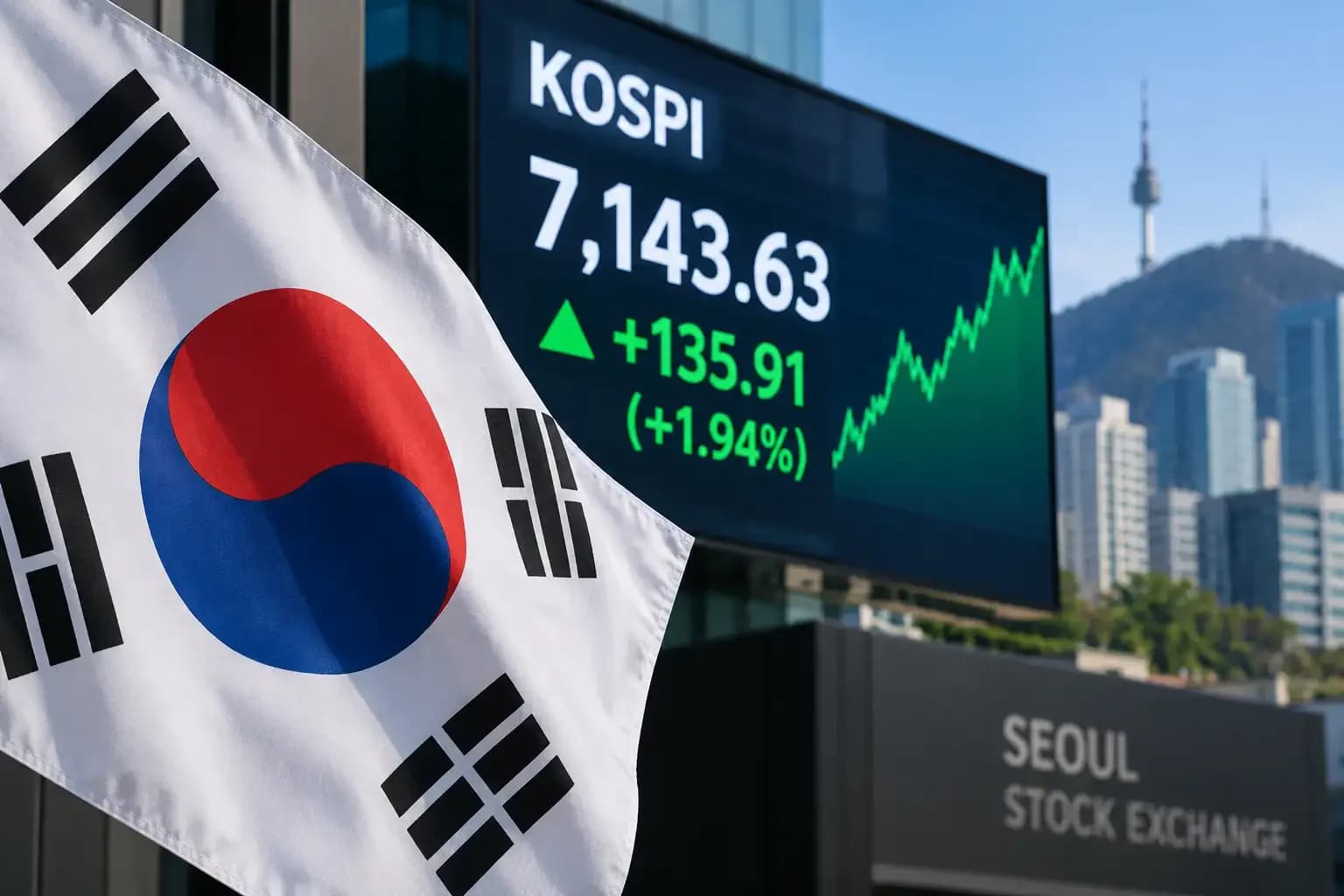
Asian markets experienced a broad-based rally on Tuesday, with MSCI's gauge of Asian shares climbing 0.5%, heading for a fifth day of gains, according to latest reports. South Korean markets led the charge, with South Korea's Kospi Index jumping more than 2% while Taiwan's stock benchmark hit an intraday record. The strong performance was driven by gains on Wall Street, with the tech-heavy Nasdaq Composite jumping 2.8% to close at 27,122.09, marking a record closing high and the largest gain since early August. Among individual stocks, memory chipmakers Samsung Electronics Co. and SK Hynix Inc. were the top contributors to gains, leading the semiconductor sector rally. As of latest trading, Samsung Electronics was up 2.65% from the previous session at 280,000 won ($205) and SK Hynix had gained 2.94% to 1.923 million won ($1,408), according to Bloomingbit.
The gains came as a broader wave of AI optimism spread through global markets overnight, with Meta Platforms Inc.'s successful rollout of its personal AI agent Muse helping fuel the optimism, with Muse released on September 8 rising to No. 1 among free apps on Apple's App Store and reviving expectations for AI-related companies. Meta shares surged 11%, their biggest gain since April last year, while the S&P 500 rose 1.5% to 7,764.70 and the Dow Jones Industrial Average added 0.7% to 52,048.83. Semiconductor stocks also drew heavy buying, with Advanced Micro Devices Inc. topping $1 trillion in market value for the first time, joining Nvidia Corp., Broadcom Inc. and Micron Technology Inc. among U.S. chipmakers with market values above $1 trillion. An index of US semiconductor stocks rallied over 4% on Monday (Sep 21) as early signs of success for Meta's AI agent revived enthusiasm around demand for the chips needed to power such agents.
Sentiment toward the tech sector received another significant boost on Tuesday as Alibaba Group Holding Ltd. said it was rolling out what it calls China's most powerful AI chip, an accelerator designed to compete with Nvidia Corp., according to Bloomberg. Its shares rallied in Hong Kong alongside those of Tencent Holdings Ltd., which also launched its latest and best image-generation model. This development adds momentum to the AI investment cycle and strengthens semiconductor demand expectations across the Asian tech sector. Kyle Rodda, a senior analyst at Capital.com, noted that "The most meaningful catalyst appears to be the release of Meta's new AI chatbot, which has been met with strong demand and resurfaced optimism about the growth outlook for the so-called AI trade. Signs of strong AI demand should improve sentiment throughout the AI ecosystem, especially chips, which ought to filter through to pockets of the Asian tech sector."
Recent analysis from Futurum's Head of Semiconductor & Infrastructure Equity Research, Rolf Bulk, reveals significant competitive advantages for major memory chip manufacturers. According to his CNBC interview, SK Hynix, Micron, and Samsung have an advantage of about two to three generations over Chinese memory manufacturer ChangXin Memory Technologies (CXMT). Bulk highlighted that CXMT has to incur a higher cost in manufacturing its chips when compared to rivals SK Hynix, Micron, and Samsung, spending 20% to 30% more on a cost per bit basis. He believes CXMT is unlikely to catch up with the three incumbents in the sector anytime soon due to constraints on fab expansion and limited access to ASML's tools. Despite these challenges, CXMT is expected to achieve revenues of $50 billion this year with gross margins of around 70%, with Bulk noting that "the supply and demand imbalance is so severe that CXMT's profitability and demand continue to remain good."
The South Korean won strengthened 0.71% to 1,365.7 per dollar on the onshore settlement platform, as reported by The Economic Times. This strengthening follows the currency's 5.4% gain against the dollar so far this year. In the bond market, December futures on three-year Treasury bonds gained 0.04 points to 102.26, while the most liquid three-year Korean Treasury bond yield fell 1.1 basis points to 4.044%. The benchmark 10-year yield declined 0.8 basis points to 4.438%, reflecting improved investor sentiment and risk appetite. A broad gauge of the dollar was little changed while markets in Japan remained shut for holidays. Hang Seng futures rose 0.3% and Australia's S&P/ASX 200 rose 0.5%, while Euro Stoxx 50 futures rose 1.4% as of 9.11 am Tokyo time.
Beyond the technology sector leaders, other major Korean companies showed positive momentum, as reported by The Economic Times. Hyundai Motor rose 2.30% and Kia Corp advanced 0.92%, while battery maker LG Energy Solution gained 0.43%. Steelmaker POSCO Holdings added 0.63%, and Samsung BioLogics edged up 0.07%. Among all traded stocks, 458 advanced and 381 declined, with foreign investors being net buyers of ₹162.8 billion ($119.3 million) worth of shares. Additional gains included Samsung Electronics preferred shares rising 2.40% to 213,000 won ($156) and SK Square adding 2.93% to 1.16 million won ($849), while Samsung Electro-Mechanics jumped 6.44% to as high as 1.521 million won ($1,114). The strong Tuesday performance builds on an already impressive year for South Korean markets, with the KOSPI rising 69.51% so far this year, according to The Economic Times.