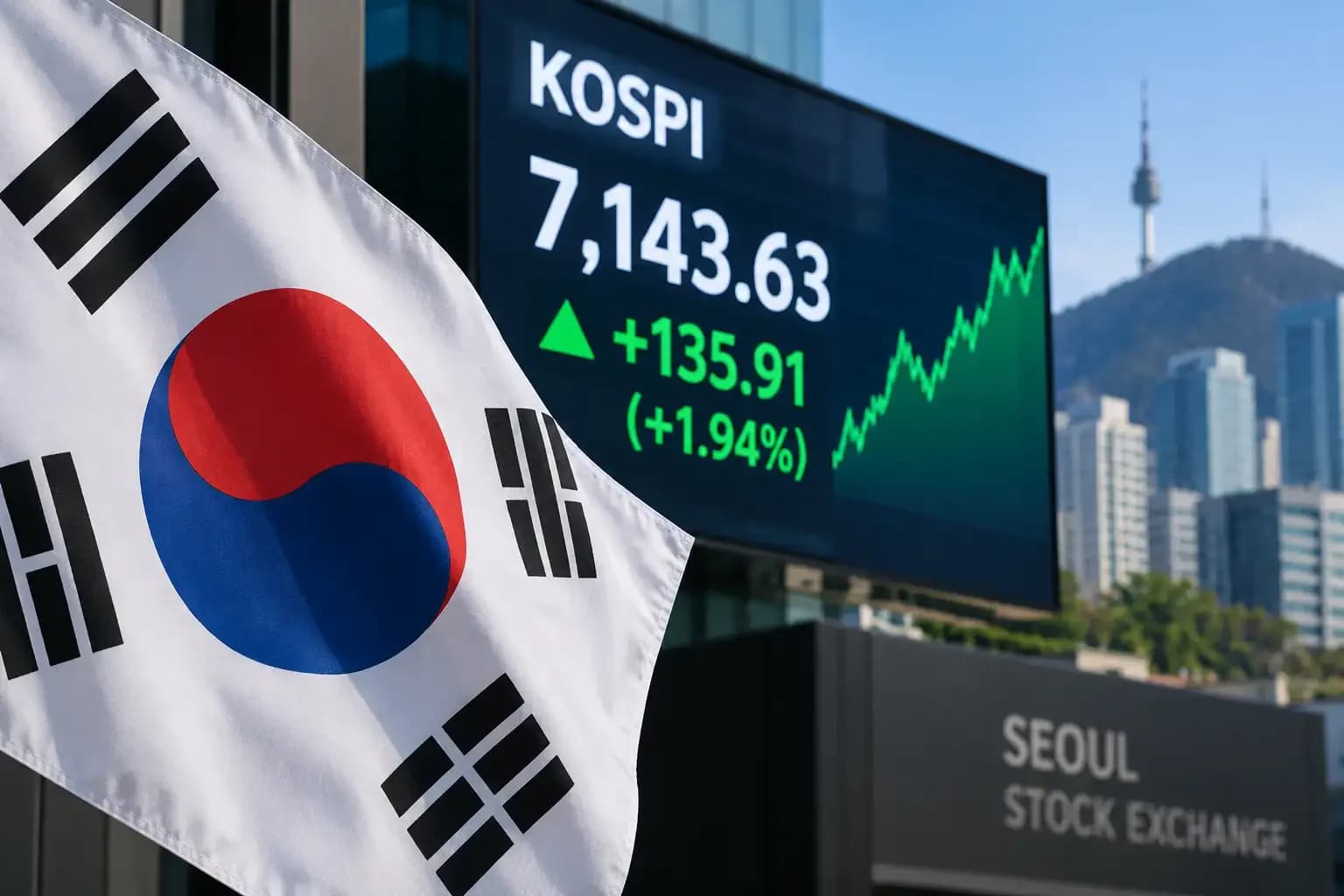
South Korea's Kospi index jumped as much as 2.7% Monday, marking a significant recovery from recent volatility. The tech-led rebound came as Samsung Electronics climbed as much as 4% and SK Hynix rose as much as 1.8% ahead of closely watched earnings. The index briefly traded above 8,300 points before easing slightly towards the 8,150 mark, while Japan's Nikkei 225 also broke above 70,000 points, rising 0.73% as chip stocks rallied across the region. According to latest reports, the moves follow a volatile stretch for Korean chip stocks, with Samsung and SK Hynix having swung sharply on memory pricing disputes and trillion-dollar investment pledges this year.
The AI trade is experiencing a significant rotation as investors question the sustainability of current semiconductor optimism. As reported by Investing.com India, some market participants are concerned about reports that Meta may consider selling excess AI compute capacity. While this does not signal the end of AI build-out, it raises questions about whether hyperscalers still need to purchase every available chip from production lines. The Korean market serves as the natural home for three-times leverage assaults, creating an ecosystem where large moves feed into themselves through retail flows, leveraged ETFs, and momentum machines. The AI trade is not collapsing but is rotating in fast motion, repricing, and becoming far less forgiving of crowded positioning, with Korea simply where the stress shows up first because the country has turned into the natural home of the three-times leverage assault.
Traders are positioning ahead of Samsung's preliminary second-quarter results due Tuesday, which will likely determine whether Monday's gains hold as investors weigh whether AI infrastructure spending is turning into profit. The rally follows recent weeks in which the Kospi flashed warning signs over stretched AI chip valuations. Additionally, traders are betting SpaceX's Nasdaq 100 inclusion on Tuesday could lift sentiment across AI-linked tech names in Asia. The upcoming earnings and SpaceX listing represent major catalysts that could provide clarity on the sustainability of current semiconductor optimism and AI infrastructure spending trends.
The Korean Butterfly Effect is evolving as the market learns to manage its volatility. According to Investing.com India, what used to appear as shockwaves is increasingly recognized as localized leverage events involving three-times ETF flows, retail momentum, forced de-risking, and thin exits. The Rubber Band Effect is now occurring intraday as quantitative traders adjust their parameters to account for Korean 3x ETF flows. As quants adjust their parameters to account for Korean 3x ETF flows, the reflexive sell-off is being met faster by systematic buying, volatility targeting adjustments, and short-covering, effectively teaching the market the rhythm of Korean market dynamics. The danger lies in that this works until the move stops being mechanical - if the underlying AI narrative genuinely weakens, the models will discover that a familiar Korean flush is not always just another rubber band snap.

The cross-market picture suggests investors have taken Federal Reserve Chair Kevin Warsh's softer inflation language to heart. According to Investing.com India, gold is edging back toward $4,100 and USD/JPY has slipped back through 162, with short-dated US rates having steadied after initially falling 5-6bp following his Sintra appearance. Warsh offered little fresh guidance and avoided endorsing either a more hawkish or dovish path, leaving markets to draw their own conclusions from the data. The Dollar Index (DXY) is sitting near the middle of its one-week range, with another 150k-plus payrolls print potentially sending it toward 101.50-101.80 as traders lean into earlier Fed hike expectations. The real instability remains in the AI rotation beneath the surface, with the cross-market picture suggesting that while equity futures are stabilizing and FX is catching its breath, the underlying leverage is being stress-tested.