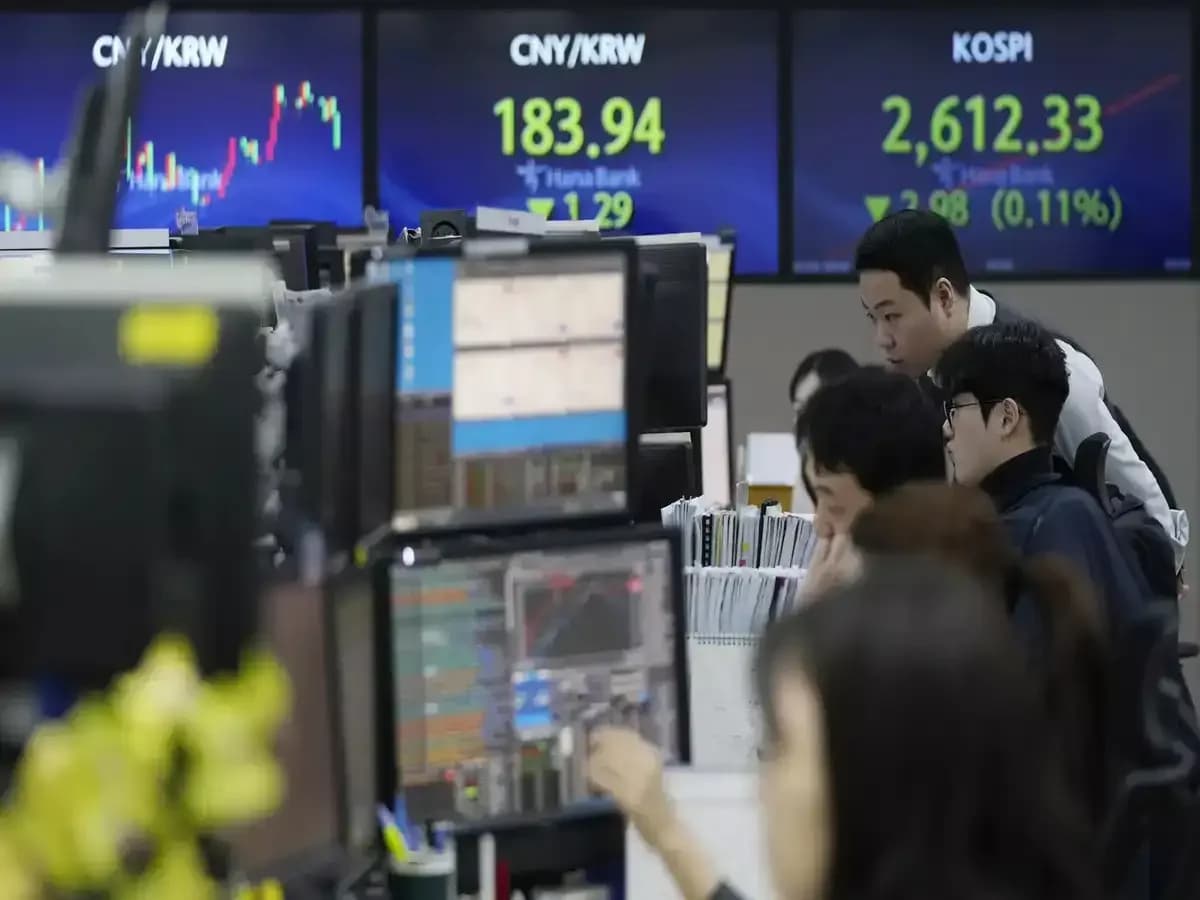
South Korean shares rallied sharply on Friday, with the KOSPI advancing 1.8% to 6,836.51 as investors awaited the U.S. Federal Reserve's interest-rate decision later in the day. According to The Economic Times, the benchmark index gained 121.10 points despite remaining down 0.9% for the week, following a 3.3% advance in the previous week. Asian stocks gained on Friday as easing oil prices and a rebound in technology shares on Wall Street improved investor sentiment, with lower U.S. Treasury yields also helping ease pressure on risk assets. The broader MSCI Asia-Pacific index outside Japan also edged higher after four consecutive sessions of declines, with Asian markets trading cautiously ahead of the Fed decision. Financial markets were pricing in a 25-basis-point increase, with the central bank's accompanying guidance expected to be closely watched for indications of further tightening.
The Bank of Korea's August rate hike exposed a growing policy divide, with one policymaker voting against the increase and favoring a pause. According to Reuters, the central bank raised its benchmark interest rate by 25 basis points to 3.00% on August 27, delivering its second straight increase as inflation remained above target and financial stability concerns persisted. However, minutes from the meeting released on Tuesday showed that one policymaker opposed the rate increase and preferred to keep borrowing costs unchanged. Dissenting board member Hwang Kun-il argued that the central bank should pause to assess rising loan delinquency risks and provide greater support to economic growth. The seven-member monetary policy board voted 6-1 in favor of the August increase, with the split decision highlighting growing debate over monetary policy tightening.
Samsung Electronics and SK Hynix led the market rally on Friday, with Samsung Electronics rising 2.28% and SK Hynix gaining 4.30%, tracking a 3.1% rise in the Philadelphia Semiconductor Index on Thursday. As reported by The Economic Times, SK Hynix, the world's second-largest memory-chip maker, has also reported strong earnings as demand for AI-related memory products remains elevated. The company's second-quarter operating profit reached 60.54 trillion won, demonstrating the continued strength of AI-related memory demand. Samsung Electronics and SK Hynix have announced shareholder-return plans totalling more than ₹130 trillion ($97 billion) for 2026, supported by strong cash flows from the AI boom. These companies have remained a key driver of South Korean equities amid strong demand linked to artificial intelligence and high-performance computing.
South Korea's economy is experiencing unprecedented growth driven by artificial intelligence chip demand, with nominal GDP growing 21.9% in the first half of 2026. However, as reported by the Bank of Korea, real GDP grew only 0.6% from the previous quarter during the second quarter of 2026, while nominal output increased 26.4% year-over-year as higher semiconductor export prices improved the country's terms of trade. The central bank has raised its full-year real GDP growth forecast from 2% to 2.6%, attributing much of the revision to semiconductor exports connected with global AI investment. Almost 70% of this expansion comes from semiconductors alone, highlighting the sector's dominant role in the country's economic performance, with semiconductors representing more than 40% of South Korea's merchandise exports during some months in 2026.
The AI chip boom has created significant concentration risks in South Korea's market structure. As reported by the Bank of Korea, the KOSPI benchmark stock index, dominated by semiconductor giants Samsung Electronics and SK Hynix, both now concentrate close to half of their market cap and most of their earnings growth in the first six months of 2026. Global demand for high-bandwidth memory (HBM) and advanced DRAM chips is driving this rally, with major tech companies including Nvidia, AMD, Microsoft, Google, Amazon, Meta, and Oracle all depending on Samsung and SK Hynix for AI accelerator memory. The Bank of Korea notes that along with Micron, they are the only large-scale global suppliers of these advanced chips. Price moves in the two chipmakers can affect index funds, derivatives, retirement portfolios and structured products linked to the Kospi, creating systemic risks for the entire market. South Korean equities have remained sensitive to global technology-sector moves and changes in expectations for U.S. interest rates, with earlier this year the KOSPI suffering a sharp sell-off when stronger U.S. employment data increased expectations of a Fed rate hike.

South Korean authorities have responded to market volatility by proposing restrictions on leveraged trading. The government announced proposed restrictions in July that could cap an individual's allocation to leveraged single-stock ETFs at 20% of investment assets, following sharp changes in domestic technology stocks. The Bank of Korea's next monetary policy decision is scheduled for October 22, when officials will reconsider inflation, growth, household debt and financial-market conditions. The central bank warns that a reversal in AI spending could reach other markets, with some analysis suggesting global AI investment growth could reach its fastest pace before the end of 2026. Samsung and SK Hynix have announced shareholder-return plans totaling more than ₹130 trillion ($97 billion) for 2026, though analysts describe the earnings gains as dependent on a cyclical industry.