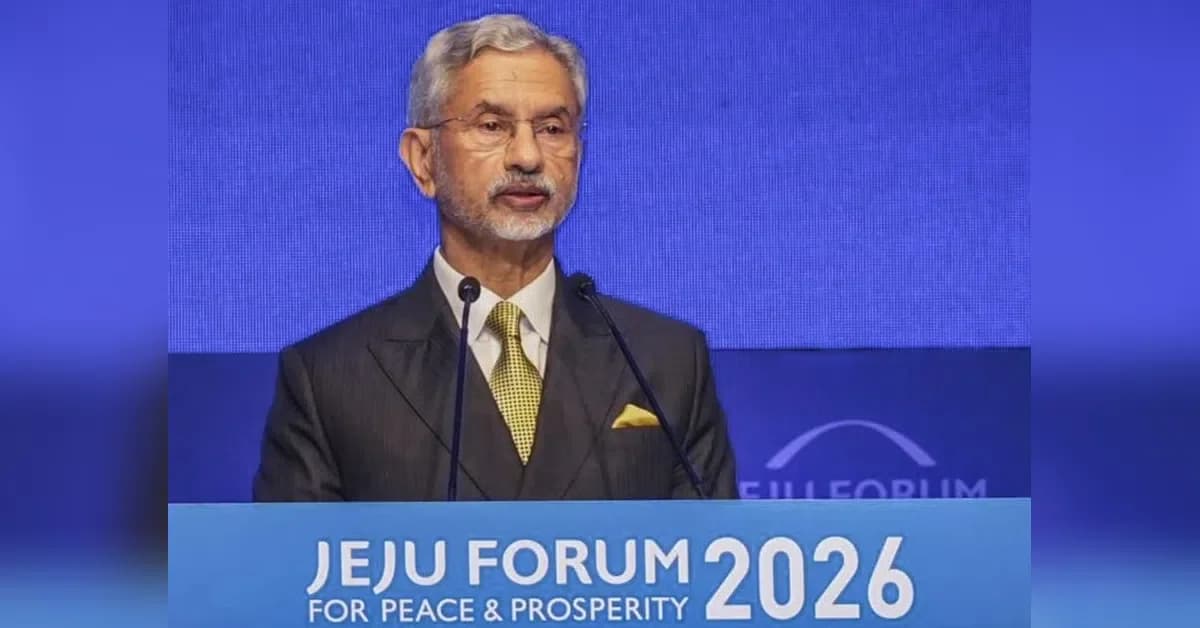
External Affairs Minister S Jaishankar emphasized that 'reformed multilateralism' is essential in an increasingly fragmented global order, stating that 'the world cannot rely on a few countries to uphold rules and norms.' According to reports from Business Standard, Jaishankar made these remarks while addressing the Jeju Forum for Peace and Prosperity 2026 in South Korea, where discussions centered on 'a fragmented world as a problem' and 'reinventing cooperation as a solution.' The minister argued that 'fragmentation is here to stay' and 'it is not altogether bad; in some ways, even good,' as it means 'less dominance, more space and greater democratisation.'
Jaishankar outlined a comprehensive five-pronged approach to address fragmentation challenges, as reported by Business Standard. The strategy includes de-risking the global economy, diversifying production and supply chains, agenda-specific cooperation among influential nations, protecting international law and regimes such as the United Nations Convention on the Law of the Sea (UNCLOS), and providing the Global South with greater capacity and opportunities. The minister emphasized that 'the world must take more control over its own future' and that this must be expressed through reformed multilateralism. These comments come amid pressure on energy supplies due to West Asia conflict, India's difficulties in sourcing critical minerals, and some permanent UN Security Council members violating international law.
According to Business Standard, Jaishankar noted that the world had always been partly globalised and partly fragmented, but the current situation is different due to 'the degree of economic integration and interdependence, with global supply chains, their efficiency and resilience playing a much larger role.' He pointed to leveraging of financial strength, production capabilities, market share and control over resources as divisive forces. Referring to disruption around the Strait of Hormuz, he said 'the natural flow of commerce is increasingly influenced by strategic calculations, with implications for global connectivity.'
As reported by Business Standard, Jaishankar highlighted several challenges facing international cooperation, including 'double standards' in countering terrorism and criticised what he described as 'empty promises, with some even in denial' on climate change. He said 'the natural evolution of the international economy is being blocked by non-market factors and that developing countries are being denied the right and capacity to industrialise through the manipulation of competitiveness and restrictions on market access.' The minister also flagged 'double standards' in countering terrorism and criticised what he described as 'empty promises, with some even in denial' on climate change.
According to Business Standard, Jaishankar said the world is witnessing 'greater weaponisation, higher risk-taking and a style of politics suited to the social media era.' He noted that 'as the interests of a few are openly prioritised, the costs to the many are less considered,' adding that these trends can only be countered through broader cooperation involving more countries. The minister concluded by saying 'At the end of the day, we will see whether multipolarity really delivers,' emphasizing that addressing global fragmentation requires deeper international cooperation and reformed multilateralism frameworks.