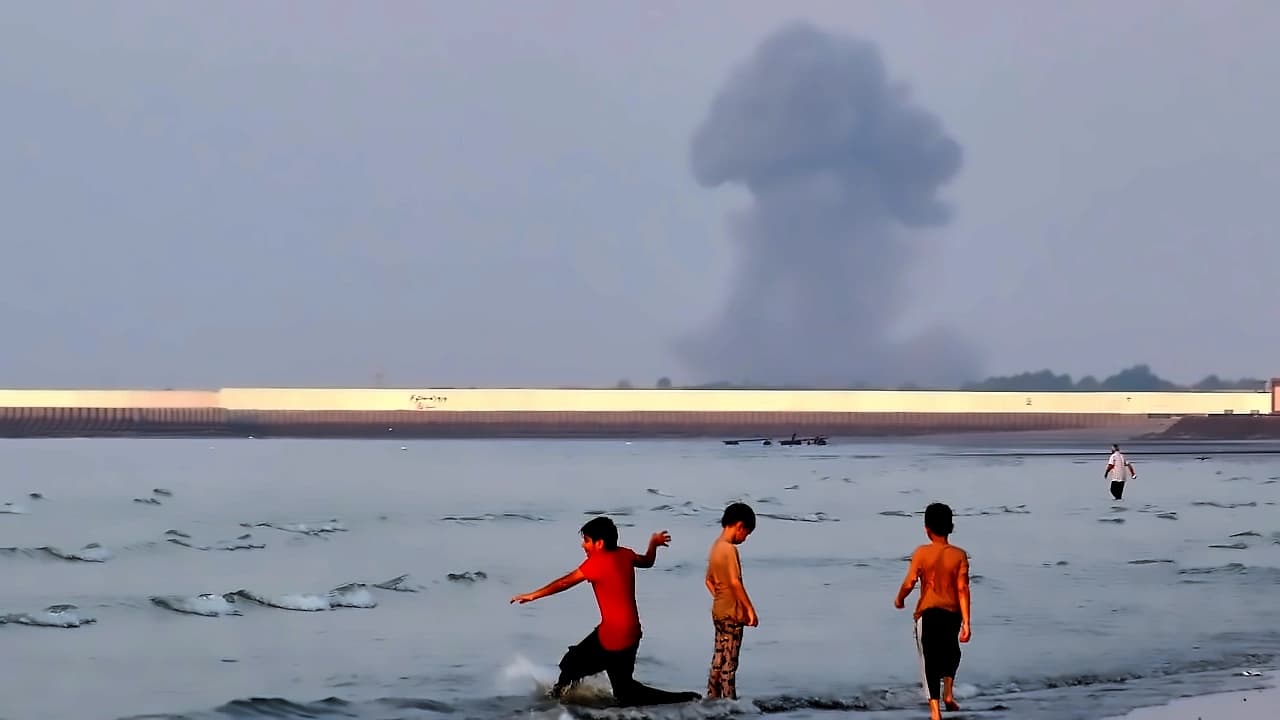
The United Arab Emirates' air force intercepted an Iranian drone over its territorial waters on Monday, according to the UAE Defence Ministry. In a short statement, the Defence Ministry said it 'dealt with' an Iranian drone that was detected over its waters approaching from Iran, with no immediate claims of responsibility from Tehran nor any reports of damage. The UAE Defence Ministry later issued a second statement denying the Al Minhad Air Base in Dubai had been targeted by Iranian missiles, as had been reported by Iranian media outlets. This incident came after US and Iran exchanged fire over the weekend, marking the first significant military action in a month and ending a lull in fighting during an intermittent war that has lasted more than six months.
US forces conducted strikes on Iranian rocket launchers on an Iranian island on Sunday, marking the first military action in over a month and ending a lull in fighting during an intermittent war that has lasted more than six months. According to CNN, the attack was triggered after forces with the Revolutionary Guard Corps were observed preparing to launch rockets with sea mines into the strait, as confirmed by Capt. Tim Hawkins, a spokesperson for the US Central Command. The US military said it carried out limited, precise action against IRGC minelaying forces posing an imminent threat in the strategically important Strait of Hormuz. This represents a significant escalation from the month-long pause in direct attacks that had been in place since the last confirmed US military action on July 29. The US military had completed clearing sea mines from the strait's international shipping routes just the previous week, highlighting the ongoing threat posed by Iranian military activities.
US President Donald Trump said on August 1 he would order the military to hold off on new strikes at the urging of Gulf allies Qatar, Saudi Arabia and the United Arab Emirates. According to Business Standard, this comes as Washington pressures other countries to help the US economically isolate Iran to try and exact concessions out of its leaders to end the war. The last time the US military confirmed targeting Iran was on July 29, when it announced a 'heavy wave of strikes' on dozens of Revolutionary Guard targets including coastal surveillance and defense sites. Trump has previously threatened action against Iran's Kharg Island, Iran's main crude oil export hub and handled about 90% of the country's oil exports before the war, located in the Persian Gulf about 25 kilometres off Iran's mainland with major oil export infrastructure.
Iran swiftly vowed to retaliate for what it called a deadly attack, with the Islamic Revolutionary Guard Corps launching missile and drone strikes against two US air bases in Jordan in response to the US attack on Larak Island. According to CNN, Iranian missiles fired into Jordan have been intercepted, with Jordan's armed forces saying they intercepted and destroyed eight missiles that entered the kingdom's airspace, neutralizing them before they could pose any threat to civilians or property. Iranian President Masoud Pezeshkian, who has favoured a negotiated end to the conflict, stressed that Iran was not seeking war before heading to attend the Shanghai Cooperation Organization's summit in Kyrgyzstan with Foreign Minister Abbas Araghchi. Pezeshkian said: 'But, we will respond decisively to aggressors.' The summit brings together a group billed as a counterweight to US global influence, and includes Chinese President Xi Jinping, Russian President Vladimir Putin and Indian Prime Minister Narendra Modi.
The fresh military action pushed oil prices higher on Monday, with Brent crude futures rising more than 2% as concerns grew over possible disruption to oil supplies and shipping through the Gulf. According to Upstox News Desk, Brent crude climbed $2.21, or 2.51%, to $90.31 a barrel as of 0436 GMT, while US West Texas Intermediate crude rose $1.83, or 2.19%, to $85.23 a barrel. The developments mark the first direct exchange of attacks between the two sides in more than a month and threaten to disrupt a period of relative military calm. A return to open conflict would be dangerous for the region, where Iran has targeted US military bases and infrastructure in Gulf countries since the war began on February 28. Despite the military action, appointments to Iran's senior security leadership in the past month have signaled Tehran's defiance after weathering decades of sanctions, with Iran still having enough drones and missiles to fire at vessels transiting the waterway through which 20% of the world's oil normally flows.