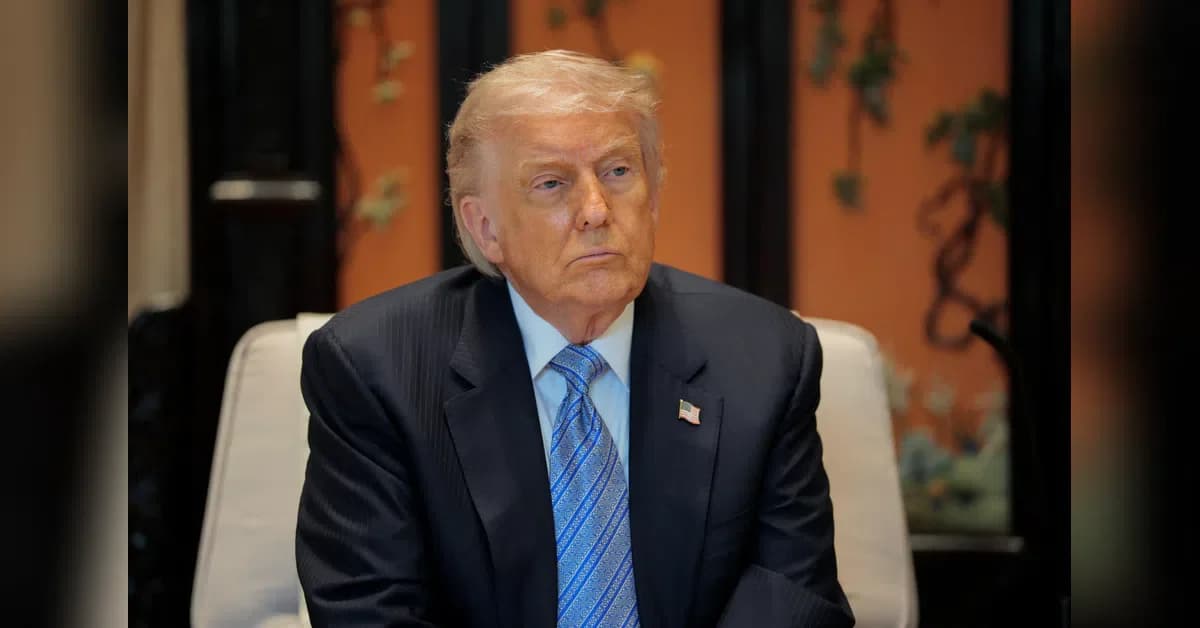
US President Donald Trump has renewed his demand that other nations reimburse Washington for keeping the Strait of Hormuz open, arguing that countries benefiting from the oil route have offered the United States 'no help whatsoever' during its ongoing conflict with Iran. According to Truth Social posts on Monday, Trump wrote 'Oil is flowing through the Hormuz Strait. The Countries of the World, which have been no help to us whatsoever, should, and will, reimburse the United States of America when this SCAM Confligration is all over. We are doing it much more for others, than we are for ourselves, and we have been for Generations!' This marks the latest escalation in Trump's efforts to secure financial compensation for US military presence in the region. In July, Trump named Saudi Arabia, Qatar, the UAE, Kuwait and Bahrain as countries that should compensate the US for protecting shipping through the Strait, having earlier floated and then dropped a proposed 20% transit fee on cargo passing through the corridor in favour of trade and investment arrangements.
Iran and Oman have postponed their scheduled meeting to discuss control of the Strait of Hormuz, with Oman's government citing the need for 'consensus' as the reason for the delay. According to The Associated Press, Iranian Foreign Ministry spokesman Esmaeil Baghaei confirmed that Saudi Arabia had demanded the cancellation of the Monday meeting in Muscat, which was to be hosted by Oman. Baghaei called the postponed meeting a 'proper opportunity' to restore security in the region, stating that an agreement between Iran and Oman on the Strait of Hormuz had been finalized and would be announced later. However, Saudi Arabia submitted amendments to the agreement, citing concerns that the emerging deal could have lasting implications for the Strait of Hormuz that could negatively impact other Gulf Cooperation Council countries. The meeting was originally planned to include Iranian, Omani and other regional delegations to discuss future control of the vital waterway.
Oil prices have remained elevated above $100 per barrel as escalating tensions in the Gulf region continue to impact global energy markets. According to The Associated Press, Brent crude settled Monday at $105.68 per barrel, remaining in triple digits after crossing $100 last week, while U.S. crude sold at around $101 per barrel, representing more than 20% higher than a month ago. The price surge comes as U.S. Energy Secretary Chris Wright reported that the rolling weekly average of oil shipments transiting the Strait of Hormuz under U.S. Navy escort was rising and would continue to do so, with Wright noting that on Sept. 1 there was a peak of 18 million barrels passing through on a single day. Despite Trump's assurance that oil continues to move through the waterway, Both Brent crude and US West Texas Intermediate remained above $100 a barrel on Monday despite the president's statements. The Strait of Hormuz, through which roughly a fifth of the world's traded oil normally passes, has been a flashpoint since the US-Iran conflict escalated earlier this year, disrupting shipping and rattling energy markets.
Iran's Atomic Energy Organization has strongly condemned the reported exclusion of its head Mohammad Eslami from attending the U.N. nuclear watchdog's ongoing conference, describing it as a 'dangerous precedent' for all countries. As reported by Al-Araby Al-Jadeed, Iran's ambassador to the agency, Reza Najafi, told delegates at the general conference that 'By obstructing our full and effective participation, the denial of access contravenes both the letter and the spirit of the legal framework' governing attendance. Najafi criticized Austria, the host country, as well as other U.N. organizations, saying that Vienna's decision not to grant a visa to Mohammad Eslami 'violates the host country's obligation.' The U.S. ambassador to the U.N. in Vienna, Preston Wells Griffith, said Austria's request for an exemption to standing international sanctions was denied after Washington lodged an objection with the IAEA committee, stating 'We could not allow a U.N. designated official to travel … without any meaningful cooperation on nuclear safeguards.'
Iranian President Massoud Pezeshkian claimed that Iran and the United Arab Emirates want to 'turn the page' after months of deteriorating relations. According to Al-Araby Al-Jadeed, Pezeshkian said 'For the first time since the war and the incidents that occurred in the Persian Gulf, we had a constructive exchange with the crown prince of Abu Dhabi.' The president's comments came after a meeting with Sheikh Khaled Bin Mohamed Bin Zayed Al Nahyan in India on the sidelines of the BRICS summit. 'It was agreed that we would turn the page, look to the future and build it together,' Pezeshkian stated. The improvement comes after August when the UAE announced it was suspending trade and financial exchanges with Iran, with Dubai being home to a deeply rooted Iranian community and serving as a vital economic lifeline for Iran under U.S. and international sanctions.