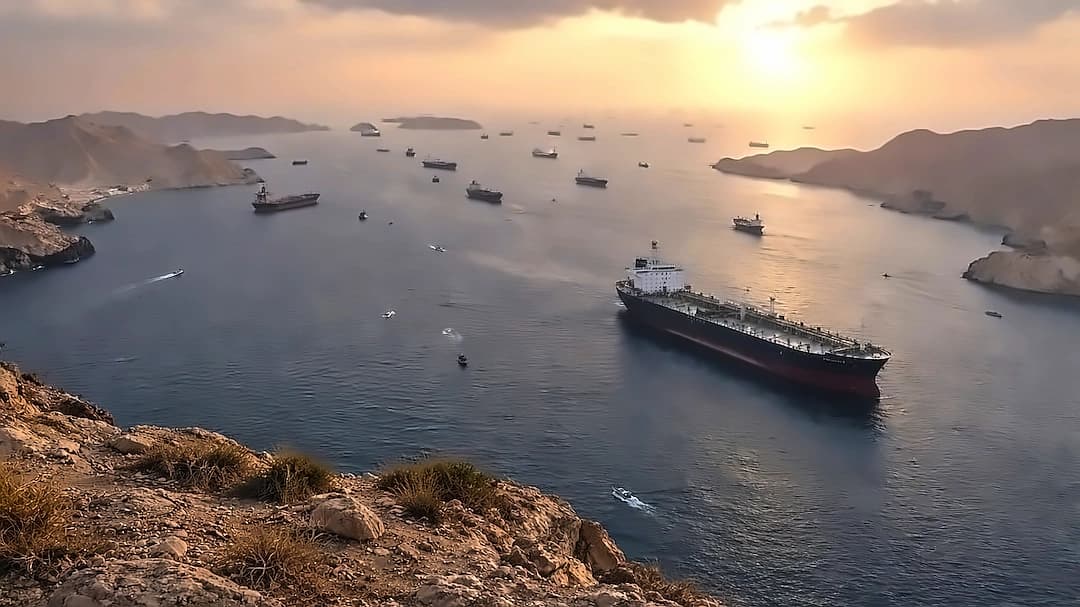
The US military carried out new strikes targeting Iranian drone operations in the Strait of Hormuz, shooting down four Iranian attack drones and striking a ground control station in the port city of Bandar Abbas that was preparing to launch a fifth drone. According to a US official who spoke to Reuters on Wednesday, these actions were described as 'measured, purely defensive and intended to maintain the ceasefire' that took effect in early April. Iran's Tasnim news agency cited military sources reporting that the Islamic Revolutionary Guards Navy fired toward a US oil tanker attempting to transit the strait, forcing it to turn back. Iranian media later reported that four vessels tried to transit the strait early Thursday, only to be turned back by warning shots.
At a cabinet meeting attended by media on Wednesday, President Donald Trump warned Oman not to enter into any agreement with Iran to share control of the Strait of Hormuz, stating there would be 'serious repercussions' if the two countries agreed to such a deal. Trump stated that 'Nobody's going to control (the strait),' and appeared to threaten Oman, stating 'It's international waters and Oman will behave just like everybody else or we'll have to blow them up. They understand that, they'll be fine.' The White House and Oman's embassy in Washington did not immediately respond to requests for comment. The US Treasury Department later added the Persian Gulf Strait Authority to a list of sanctioned entities seen as posing threats to US national security. During his cabinet meeting, Trump emphasized that 'The Strait is going to be open to everybody. It's international waters. We'll watch over it, but nobody's going to control it.'
Iranian state TV reported that the draft deal would have the US withdraw military forces from the immediate vicinity, though it said the issue of US troops in the region needed further discussion. The White House dismissed the report as a 'complete fabrication.' Iranian sources have indicated that talks on Iran's nuclear program will come in a second round of negotiations, which may not be acceptable to some of Trump's closest supporters. Iran says its nuclear program is for peaceful purposes only. Ebrahim Azizi, head of the Iranian parliament's national security committee, stated that Trump's rhetoric would not force Iran to back away from its demands to enrich uranium, wield authority over the strait and see sanctions against it lifted. Iranian Revolutionary Guard official Mohammad Akbarzadeh warned Iranian troops were prepared for defense, but sought to downplay the possibility of full-scale conflict with the US, stating 'The possibility of war is low because of the enemy's weakness, the armed forces are lying in wait with full magazines.'
Oil prices had fallen more than 5% on Wednesday before rebounding after Reuters reported the new strikes. US crude futures gained close to 2% to $90.38 a barrel in early Asian trade on Thursday. The Strait of Hormuz, which handled a fifth of the world's oil and liquefied natural gas traffic before the conflict, remains a critical chokepoint for global energy flows. The monthslong disruption has already had significant negative impacts on the global economy. South Korean Vice Foreign Minister Park Yoon-joo said on Wednesday that the government had summoned the Iranian ambassador after an investigation into an explosion aboard a Korean shipping vessel earlier this month. The HMM Namu had been navigating the flashpoint Strait of Hormuz on May 4 when it was struck by a projectile, injuring a crew member. Various pieces of evidence point toward Iran, with the projectile being an Iranian-developed anti-ship missile, according to Park's statement to the Korea Herald.
Trump has indicated that an agreement was 'largely negotiated' but that final details remain in flux, stating 'Iran is very much intent, they want very much to make a deal. So far they haven't gotten there... we're not satisfied with it, but we will be. We will be either that or we'll have to just finish the job.' Iranian officials stressed that the details were not yet finalized, and that any deal would have to go before the UN Security Council before it can become a binding resolution. The US government appears to be disputing Iranian state media accounts of a tentative provisional agreement, with the White House's Rapid Response 47 account claiming 'This report from Iranian controlled media is not true and the MOU they ''released'' is a complete fabrication.' The US military will need at least three years to bring its stockpiles of key weapons systems back to pre-Iran war levels, according to a new report by the Center for Strategic and International Studies, with US-made Tomahawk cruise missiles, Patriot defense systems and THAAD drones and missile interceptors becoming massively depleted due to strikes in Iran.