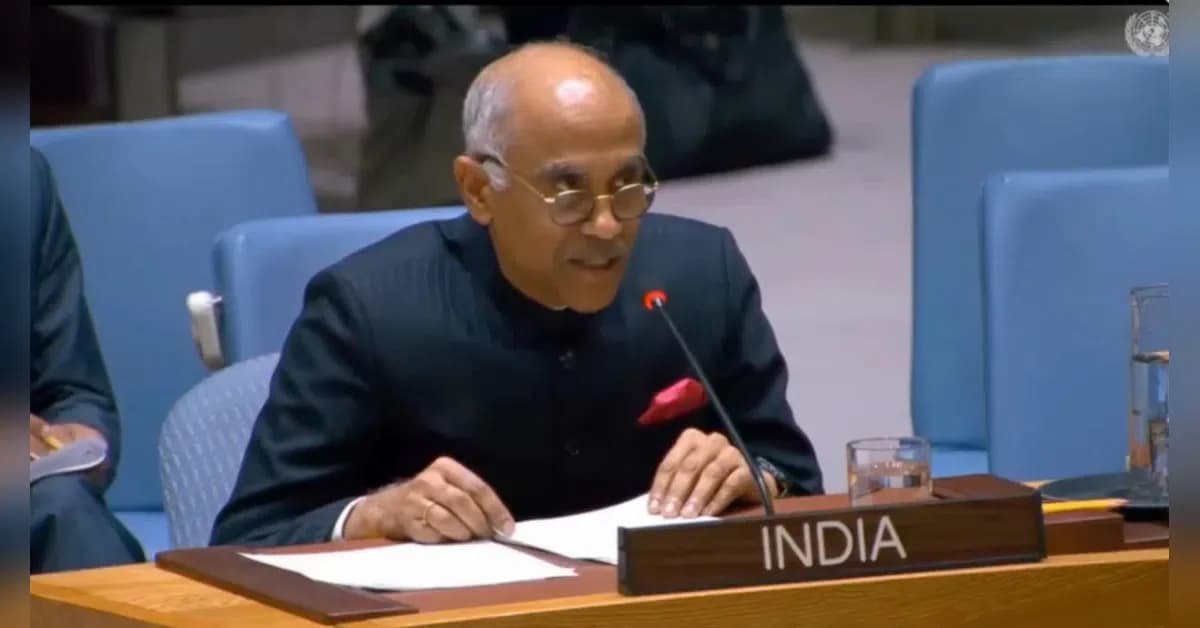
India has delivered a sharp rebuke to Pakistan at the United Nations Security Council (UNSC), with First Secretary Anupama Singh calling Islamabad a 'Frankenstein state' that gets shocked when its 'own monster bites back'. According to reports from NDTV, Singh made these remarks during the Interactive Dialogue on the UN High Commissioner's annual report on Wednesday. The diplomatic response came after Pakistan's representative raised the issue of Jammu and Kashmir at the forum. 'For the record, Jammu and Kashmir was, is, and will always remain an integral and inalienable part of India. The only unresolved issue is Pakistan's illegal occupation of Indian territories and their return,' Singh stated as reported by NDTV.
India categorically rejected allegations made by Pakistan, with Singh stating that 'India is compelled to exercise this right of reply in response to references made to it by Pakistan'. As reported by NDTV, Singh accused Pakistan of being a country 'whose sitting defence minister boasts of hosting, training and deploying terrorists as state policy'. She emphasized that 'This should surprise no one. An illegal and illegitimate occupation can be sustained only through force'. Singh noted the paradox, stating 'This is the country with the sitting Defence Minister boasts of hosting, training, and deploying terrorists and state policy, and yet Pakistan calls itself a victim of terrorism'. The diplomat described this as 'a living example of a Frankenstein state, which is shocked when its own monster bites back'. According to NDTV, Singh was likely referring to Pakistan Defence Minister Khawaja Asif's rare public acknowledgement during an interview where he admitted that Pakistan backed, trained, and funded terror organisations for over three decades, stating Pakistan did the 'dirty work' for the US and the West post-9/11.
Singh drew attention to what she described as the deteriorating conditions in Pakistan-occupied Kashmir (POK), referring to recent unrest in Rawalakot. According to NDTV, Rawalakot saw violent protests this month, where 11 people, including four police officers, were killed and hundreds injured during clashes. The protesters also demanded subsidised wheat and rice. A crackdown on the protests by the Pakistani army left 11 dead and hundreds injured. Following the crackdown, the Jammu Kashmir Joint Awami Action Committee (JKJAAC) said there was a near-total breakdown of communications and curbs on the movement of essential supplies. Singh emphasized that 'decades of military land grabs, demographic engineering, and the denial of basic freedoms have brought matters to a point where even demands for bread, electricity, rights, and dignity are met with bullets and brutality'. She pointed out that 'The ongoing tragedy in Rawalakot, the killing of hundreds of civilians, and the brutal crackdown across POK are the predictable outcome of a system built on forcible occupation and sustained through repression'.
On the Kashmir issue, Singh maintained India's position that 'Jammu and Kashmir was, is, and will always remain an integral and inalienable part of India'. According to NDTV, she rejected OIC references to the region, stating that 'The only unresolved issue is Pakistan's illegal occupation of Indian territories and their return'. Singh emphasized that 'denial of basic freedoms has brought matters to a point where even demand for bread, electricity, rights, and dignity are met with bullets and brutality'. This position represents India's consistent stance on the territorial dispute. Singh also underlined that 'Pakistan's propaganda on Kashmir was designed to mask its domestic failures' and urged Pakistan to put its own house in order rather than making claims over Indian territory.
Singh also criticized the Indus Water Treaty, calling it 'outdated' and questioning why Pakistan continues to demand cooperation privileges while 'exporting terror as an instrument of policy'. As reported by NDTV, she stated that 'Our position on the Indus Water Treaty is well known. It defies logic that a state which exports terror as an instrument of policy continues to demand the privileges of cooperation predicated on goodwill and friendship'. The diplomat noted that 'It is equally undeniable that the treaty is now outdated. No technical arrangement can remain frozen in time while the world around it is transformed'. The decades-old treaty was suspended after the Pahalgam terror attack on April 22 last year that left 26 civilians dead. Singh added that 'A treaty negotiated in 1960 cannot be treated as a perpetual entitlement - insulated from accountability, detached from present-day realities, and untouched by the profound changes of the past six decades'.