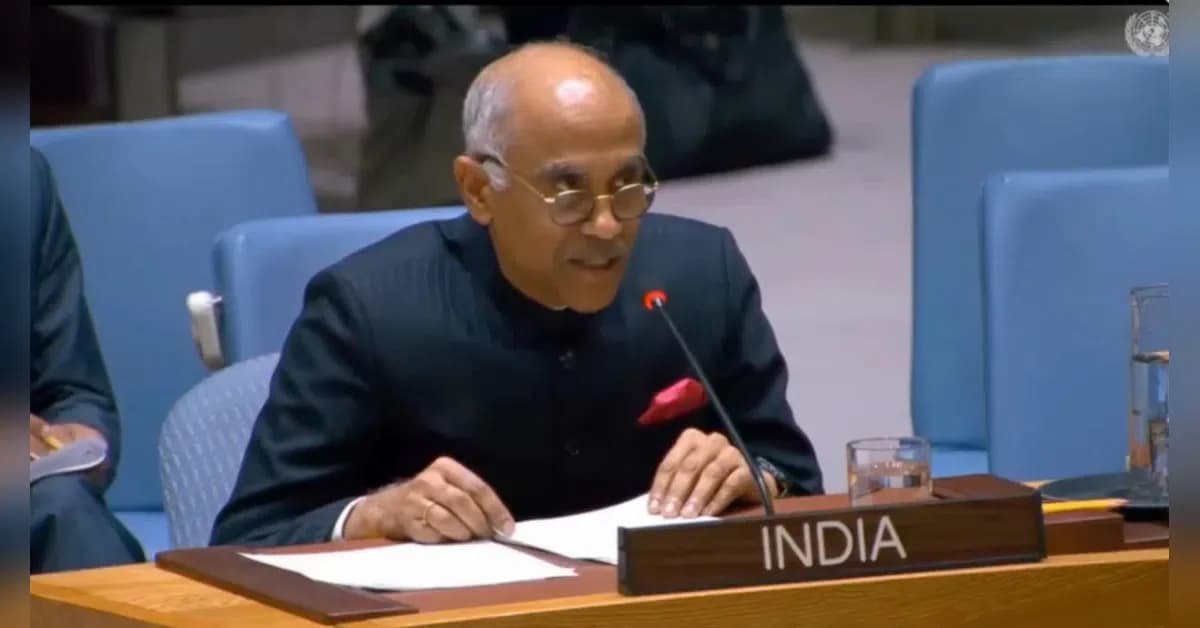
India has called on the international community to work collectively to root out terrorism without finding any justification for the murderous ideology. Permanent Representative Parvathaneni Harish stated that 'A terrorist is a terrorist!! We must work hand in hand to root out the murderous ideology without finding any grievance to justify terrorism' during the UN General Assembly's adoption of the Ninth Review of the United Nations Global Counter-Terrorism Strategy (GCTS). Speaking on Wednesday, Harish emphasized that 'irrespective of any grievance, political cause or strategic calculation, terrorism in all its forms and manifestations must be condemned unequivocally'. He noted that 'India has been a victim of cross-border terrorism for decades. Our people have paid the price of terrorism in lives lost, families scarred, and societies shattered' and that this experience has shaped India's approach that 'there can be no justification for terrorism'. The Indian representative stressed that 'counter-terrorism should not be hollowed out by false equivalences or politicised narratives' and called for addressing conditions conducive to terrorism without confusing context with justification.
India has strongly defended the Financial Action Task Force (FATF) at the United Nations, with Permanent Representative Parvathaneni Harish stating that attempts to question the FATF's credibility reflect 'fear of scrutiny rather than genuine process-related concerns'. Speaking at the 2026 Counter-Terrorism Week side event titled 'Joining Forces to Counter Terrorism Financing in the Context of Evolving Threats and Emerging Technologies', Harish emphasized that the FATF remains an 'indispensable pillar' of global counterterrorism financing architecture. According to reports from Business Standard, Harish noted that the FATF's work is 'technical, evidence-based and rooted in internationally accepted standards' and that countries facing adverse assessments should address identified deficiencies, strengthen domestic enforcement, improve financial transparency, and demonstrate irreversible action against terror-financing networks. India stressed that 'the international community must improve financial intelligence sharing, strengthen implementation of Financial Action Task Force standards, and ensure that no jurisdiction remains a safe conduit for terror financing'. Harish emphasized that India has made an 'honest effort' to practice what it advocates, stating 'We have contributed case studies to the FATF's updates and best practices to mitigate terror financing risks' and noted that 'it is a matter of great satisfaction that its pillars are being taken forward and the world is gaining from it'.
In a veiled reference to Pakistan, Harish urged states to 'stop exporting instability and start fulfilling their obligations towards international peace and security'. As reported by Business Standard, he stated that the answer to FATF scrutiny is not 'politicised activism in UN forums but credible compliance'. Pakistan had been on the FATF grey list since 2018 but was removed in 2022. Harish emphasized that countries allowing their territory, institutions, or financial channels to be misused for terrorism must address these issues, noting that 'states that allow their territory, institutions or financial channels to be misused for terrorism must stop exporting instability'. In his remarks, Harish told the event that he is not speaking on the issue of counter-terrorism in the abstract, stating 'For decades now, my country, India, has confronted cross-border terrorism, and new digital technologies are only making the sources, the methods, and channels used for the flow of assets more complex'.
Harish highlighted the evolving nature of terrorist financing methods, noting that 'crowdfunding from radicalised individuals for terrorist financing and use of tokens, stars and points in social media platforms by terrorists to store and transfer their value' are real issues of concern. According to Business Standard, he stated that 'terrorists are technology neutral, and they adopt whatever is cheap, fast, lightly-regulated, and whatever works for them'. The Indian representative emphasized that 'our response must be a risk-based architecture anchored in the FATF standards' and called for regulation that doesn't punish the legitimate while addressing illicit flows. Harish noted that 'terrorists have grown adept at exploiting emerging technologies, including artificial intelligence, digital platforms, and unmanned weapons' and that 'history shows that critical terrorist financing risks have not emerged anonymously. They have been sponsored, including by some state actors'. He warned that 'new technologies make it easier for them to finance and recruit' and that 'criminal networks speed the flow of cash and weapons, now including deadly drones'. Noting that negotiations of the GCTS review were not able to reach an acceptable landing point on ensuring terrorists are denied technological tools for nefarious acts, India called this 'disheartening'.
India emphasized the urgent need for a universally agreed legal framework to combat terrorism, noting that 'the absence of a universally agreed legal framework continues to hobble collective action against terrorism'. According to Business Standard, Harish stated that 'this legal instrument is essential to close normative gaps, strengthen prosecution and extradition, and deny terrorists and their sponsors access to safe havens, funds and arms'. He noted that 'nearly three decades of delay have hindered our collective efforts to combat terrorism. The time has come to demonstrate political will to conclude the CCIT'. India had called for the adoption of the Comprehensive Convention on International Terrorism (CCIT) a decade before GCTS was first adopted in 2006, and the adoption of this review comes at an important moment as 20 years ago, Member States had come together to adopt the GCTS. Harish criticized the 'unfortunate situation of how this Assembly is held hostage to petty bean counting', noting that 'it is doubly unfortunate when the international community continues to tolerate this behaviour' and that the 'lack of mention of the landmark Delhi Declaration in the GCTS in 2023 reflects this unfortunate situation'.
UN Secretary-General Antonio Guterres highlighted the challenging global environment for counter-terrorism efforts at the Fourth High-Level Conference on Counter-Terrorism. According to Business Standard, Guterres noted that 'the world is grappling with acute instability as conflicts are triggering energy shocks, inflation and hunger across the globe, millions are displaced, and millions more are facing economic hardship'. He stated that 'these conditions - of want, of fragility, of mistrust - are ideal circumstances for terror to thrive' and that 'from Africa to South Asia, and across the Middle East, affiliates of Al-Qaida and Da'esh and other terrorist groups persist'. Guterres emphasized that 'violent extremist narratives - including those based on xenophobia, racism, and other forms of intolerance, or in the name of religion or belief - pose deadly domestic threats in many nations' and that 'terrorists of all stripes are adapting. New technologies make it easier for them to finance and recruit'. He warned that 'terrorists had grown adept at exploiting artificial intelligence, digital platforms and unmanned weapons' and called for greater international cooperation, stressing that 'terrorism is a transnational threat that no nation can address on its own'. Harish stressed that 'only if we have the political will to counter it in all its manifestations; Only if there are no double standards; Only if there is no distinction between good or bad terrorists' could terrorism be successfully combatted.